





Basket
{{item.CourseTitle}}
Price: {{item.ItemPriceExVatFormatted}} {{item.Currency}}
Browse by Topic
Browse by Vendor

Unlimited Training
Attend all the top-notch LIVE Instructor-led Courses you want for the price of less than one course.

In the current digital landscape, companies rely heavily on technology. This dependence makes them vulnerable to cyber criminals. The increasing significance of security in today's businesses is indisputable. Daily, firms of all sizes face new, changing dangers. These dangers jeopardize their data, finances, and customer trust. Currently, no organization is immune. So, it's crucial to understand the scope of the problem. There has been a notable rise in the number and intricacy of cyber attacks. These are no longer merely technical issues. They pose risks to business continuity. They can paralyze operations and result in catastrophic losses.
Strong technical defenses, such as firewalls and anti-virus software, are vital. However, there are not enough. The weakest link in any security system is the human. That is why cybersecurity training for employees is essential. For example, the worker lacks awareness. Then, they can open the door for attackers. Examples include a single click on a malicious link. This action can help bypass even advanced technical controls.
This reality underscores the crucial role of worker awareness and education in mitigating cyber risks. When staff members are properly educated, they become the first line of defense. They learn to spot dangers and respond correctly. This shifts the security posture from being purely reactive to one that is strongly proactive. Our article will explore why investing in information security awareness training is a necessity, not an option. We'll examine:
Remember, understanding and implementing a robust strategy is the core of modern risk management.
The global landscape of cyber threats is becoming more aggressive and sophisticated. Cybercrime is a multi-billion-dollar industry. It's run by professional groups that continuously innovate their tactics. Discussions about global trends in cyber attacks and data breaches are a daily occurrence in boardrooms worldwide. High-profile incidents dominate the news. But countless smaller attacks impact local firms every hour. No one is too small to be a target. That is why employee security awareness training is vital.
Widespread dangers are constant and unwavering. Phishing is one of the most powerful techniques for attacks. It depends on deceiving a worker into revealing credentials or installing malware. Attackers deploy expertly made emails and messages that appear authentic. Ransomware is another massive concern. It involves encrypting a firm's data and holding it hostage until a large payment is made. This can instantly halt all business operations.
Furthermore, the threat isn't always external. Insider threats, where a current or former employee misuses access, can be equally damaging. It depends on whether the action is malicious or accidental.
These risks profoundly impact modern businesses, both financially and reputationally. A data breach can lead to:
Beyond the immediate financial drain, the damage to a firm's reputation can be long-lasting and enduring. Clients can lose trust when sensitive data is compromised. This loss of goodwill can take years to restore. For a successful operation, safeguarding data is vital.
This constant state of high alert explains why learning is a proactive defense mechanism. It's an investment that pays off by preventing catastrophic events. Equipping staff with knowledge changes their behavior. It transforms employees from potential security risks into active participants. Effective cybersecurity training for employees addresses the human factors that attackers exploit.
Creating a secure organization requires more than just an annual lecture. It demands a living, breathing information security awareness training program. Defining what programs include is the first step toward resilience. The programs must be practical, engaging, and relevant to the daily workflow.
A robust one should cover several key areas. Phishing simulations are critical. They test workers' ability to find and report suspicious emails in a safe environment. Results from them provide invaluable data on who needs extra help. Password management is another fundamental topic. Training must cover how to create strong, unique passwords. It also includes the proper use of password managers and why two-factor authentication (2FA) is essential. Finally, during training employees on cybersecurity, clear procedures for incident reporting are essential. Workers need to know exactly who to contact and what information to provide the moment they suspect a security issue. Speed is often the key to cutting damage.
The importance of tailoring learning to different worker roles cannot be overstated. A one-size-fits-all approach is inefficient. Sales teams may require specialized training on secure client communication. HR staff need detailed guidance on handling confidential worker records. Developers require learning focused on secure coding practices. Customization ensures that the information is relevant and immediately applicable to their specific jobs. And it leads to better retention.
In terms of delivery, organizations often use a mix of methods. Online cybersecurity training programs offer flexibility. It allows workers to complete modules at their own pace. They're excellent for foundational knowledge and large-scale deployment. In-person workshops can foster more engagement, discussion, and hands-on practice. It's especially true for complex topics. Many organizations now use blended approaches. They combine the scale of online learning with the depth of in-person or live virtual sessions. It accommodates diverse learning styles and reinforces material through various formats.
The learning needs within a firm vary drastically based on the department. It's necessary to draw a clear line between the two main groups.
For IT teams, the focus is on developing technical skills. It includes specialized training on:
They need deep, technical knowledge to implement and maintain security systems. Their learning focuses on performing security work.
For general workers, often referred to as non-technical staff, the focus is on awareness training. Their goal is to understand the risks and adopt safe habits. Their learning is about being secure in their daily activities. This is where employee security awareness training makes the greatest impact. It teaches them basic skills. It includes:
Examples of role-based cybersecurity training responsibilities illustrate this difference. A financial analyst must be aware of the policy for encrypting budget spreadsheets before emailing them. A marketing professional must understand the risks of connecting to public Wi-Fi at a conference. An IT security analyst must know how to patch a critical server vulnerability within a set timeframe. Clear role definitions ensure everyone knows what is expected of them.
Beyond basic awareness, many organizations encourage or require specialized learning. Discussing business-focused certifications and cybersecurity employee training for workers is key. It's especially true within the IT and compliance departments. Examples like CompTIA Security+, Certified Information Systems Security Professional (CISSP), and Certified Information Security Manager (CISM) are widely respected. These programs go beyond general knowledge. They provide structured, deep expertise in specific security areas.
These formal programs offer a vital function. They are explaining how certifications reinforce skills and ensure compliance. A certified professional has demonstrated a high level of competency in relation to industry standards. This not only builds the individual's career but also enhances their professional development. It also strengthens the firm's overall security expertise. For some roles, certifications are a non-negotiable requirement. It is especially true for those handling compliance or critical infrastructure. It ensures the organization has the necessary skills to meet complex regulatory demands.

The benefits of a strong program extend far beyond just technical protection. Training employees on cybersecurity is an investment in the entire business's stability and future.
The most immediate and critical benefit is a reduced risk of data breaches and financial loss. Human error is responsible for a vast majority of security incidents. But you can make workers more vigilant. So, the probability of successful phishing or malware attacks drops significantly. This preventative action saves the firm the massive, often extreme, costs. They're usually associated with a full-scale breach.
Furthermore, it leads to a strengthened reputation and increased client trust. For example, your firm is known for taking data protection seriously. Then, it gains a competitive edge. Clients and partners will work with you because you handle sensitive data responsibly. A public commitment to security is a powerful means of building trust. This's especially true when backed by a trained workforce.
Finally, effective online cybersecurity training ensures compliance with regulations and standards. Many global regulations require firms to train their staff on data protection. This is a non-negotiable legal requirement in many jurisdictions. Structured learning provides the evidence needed to prove compliance during audits.
A secure workplace is also a more productive workplace. When workers know what to do, they operate with more confidence. Teaching staff how well-trained staff can handle security incidents efficiently means:
If a worker suspects a phishing email, they can quickly and correctly report it. It allows the security team to act immediately. Without training, that worker might hesitate. They can forward the email or even click the link out of confusion.
The overall goal is to encourage a security-first culture in the workplace. It means that security becomes everyone's responsibility. It's not just about the IT department. It becomes a shared value. It's woven into the fabric of daily operations. For example, people see security as a foundational element of their job. Then, they naturally become more careful. This boosts morale and shows that the firm values its data and its staff. Comprehensive cybersecurity training programs are the vehicle for this cultural change.
The regulatory landscape for data and privacy is complex and multifaceted. And it is constantly changing. This block provides an overview of critical regulations. It includes:
These place strict obligations on how firms protect data and critical services. Today, penalties for non-compliance are severe. They often include fines that can amount to millions of dollars. Or it can be a percentage of global annual revenue.
The core question is: How does training ensure that firms meet their compliance obligations? Almost all major compliance frameworks require a formal and documented security awareness program. For instance, GDPR's requirements around data processing and reporting breaches. Those are impossible to meet without a staff that is fully educated on privacy rules. ISO 27001 requires competence and awareness training. It is for all personnel whose work impacts information security. By delivering regular, documented cybersecurity training to employees, firms can demonstrate that they are taking "reasonable and appropriate measures" to protect data. This is a key legal defense in case of a breach. Effective training is therefore not just good practice. Today, it is a legal imperative.
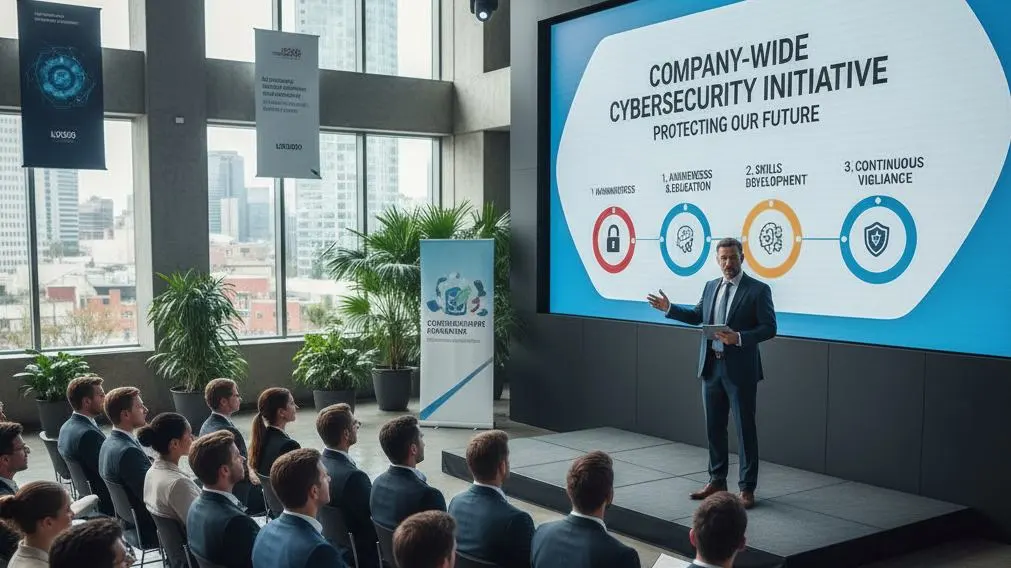
Launching a successful cybersecurity compliance training program requires two key elements. They are careful in planning and execution. This block provides a guide for launching training initiatives. Those actually stick.
Step 1: Assess and Plan. Begin by identifying the most significant risks and vulnerabilities specific to your firm. Review past incidents and survey workers. It's to gauge their current knowledge level. This needs assessment will dictate the content and focus of your program.
Step 2: Develop Content and Choose Delivery. Create customized content for different roles. Determine the optimal blend of online modules, live sessions, and practical exercises, such as phishing simulations. For maximum reach and efficiency, consider leveraging online cybersecurity training platforms. These tools offer tracking, scoring, and automated reminders.
Step 3: Launch and Communicate. Roll out the program with clear communication from leadership about its importance. Emphasize that it's for everyone's protection, not a punitive exercise.
Step 4: Frequency, Evaluation, and Continuous Improvement. Training cannot be a one-off event. It should be continuous. Corporate cybersecurity training should occur at least annually. Mini-refresher campaigns should support it throughout the year. It's especially true when new threats emerge. Evaluation is non-negotiable. Measure success using metrics. For example, phishing click-through rates, completion rates, and post-training quiz scores. Use this data to refine the program. Did the finance team fail the invoice-fraud simulation? Time for targeted follow-up training.
For success, here are tips for cybersecurity awareness programs. They help engage workers and measure effectiveness:
This structured, ongoing approach is key to an effective program.
The nature of cyber threats is always changing. And so too must the cybersecurity awareness training programs be made to combat them. Looking ahead, we can see several exciting emerging technologies. Those will transform how we deliver security education.
Now, technologies like AI simulations and virtual labs can make training far more immersive and personalized. AI can analyze a worker's performance in a phishing test. It can also automatically generate a new simulation. It can be tailored to their specific weaknesses. Virtual labs offer a safe, sandbox environment for workers. There, they can practice incident response. Or they can test out security best practices. And it's all without the risk of impacting the live real network. This high-fidelity, hands-on learning is far more effective than passive lectures.
Another major shift is the evolving role of enterprise cybersecurity training in remote and hybrid work environments. The usual office perimeter is gone. Workers are now accessing corporate data from:
This requires training to place a much greater emphasis on securing home Wi-Fi. It also includes using VPNs correctly and understanding 'shoulder surfing' risks in public. Besides, this also includes managing mobile device security. Training must be accessible from anywhere. It must also address the unique vulnerabilities of a distributed workforce. This type of large-scale, adaptive initiative is a hallmark of enterprise cybersecurity training.
Predictions for business cybersecurity needs show that the focus on the human element will only intensify. Automated defenses get smarter. So, attackers will increasingly turn to social engineering. They will aim at the easiest target: the person behind the screen. This means that continuous, cutting-edge awareness will become a core requirement for corporate cybersecurity training. Furthermore, regulations such as GDPR and NIS 2 are becoming more rigorously enforced. So, the need for documented cybersecurity compliance training will drive investment in sophisticated tracking and reporting systems. The future of cybersecurity is one where technology and human intelligence work together. It makes the educated worker the final, strongest layer of defense.

Get Unlimited access to ALL the LIVE Instructor-led Microsoft courses you want - all for the price of less than one course.