





Basket
{{item.CourseTitle}}
Price: {{item.ItemPriceExVatFormatted}} {{item.Currency}}
Browse by Topic
Browse by Vendor

Unlimited Training
Attend all the top-notch LIVE Instructor-led Courses you want for the price of less than one course.

The online world depends on strong security. Today, organizations move their operations to the cloud. So, the need for skilled professionals who can design robust defense systems grows every day. The role of a cybersecurity architect is central to this effort. This worker is responsible for:
It is especially true within Microsoft and Azure environments. A Microsoft certification is a powerful way to demonstrate your expertise. It tells employers you have the skills to take on this demanding job. The official certification for this role helps information technology professionals design, implement, and manage complex security solutions. It spans Microsoft 365, Azure, and hybrid systems.
Today, we will cover the certification details. We will suggest learning paths and training options, explore career opportunities, and share best practices. Specifically, we will focus on the path to becoming a Microsoft cybersecurity architect. It involves earning the Microsoft Cybersecurity Architect Expert certification.
Achieving this certification proves you are an expert at translating an organization's business goals into security needs and designing solutions. You will prove you can truly use the full range of Microsoft's security technologies. Earning this Microsoft security certification is a crucial step for any information technology professional aiming for a top-tier security role.
This one is a top-level credential. It is designed to validate the advanced skills needed to design and evolve security for Microsoft cloud and hybrid solutions. It covers a broad range of topics essential for an architect. It includes:
The primary target audience for this certification includes:
Candidates should already have a deep understanding of security operations. They must know about identity control and how Microsoft security products work. This is not an entry-level certification. To sit for the required exam, you must already hold one of the prerequisite Microsoft security certifications. It includes the Security Engineer Associate or the Identity and Access Administrator Associate. Microsoft recommends having at least three to five years of hands-on experience in cybersecurity and security architecture design before attempting this expert-level certification.
The certification is earned by passing the SC-100: Microsoft Cybersecurity Architect exam. The exam content is complex. It tests your ability to take high-level business needs and translate them into a technical security blueprint. It covers designing security solutions for:
The certification validates your ability to design complex tactics across the entire Microsoft ecosystem. The knowledge required for this exam is vital for anyone seeking proficiency in Azure security. It is because Azure is a major part of the overall security architecture. Earning this expert certification is a major step in an information technology professional's career. It marks them as a leader in Microsoft cybersecurity certification knowledge.
Preparing for the Microsoft Cybersecurity Architect certification requires a strategic approach. It is not just about memorizing facts. It is about building practical, architectural design skills. There are several effective learning paths and training options. They help candidates prepare for the SC-100 exam and earn the Azure Security Certification.
Microsoft provides excellent, official resources. The Microsoft Learn platform offers free, structured learning paths. Those map directly to the exam objectives. These self-paced modules are a fantastic foundation. They cover all the core concepts. It is from designing a zero-trust strategy to governing security posture. These modules are invaluable for getting a grip on the vast amount of material.
In addition to self-paced learning, there are professional options like bootcamps and specialized online programs. They are often led by expert instructors and provide a structured, intensive experience. They usually include virtual labs and hands-on exercises. They are essential for developing the practical skills of a security architect. The goal of all these paths is to ensure you can not only recall information. You must also apply it to real-world security design challenges. Success relies on both theoretical knowledge and practical application. It ensures you master the material needed for an Azure cybersecurity certification and other topics.
Self-paced learning is a flexible and cost-effective way to prepare. It allows candidates to study at their own speed and focus on their weak areas. The official Microsoft Learn platform is the best place to start. It breaks down the required skills into manageable modules. For example, it has dedicated paths on:
Designing governance, risk, and compliance solutions
Designing security for infrastructure
Another crucial component is using high-quality third-party online resources and official study guides. Many users find that a good practice exam provider is essential. Practice exams help you get used to the test's format and identify areas where you need more study time. The benefit of this self-study path is that it helps people organize their approach to studying the full spectrum of cybersecurity certifications.
It is a way to prove a high level of discipline and self-motivation. The SC-100 is a tough exam. And the right self-study plan can make all the difference. Combining Microsoft's free resources with paid, high-quality practice tests is the best strategy. It ensures the candidate covers all the material for the Microsoft cybersecurity certification.
Do you prefer a structured environment, or do you need a faster path to certification? Then, instructor-led training is an excellent option. Microsoft offers official instructor-led training courses delivered by certified partners. These courses cover the same material as the self-paced learning paths. But they are in a highly condensed, focused format. The key advantage here is direct access to a subject-matter expert. You can ask immediate questions and gain insights from an experienced user.
Online courses fall into this category as well. They are especially beneficial for their focus on hands-on experience through virtual labs. An Azure security architect must be able to:
These skills can only be truly mastered through practice. Instructor-led training provides a guided environment for that practice.
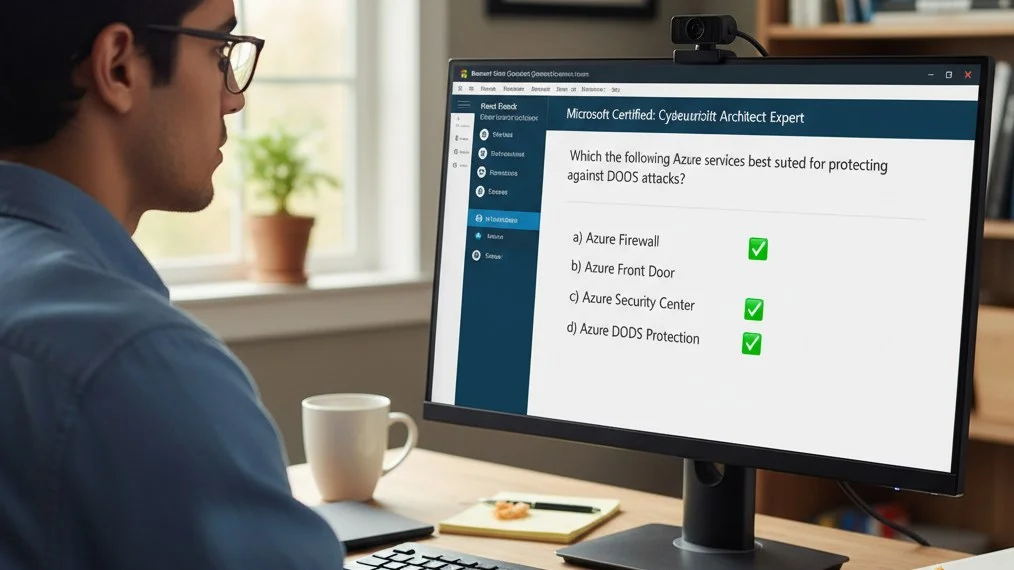
The SC-100 exam is the only test required to earn the Microsoft Cybersecurity Architect Expert certification. It is a challenging exam designed to assess expert-level skills. The exam format is typical of Microsoft expert-level tests. It includes various question types. It includes multiple-choice, drag-and-drop, and, most importantly, case studies. Case studies present detailed scenarios of fictional organizations. And they require you to apply your knowledge to design the best security solutions.
There are no formal, mandatory prerequisites to register for the cybersecurity architect exam. However, Microsoft strongly recommends that candidates already hold an administrator or engineer-level certification. The recommended prerequisites are one of the following:
Without one of these, you are unlikely to have the foundational knowledge required. The exam typically includes 40 to 60 questions. And the passing score is 700 out of 1000. It is a 150-minute exam (2.5 hours). But the actual time spent on questions is usually less. It leaves time for the tutorial and feedback portions. Successfully passing this exam means you have shown the expert-level knowledge expected of an Azure security certification holder.
A deep understanding of cloud security architecture is essential for this certification. It is a key component that focuses on Azure cybersecurity topics. A candidate must prove they can design security across the entire enterprise. It includes hybrid and cloud-native workloads. It makes the Microsoft cybersecurity cert a highly respected industry credential.
The cybersecurity certification exam has four main skill areas, each weighted differently. Candidates must have a strong grasp of all these areas to pass:
Success on the SC-100 Microsoft security certification exam requires more than just reading a book. It demands a structured, multi-faceted approach. Here are some key tips for successful preparation:

Earning the Microsoft Cybersecurity Architect certification is a significant career milestone. It opens doors to some of the most challenging and rewarding roles in information technology. This certification is a strong signal to new employers. It shows you have the knowledge and experience to handle enterprise-scale security design. Certified users can pursue several high-value career paths:
The demand for professionals who can bridge the gap between organizational strategy and security technology is high. The title Azure security architect is consistently listed among the top-paying and most in-demand jobs in information technology. Salaries vary by location, industry, and experience. But certified security architects are in the top salary brackets within information technology security. High salaries reflect the critical importance of their work. They protect the organization's most valuable assets from threats. Achieving this expert certification proves you have mastered the skills of a Microsoft cybersecurity architect. And you are ready to lead security initiatives.
The field of security never stands still. New threats, new technologies, and new compliance regulations emerge constantly. For a certified security professional, continuous learning is not optional. It is mandatory. Microsoft Cybersecurity Architect Expert certification is valid for one year from the date you pass the exam. To maintain your certification status, you must complete a free online renewal assessment on Microsoft Learn before your certification expires. This renewal process ensures your knowledge stays current with the latest Microsoft security technologies and best practices. Here are the best practices for keeping your Microsoft cybersecurity architect skills sharp:
Commit to these practices. Then, you can ensure your expertise remains relevant. A security architecture certification professional knows that the investment is just the beginning of a long and rewarding career.

Get Unlimited access to ALL the LIVE Instructor-led Microsoft courses you want - all for the price of less than one course.