





Basket
{{item.CourseTitle}}
Price: {{item.ItemPriceExVatFormatted}} {{item.Currency}}
Browse by Topic
Browse by Vendor

Unlimited Training
Attend all the top-notch LIVE Instructor-led Courses you want for the price of less than one course.

In the fast-moving business world of 2025, the ability to quickly upskill thousands of workers is a competitive necessity. As companies pivot to new technologies and global standards, corporate training certification has become the way to validate that large workforces have specific skills. However, moving from training a small group to certifying an entire global department presents massive challenges. Leaders often struggle with:
Preparing large teams for corporate training certification at scale requires more than just a large budget - it requires a strategic framework that treats learning as an operational process. The main hurdles typically include inconsistencies in training delivery and a lack of clear tracking mechanisms. Without a solid plan, scaling up can lead to fragmented knowledge and high dropout rates.
This article explores how organizations can use modern methodologies and tools to streamline the certification process. We will focus on scalable design, automated support, and data-driven improvements to ensure teams are not just trained but certified and ready to perform at the highest levels.
Scaling a certification program starts with a shift in mindset - instead of focusing on individual classes, adopt a corporate learning and development strategy that operates like a well-oiled machine. A scalable strategy relies on modularity, breaking down complex certification requirements into smaller, bite-sized learning blocks that are easier to distribute and update. This approach allows different teams to progress at their own pace without disrupting the overall program structure.
Standardization is the second pillar of scalability. Every learner, whether in London or Tokyo, should have access to the same core curriculum, ensuring that corporate training certification programs result in a uniform level of expertise across the organization. To achieve this, goals must be clearly aligned with both organizational objectives and each learner's specific needs. When team members understand how a certification helps their daily work, their motivation increases significantly.
Technology plays a vital role in making corporate learning and development strategies successful. Process automation can handle the heavy lifting of administrative tasks, such as enrolling thousands of users or triggering reminders. By automating these workflows, L&D leaders can focus on high-value activities like mentoring and strategy development. A successful strategy also includes a mix of delivery methods to cater to diverse learning styles and schedules.
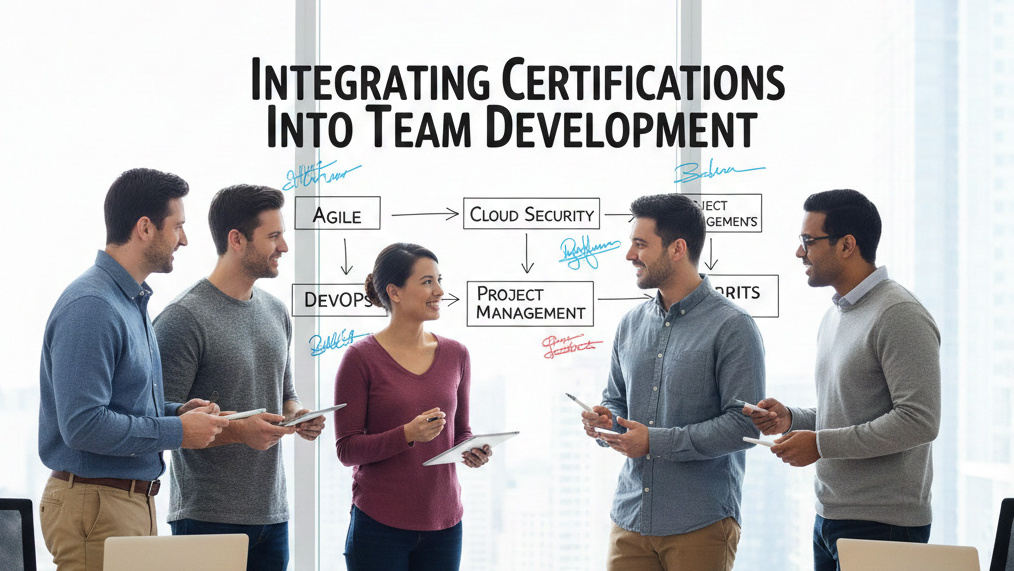
A robust Learning Management System (LMS) acts as the backbone for any large-scale initiative, providing a single source of truth for all training assets when managing corporate training certification online. It enables the rapid distribution of content to thousands of users simultaneously. Beyond simple delivery, modern LMS platforms offer advanced progress tracking that lets managers see exactly where a team stands in its certification journey and identify bottlenecks before they become major delays.
Automation within the LMS is particularly useful for reducing administrative overhead. Automated grading for practice exams and instant generation of certificates upon completion saves countless hours of manual work. Furthermore, these platforms can use AI to personalize the learner experience by recommending specific resources based on a user's performance in early modules. This ensures that even in a crowd of thousands, no individual feels lost or ignored.
Inconsistency is the enemy of scale if not managed properly. If different departments use slightly different versions of the same study guide, the final corporate training certification results will be unreliable. Maintaining strict version control over all training materials is essential to ensure every learner is studying the most up-to-date information. This is especially important for certifications related to compliance or rapidly changing technologies.
Uniform assessment criteria are equally important. To maintain the certification's credibility, the bar for success must be the same for everyone. Best practices include:
One of the biggest risks when scaling is that learners feel like just another number in the system. Disengagement is a common reason why large-scale programs fail. To keep motivation high, use a proactive communication approach - instead of sending a single email at the start, use a continuous drip of communication. Scheduled check-ins, progress milestones, and motivational updates keep the certification top of mind for busy employees.
Clear communication channels when preparing for corporate learning and development jobs are also vital for support. When a learner encounters a technical glitch or a difficult concept, they need to know exactly where to go for help. A lack of timely support often leads to frustration and dropouts. Providing a dedicated help desk or a searchable FAQ database can resolve most minor issues quickly, allowing learners to stay on track without losing momentum.
In a large-scale environment, the L&D team for corporate training certification programs cannot be everywhere at once. This is where peer-to-peer interaction becomes a powerful tool. Study groups or internal community forums allow learners to support one another. Peer learning often clarifies complex topics more effectively than formal lectures because colleagues speak the same workplace language.
Encouraging mentorship within the team also helps foster a strong learning culture. Experienced employees who have already completed the certification can guide newer team members with practical tips and emotional support. This social aspect of learning turns a solitary study process into a shared team mission, significantly increasing completion rates and knowledge retention.
Feedback is the fuel for improvement, but providing personal feedback to 500 people is beyond the reach of a single trainer. To scale coaching, organizations should adopt the best corporate training certification practices that use automated feedback tools. For example, interactive quizzes can provide instant explanations for wrong answers, giving learners immediate guidance without human intervention.
For more complex skills, a layered coaching model works best. In this model, senior team leads provide high-level guidance while automated tools handle basic progress reviews. Periodic, data-driven progress reports can be sent to both learners and their managers, highlighting areas that need more focus. This ensures support is targeted where it's needed most rather than spread too thin across the entire group.

To prove the value of your corporate learning and development efforts, you must move beyond simple completion rates. Measuring the success of a large-scale program involves examining a range of KPIs. These include:
Data analytics can provide deep insights into the program's health. For example, if data shows 40% of corporate training certification online learners get stuck on the same module, it's a clear signal that the content needs revision. This iterative approach ensures the program evolves based on real-world usage. By continuously refining the curriculum and delivery methods, you can ensure the certification remains impactful over the long term and continues to meet the organization's changing needs.
Scaling up always brings unique obstacles, from tight budgets to a diverse workforce with different starting levels of knowledge. Resource constraints are often the most cited hurdle. When budgets are limited, it's essential to prioritize the most critical certifications and use phased rollouts. Instead of launching everything to everyone at once, start with a pilot group, refine the process, and then expand. This "start small, scale fast" approach reduces risk and enables more efficient resource use.
Another challenge is the diversity of the learners themselves - a team of 1,000 people will have different backgrounds, languages, and technical abilities. Using adaptive learning paths helps solve this by ensuring experienced workers aren't bored while beginners aren't overwhelmed.
Finally, leadership buy-in is crucial for the success of corporate learning and development. When managers give their teams the time to study, even a mediocre program can succeed. High-level support ensures learning is treated as a priority. By showing leaders the direct link between certification and business results, you can secure the necessary support and resources to make the program successful.
As companies grow, the demand for specialized talent to manage these programs increases, leading to a rise in corporate learning and development jobs ranging from instructional designers to learning data analysts. These professionals focus on the intersection of education and technology, ensuring that every piece of content serves a strategic purpose. For those looking to enter this field, staying up to date on the latest trends is essential.
Events such as corporate learning and development summits offer valuable networking opportunities for professionals in this field. These gatherings allow leaders to share case studies on how they handled massive certification rollouts and which tools proved effective. Staying connected to the wider L&D community helps organizations avoid common pitfalls and adopt proven strategies more quickly.
In conclusion, preparing large teams for certification is a complex task that requires a blend of smart strategy, robust technology, and human-centric support. By standardizing materials, leveraging an LMS, and fostering a culture of peer learning, you can achieve scale without sacrificing quality. As you build your programs, remember that the goal is not just to hand out certifications but to build a more capable, confident, and future-ready workforce.

Get Unlimited access to ALL the LIVE Instructor-led Microsoft courses you want - all for the price of less than one course.