



Basket
{{item.CourseTitle}}
Price: {{item.ItemPriceExVatFormatted}} {{item.Currency}}
Browse by Topic
Browse by Vendor

Unlimited Training
Attend all the top-notch LIVE Instructor-led Courses you want for the price of less than one course.

Cloud certification planning for healthcare and life sciences teams means identifying which paths genuinely support regulated work, rather than simply adding another credential to a résumé.
The useful answer depends on role, cloud environment, and compliance responsibility. A hospital security engineer supporting Azure will need different proof of skill from a life sciences data platform architect building research pipelines across several clouds, and neither path should be treated as a substitute for legal or compliance review.
Cloud certifications matter in healthcare because the technical decisions behind identity, encryption, logging, data residency, backup design, and incident response directly affect protected health information, clinical operations, and research integrity. HIPAA, GDPR, NIST guidance, HITRUST, and internal risk policies do not become “cloud native” on their own; teams have to translate those obligations into controls that can be deployed, monitored, and evidenced.
That is where certifications can be useful. They give practitioners a structured way to learn platform services, security models, and architecture patterns, while also giving leaders a common language for assigning responsibilities. Even so, no certification guarantees HIPAA, GDPR, or HITRUST compliance. Certification should be treated as evidence of knowledge, not as a compliance decision or legal opinion.
Healthcare and life sciences organisations do not adopt cloud platforms in the same way as many commercial technology teams. A misconfigured storage account, excessive administrator access, weak audit logging, or unclear business associate agreement scope can create operational and regulatory consequences that go beyond ordinary downtime or data loss.
The shared responsibility model is especially important. AWS, Microsoft Azure, and Google Cloud secure the underlying cloud infrastructure, but healthcare organisations remain responsible for how workloads are configured, who has access, how data is classified, how logs are retained, and how incidents are handled. Certification programmes that ignore this boundary tend to produce engineers who know services but struggle with governance.
That distinction affects which credentials are worth pursuing. Platform-specific certifications are valuable when a team operates deeply in one cloud and needs practical implementation skills. Vendor-neutral credentials are valuable when the organisation is multi-cloud, heavily regulated, or trying to standardise security and compliance language across architecture, legal, privacy, and operations teams.
In many hospitals and research organisations, the strongest hiring signal is a combination: one vendor-neutral cloud security or healthcare privacy credential, plus one platform-specific security or architecture certification aligned to the employer’s main environment. That blend shows that the candidate understands both the control objectives and the service-level implementation work.
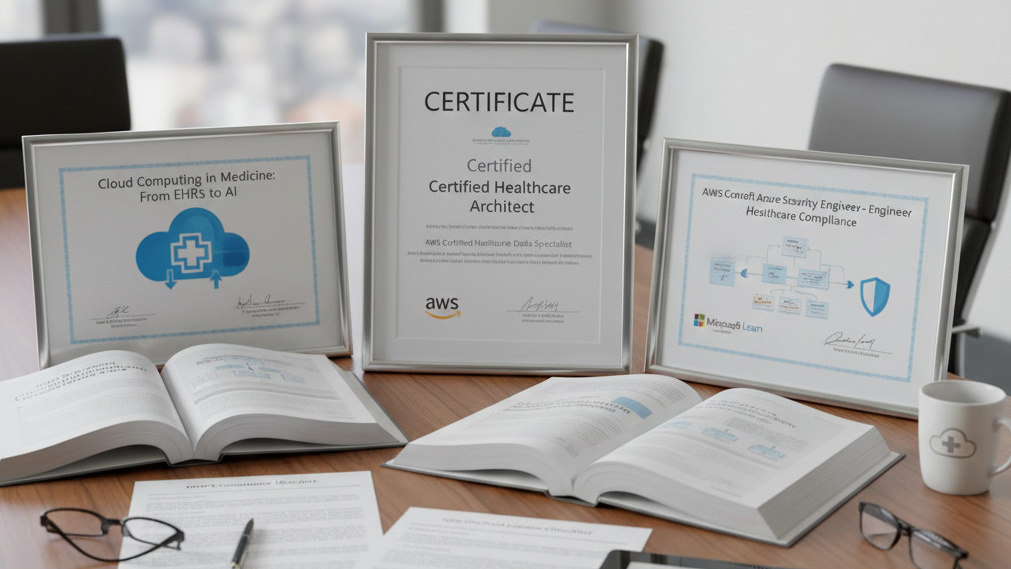
The starting point should be the role, not the badge. A certification that is useful for a cloud security engineer may be too technical for a compliance officer, while an architecture credential may not go far enough for someone responsible for incident response or key management.
| Role | Good first certification direction | Useful next step | What the credential should help prove |
|---|---|---|---|
| Cloud security engineer | Platform security certification such as Microsoft AZ-500, AWS Certified Security – Specialty, or Google Professional Cloud Security Engineer | Vendor-neutral cloud security such as CCSP or CCSK | Ability to implement IAM, encryption, monitoring, network isolation, and incident response controls |
| Cloud or solution architect | Architecture certification aligned to the primary platform, such as AWS Certified Solutions Architect or Microsoft Certified: Azure Solutions Architect Expert | Security or governance-focused credential once core architecture is established | Ability to design resilient, compliant, well-segmented cloud environments for clinical and research workloads |
| Compliance, privacy, or risk professional | Healthcare privacy and security credentials such as HCISPP, where relevant to the role | Cloud security knowledge such as CCSK or CCSP to understand cloud operating models | Ability to map regulatory obligations to cloud controls, evidence, and operating procedures |
| Data, analytics, or AI practitioner | Cloud data or machine learning certification aligned to the active platform | Security, privacy engineering, or governance training for sensitive data use | Ability to build governed data pipelines, protect datasets, and support model oversight when PHI or research data is involved |
This role-based view also helps prevent a common mistake: choosing a certification because it is widely recognised, rather than because it maps to the work the person performs. A security engineer who spends most of the week building policies, alerts, and key management workflows needs hands-on platform security depth. A compliance lead reviewing cloud risk may gain more from understanding shared responsibility, evidence collection, data residency, and audit controls than from learning how to deploy every service in a vendor console.
Platform-specific certifications are the clearest choice when the organisation has standardised on one cloud. Microsoft AZ-500 is relevant to Azure security engineers because it focuses on identity, platform protection, security operations, and data/application protection in Azure environments. AWS Certified Security – Specialty is more relevant when security teams work deeply with AWS-native identity, detection, infrastructure protection, and data protection services. Google Professional Cloud Security Engineer suits teams building on Google Cloud and needing to secure workloads using Google’s native controls.
Architecture credentials serve a different purpose. AWS Certified Solutions Architect and Microsoft Azure Solutions Architect Expert are useful for professionals designing high-availability environments, hybrid connectivity, disaster recovery patterns, and workload segmentation. In healthcare, architecture decisions often have to consider clinical uptime, legacy integration, regulated data flows, and the practical limits of migration from older systems.
Vendor-neutral certifications help when the organisation needs a consistent security and compliance model across platforms. CCSP from ISC2 is aimed at cloud security governance and architecture across provider boundaries. HCISPP, also from ISC2, is more focused on healthcare privacy and security concepts. CCSK from the Cloud Security Alliance is often used to establish a common baseline of cloud security knowledge, particularly where teams need to understand shared responsibility, cloud risk, and control frameworks without tying the discussion to one provider.
The practical framework is simple: choose a platform certification when the role builds, operates, or secures workloads inside a named cloud; choose a vendor-neutral certification when the role defines policy, assesses risk, works across clouds, or needs to communicate with privacy and compliance stakeholders. Many healthcare teams eventually need both, but the order should reflect the organisation’s immediate risk and delivery needs.
Certification study has the most value when learners can connect exam objectives to real controls. HIPAA Security Rule technical safeguards, GDPR security and accountability expectations, NIST SP 800-53 controls, the NIST Cybersecurity Framework, and HITRUST-aligned control thinking all point toward operational questions that cloud teams must answer in evidence, configuration, and process.
For example, identity and access management supports least privilege by ensuring that clinicians, administrators, researchers, vendors, and service accounts receive only the access required for their role. Encryption at rest and in transit supports confidentiality, but only when key management, rotation, access to keys, and backup encryption are also understood. Logging and monitoring support auditability and incident response, but logs need retention rules, alerting logic, ownership, and a tested escalation path.
Network isolation is another practical example. A regulated workload may require private subnets, restricted administrative access, segmentation between research and clinical systems, and controlled egress to prevent accidental data movement. These are cloud architecture choices, but they are also compliance implementation choices because they shape how the organisation demonstrates control over sensitive data.
Readynez can support teams that need structured cloud training, but the more important principle is that study should use healthcare-relevant scenarios. Labs should never contain live PHI. Teams should use synthetic or properly de-identified datasets, document which services are covered by a business associate agreement where applicable, and align exercises with internal data residency and retention policies.
Healthcare leaders often focus on getting staff certified and underestimate the maintenance burden. Many credentials require continuing education, periodic renewal, or keeping up with changed exam objectives. Even where the renewal process is straightforward, it still consumes staff time and budget that should be planned rather than handled as an afterthought.
This matters in regulated environments because cloud services and security expectations change faster than many internal policies. A certification earned several years ago may still show commitment, but it may not reflect current approaches to identity governance, managed detection, confidential computing, data loss prevention, or AI governance. Teams should check the official vendor or certification body pages for current exam names, retirement notices, prerequisites, and renewal requirements before committing to a pathway.
A practical organisation-wide programme usually starts with role mapping. Security engineers, architects, platform administrators, compliance staff, and data teams should not all be sent through the same learning path. Leaders can then assign time for study, create safe cloud sandboxes, define which credentials are required or optional by role, and measure outcomes through operational indicators such as improved control coverage, fewer configuration exceptions, faster evidence collection, and better incident response exercises.
The most serious training mistake is using real patient or trial data in labs, screenshots, demos, or unmanaged development environments. Even well-intentioned learning exercises can create exposure if PHI, genomic data, or trial participant information is copied into accounts that lack the required controls. De-identified or synthetic datasets should be the default, and lab environments should be governed with the same seriousness as production-adjacent systems.
Another common pitfall is treating the business associate agreement as a blanket approval for every service or configuration. A BAA may define a relationship and scope, but the customer still has to configure services correctly, understand which services are covered, and document how data is protected. Certification study should reinforce that contractual, technical, and operational controls have to work together.
There is also a governance gap around AI and machine learning. Life sciences teams increasingly use cloud platforms for model training, imaging analysis, trial optimisation, and research analytics. When sensitive health data is involved, the technical skills around data pipelines, access control, model monitoring, and auditability need to be paired with privacy engineering and model governance. Certification bodies are likely to keep expanding coverage in this direction, but teams should not wait for exam blueprints before building internal guardrails.

A healthcare security engineer should usually start with the security certification for the platform used most heavily by the organisation, such as Microsoft AZ-500 for Azure, AWS Certified Security – Specialty for AWS, or Google Professional Cloud Security Engineer for Google Cloud. If the organisation is multi-cloud, a vendor-neutral credential such as CCSP or CCSK can provide a useful governance baseline before or alongside a platform-specific path.
No. Certifications can improve the knowledge of the people designing and operating cloud systems, but compliance depends on legal interpretation, policies, contracts, technical controls, evidence, and ongoing operations. Healthcare organisations should involve legal, privacy, compliance, security, and clinical stakeholders when making compliance decisions.
They solve different problems. Healthcare-specific credentials are useful for privacy, regulatory, and sector context, while cloud provider certifications are stronger for implementing services in a live platform. Regulated cloud teams often benefit from combining both types rather than treating them as alternatives.
The right cloud certification path for healthcare and life sciences starts with the work being performed: securing workloads, designing architecture, governing risk, or managing sensitive data and AI pipelines. Platform credentials help practitioners implement controls correctly, while vendor-neutral credentials help teams reason about security, privacy, and shared responsibility across environments.
A practical next step is to map each role to one near-term certification, one later-stage credential, and the controls the person is expected to improve after training. Readynez offers cloud and security training that can fit into that kind of role-based plan, but the certification should remain a means to better engineering, safer operations, and clearer compliance evidence rather than an end in itself.

Get Unlimited access to ALL the LIVE Instructor-led Microsoft courses you want - all for the price of less than one course.
You're viewing our global site from United States
Would you like to view the site in
English
with prices in
Dollar?