





Basket
{{item.CourseTitle}}
Price: {{item.ItemPriceExVatFormatted}} {{item.Currency}}
Browse by Topic
Browse by Vendor

Unlimited Training
Attend all the top-notch LIVE Instructor-led Courses you want for the price of less than one course.

In the modern business world, keeping talented people is one of the biggest challenges leaders face. The "war for talent" is real, and losing a skilled team member costs more than just their salary. It costs time, knowledge, and team morale. Many companies struggle to find the right balance between demanding high performance and offering enough value to keep people from leaving, and this is where certification training becomes a game-changer.
When a company invests in its people, it sends a powerful message: "We value your future as much as your current output." Employees today aren't just looking for a paycheck. They are looking for a place where they can grow, and if they feel stagnant, they will look elsewhere. By providing structured paths to earn industry-recognized credentials through professional development training, businesses can significantly boost loyalty.
There is a direct link between learning opportunities and employee motivation. When a worker masters a new skill and earns an official certificate, their confidence grows. This sense of achievement builds a stronger bond between the individual and the company. Instead of being a temporary stop in their career, the company becomes a partner in their long-term professional journey. Reducing turnover starts with giving people a reason to stay that goes far beyond the monthly paycheck.
Why do people leave their jobs? Often, it's because they feel they have hit a ceiling, and without a clear path forward, the excitement of a new role fades. Implementing employee training programs solves this by providing a roadmap for advancement. Certifications do more than just add lines to a resume - they validate an employee's expertise and make them feel like a true specialist in their field.
When a company pays for a worker to become a certified project manager, a licensed technician, or a certified developer, it creates a "psychological contract." The employee feels a sense of gratitude and obligation to apply those new skills within the company that provided the opportunity. This investment lowers turnover rates because the cost of leaving includes giving up a supportive learning environment.
Furthermore, these employee training programs bridge the skill gap. Instead of hiring from the outside to fill senior roles, companies can promote from within, and this culture of promoting from within is a massive draw for high achievers. For example, tech giants like Google and Amazon have seen great success after offering internal academies. They don't just hope their employees stay - they give them every technical and professional reason to do so. By focusing on growth, these companies ensure their best people are always looking forward to their next internal milestone rather than browsing job boards.
Motivation is the fuel of any successful business. However, motivation isn't just about pep talks or office snacks - true, lasting motivation comes from a sense of progress. When workers participate in professional development training, they experience a shift in how they view their daily tasks. They start to see their work as part of a larger mastery process.
High engagement levels are almost always found in workplaces that prioritize learning through professional development training. When an employee knows the company is willing to invest hundreds or thousands of dollars in their certification, their job satisfaction skyrockets. They feel seen and respected, and this emotional connection is the best defense against quiet quitting and competitor headhunters. People want to stay where they are being built up into better versions of themselves.
We must look at certification as more than just a classroom exercise - it is a vital career development tool. In many industries, a certification is a passport to higher-level responsibilities. By offering employee development programs that include these credentials, a company helps its staff build their personal "brand" while they remain under the corporate umbrella.
This creates a win-win scenario. The employee gains a portable, valuable asset (the certificate), and the company gains a highly skilled expert who is up-to-date with the latest industry standards. Development programs allow employees to expand their professional horizons without changing companies. If an entry-level analyst can see a path to becoming a Senior Lead through a series of internal certifications, they are much more likely to commit their next five to ten years to that organization.
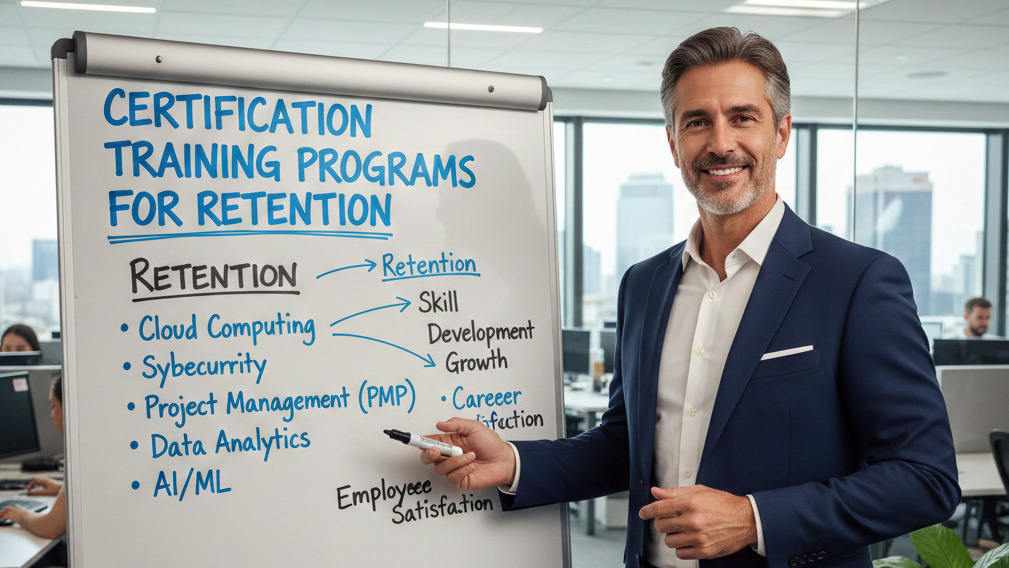
Creating a training program is not as simple as buying a few online courses and telling people to finish them - you must have an employee engagement strategy. To actually help with retention, the program must be high-quality and relevant. A poorly designed program can actually frustrate employees and make them feel like they are wasting their time on busywork.
The first step is alignment - the certifications offered should match the company's future needs and the employee's personal interests. For example, if the company is moving toward cloud computing, then offering cloud architecture certifications is a perfect match.
Corporate training benefits are most visible when the program is structured fairly. Companies should consider:
When the process is transparent and rewarding, it becomes a core part of the company culture. It shouldn't feel like an extra burden but rather a perk of the job.
A one-size-fits-all approach rarely works in education, as a junior marketing assistant needs different skills than a senior creative director. Therefore, workforce certification programs must be tiered:
Personalizing these paths shows the company recognizes the unique contribution of every individual. When a manager sits down with an employee to map out a custom certification journey, it builds trust. It shows the employee that their specific career aspirations are being heard and valued.
Even with the best intentions, companies face hurdles, with the three biggest being cost, time, and lack of interest in workforce certification programs:
How do you know if your investment is working? You cannot just feel that retention is better. For this, you need data, and to prove the ROI of your employee engagement strategy, management should look at specific metrics.
The most obvious metric is the retention rate of those who have completed certifications versus those who haven't. For example, if 90% of certified employees stay for at least 2 years, while only 60% of non-certified workers do, the result is clear - the program is working.
Other important metrics include:
By tracking these numbers, HR departments can refine their employee engagement strategies and focus on the areas that deliver the most value. For example, if a certain certification doesn't seem to improve performance or happiness, it can be replaced with something more relevant.
Comparison of retention metrics before and after training implementation:
|
Metric |
Before Program |
After Program (Year 1) |
|
Annual Turnover Rate |
25% |
15% |
|
Internal Promotion % |
10% |
35% |
|
Training Satisfaction |
4/10 |
8.5/10 |
|
Average Tenure |
2.1 Years |
3.4 Years |

The world of work is changing fast. With the rise of AI, remote work, and the gig economy, traditional loyalty is harder to find. In the future, employee retention strategies will have to be even more dynamic. We are moving toward a model of continuous learning rather than one-time training events.
Digital badges and micro-credentials are becoming the new standard, enabling employees to showcase their skills on platforms like LinkedIn. This actually helps the company's employer brand - when outsiders see your employees constantly gaining new certifications, they see your company as a center of excellence.
Remote and hybrid work also means that training must be accessible from anywhere, making mobile-first learning platforms essential. Furthermore, as technology evolves, the shelf life of skills is getting shorter. This means that certification will not be a one-and-done event but a lifelong cycle.
In conclusion, as part of your employee retention strategy, you must help employees become the best versions of themselves. By integrating certifications into the very heart of your business, you create a culture of growth that is hard for competitors to replicate. You aren't just teaching skills - you are building a future where your employees feel valued, capable, and committed to staying for the long haul.

Get Unlimited access to ALL the LIVE Instructor-led Microsoft courses you want - all for the price of less than one course.