



Basket
{{item.CourseTitle}}
Price: {{item.ItemPriceExVatFormatted}} {{item.Currency}}
Browse by Topic
Browse by Vendor

Unlimited Training
Attend all the top-notch LIVE Instructor-led Courses you want for the price of less than one course.

Privacy-ready teams differ from privacy-aware teams in treating privacy capability as product and operational work, not just knowledge of the rules or escalation to legal. Privacy risk is now created in product decisions, data pipelines, security-professional" data-autoinject="link_injection">security controls, telemetry defaults, vendor integrations, and operational handoffs.
A privacy-aware team understands that personal data must be handled carefully. A privacy-ready team can turn that understanding into repeatable engineering and operating habits. The difference becomes visible when a new feature is planned, a model needs training data, logs start collecting identifiers, or a product manager has to decide whether a consent prompt is clear enough to support the intended use.
Last reviewed: 2026. This article is a practical skills self-check for privacy-by-design capability. It is not legal advice, and frameworks such as the NIST Privacy Framework and ISO/IEC 27701 should be treated as guidance for governance and implementation, not substitutes for legal review.
Privacy used to be treated mainly as a compliance checkpoint: draft a notice, review a contract, respond to a data subject request, and keep records for auditors. Those activities still matter, but they no longer cover the practical risk created by modern systems. Personal data now moves through APIs, analytics platforms, machine learning workflows, customer support tools, observability stacks, and third-party services long before a formal review can catch every issue.
As a result, privacy is increasingly part of everyday delivery. Sprint planning may need a privacy acceptance criterion. Threat modeling may need to cover identifiability, linkability, inference, and secondary use. Logging standards may need to define which identifiers are allowed, how long they are retained, and who can query them. A security architect who understands encryption but has no process for minimization or data lineage is still leaving important privacy risk unmanaged.
This is why a realistic self-assessment should test implementation skill rather than privacy vocabulary. A person may know what a DPIA is and still be unable to run one early enough to influence architecture. A team may publish a privacy notice and still have weak defaults, excessive telemetry, unclear consent journeys, or no documented process for evaluating privacy-enhancing technologies.
The following rubric is designed for engineers, analysts, product managers, security architects, and privacy or infosec leaders. It is deliberately role-agnostic because privacy-ready work depends on handoffs across disciplines. A product team that scores well should be able to explain what data is collected, why it is needed, where it goes, how it is protected, when it is deleted, and how privacy trade-offs are reviewed before release.
Data inventory and lineage: Can the team trace personal data from collection through storage, processing, sharing, retention, and deletion for a live product or service.
Data minimization: Can the team justify each personal data field against a defined purpose, and can it show where unnecessary collection was removed or avoided.
DPIA and risk review routines: Are privacy risks assessed early enough to change design choices, rather than after development is largely complete.
Privacy-enhancing technologies: Can the team evaluate high-level trade-offs such as pseudonymisation, aggregation, encryption, access controls, differential privacy, or secure computation without treating any technique as a universal answer.
Telemetry and observability controls: Are logs, analytics events, crash reports, and monitoring data reviewed for personal data exposure, retention, access, and secondary use.
Consent and user choice: Are defaults, notices, preference controls, and withdrawal paths tested for clarity, usability, and alignment with actual data use.
Vendor and integration risk: Are third-party tools reviewed for data flows, subprocessors, retention, access, security measures, and deletion support before integration.
Operational readiness: Can the team handle data subject requests, deletion requests, incidents, and product changes without relying on undocumented knowledge held by one person.
A simple way to use the rubric is to rate each area as absent, inconsistent, repeatable, or evidenced. “Absent” means the practice depends on luck or individual judgement. “Inconsistent” means it happens in some projects but is not dependable. “Repeatable” means the team has a routine and named owners. “Evidenced” means the routine leaves artifacts that can be reviewed, such as data maps, DPIA records, design decisions, test cases, telemetry approvals, and vendor assessments.
The strongest signal is not a high score on every line. It is whether the team can explain trade-offs clearly. For example, if analytics requires user-level event history, the privacy-ready answer is not simply to collect less data. It is to define the purpose, test whether aggregation would work, restrict access, set retention, document the decision, and verify that downstream systems do not reuse the data for unrelated purposes.
Engineers often discover that their main gap is not intent but visibility. They may implement secure storage and access controls while lacking a current map of where personal data enters and leaves the system. This becomes a problem when a deletion request arrives, when a data pipeline is reused for analytics, or when telemetry captures identifiers that were never included in the product’s privacy review.
Data scientists and analysts usually face a different challenge: purpose limitation and re-identification risk. A dataset that looks safe in isolation may become sensitive when joined with another source. Privacy-ready analysis therefore requires more than removing obvious identifiers. It requires careful feature selection, documented purpose, retention limits, access controls, and a review of whether the output could expose or infer information about individuals.
Product managers tend to sit at the point where commercial goals, user experience, and privacy expectations collide. Common weaknesses include vague acceptance criteria, consent screens that are treated as copywriting rather than control design, and feature backlogs that do not include privacy work until late in delivery. Strong product practice makes privacy visible in requirements: what data is necessary, what choices users have, what happens if they decline, and how the feature behaves by default.
Security architects and infosec leaders often score well on protection but less consistently on privacy governance. Encryption, identity, network segmentation, and monitoring are essential, yet they do not answer every privacy question. The architecture review should also ask whether the system needs the data at all, whether identifiers can be separated, whether retention is proportionate, and whether monitoring data creates a secondary privacy exposure.
The most persistent failure is treating privacy as a legal-only concern. Legal review can interpret obligations and set boundaries, but it cannot inspect every schema change, analytics event, model feature, or vendor configuration. When privacy knowledge is absent from technical roles, risks are discovered too late, and remediation becomes more expensive because designs have already hardened.
A second failure is weak data lineage. Teams may know which database stores customer records but not which support tool, BI dashboard, logging platform, machine learning workspace, or vendor connector receives copies. Without lineage, deletion, retention, incident response, and data subject request handling become slow and uncertain. From a practical perspective, a partial map that is maintained is more useful than a polished inventory that becomes obsolete after one release cycle.
Weak defaults and confusing consent experiences are another recurring source of risk. A product can be technically secure while still nudging users into unnecessary disclosure or making privacy choices hard to understand. Privacy-ready teams review defaults with the same seriousness they apply to security settings, because defaults often determine the real user outcome.
Finally, many organisations have no repeatable process for evaluating privacy-enhancing technologies. PETs can be valuable, but the decision should begin with the problem being solved. Pseudonymisation, aggregation, encryption, synthetic data, and other approaches each carry trade-offs in utility, complexity, governance, and residual risk. A mature team can explain why a technique was chosen, what risk remains, and how effectiveness will be checked over time.
The most useful response to a weak assessment is not a large policy rewrite. It is a set of operating habits that make privacy visible where work already happens. A product team can add privacy questions to discovery, include data minimization in acceptance criteria, and require telemetry review before release. A platform team can standardise retention patterns, approved logging fields, and access review routines. A security team can extend threat modeling to include privacy harms as well as confidentiality, integrity, and availability.
Managers can make this practical by translating assessment results into role-specific objectives. An engineering objective might be to complete and maintain data-flow records for the highest-risk services. A product objective might be to document user choice and default behaviour for new features. A security architecture objective might be to add privacy threat scenarios to design reviews. These objectives work best when they are tied to existing delivery ceremonies rather than handled as a separate privacy project.
Drills are also useful because they reveal operational gaps faster than discussion. A data subject request drill can show whether systems can locate, export, correct, or delete relevant data. A DPIA drill can test whether teams know when to escalate a design for review. A vendor risk drill can uncover whether procurement, security, privacy, and product teams share the same understanding of data flows and responsibilities.
A champion model can help sustain the work, especially in larger organisations. Privacy champions do not replace privacy counsel or security teams. Their value is local awareness: they know which product decisions are being made, which data flows are changing, and which teams need help before risk becomes embedded in the design.
Structured training adds the most value when a person’s role requires privacy decisions in delivery, architecture, product design, security operations, or data governance, but their current knowledge is fragmented. The IAPP’s Certified Information Privacy Technologist, commonly known as CIPT, is positioned around implementing privacy in technology and day-to-day operations. That makes it relevant for technical and product roles that need to bridge privacy concepts with practical implementation.
It is less useful as a standalone fix when the organisation has no ownership model, no data inventory discipline, or no route for privacy decisions to affect delivery. In those cases, internal enablement should come first: define who approves data collection, where data maps live, when DPIAs are triggered, and how architecture exceptions are recorded. Training then has somewhere to land because learners can apply the concepts to real systems rather than abstract examples.
A practical decision rule is to choose self-directed improvement when the gap is narrow and the person already has access to strong internal processes. Choose structured training when the gap spans several areas, such as DPIA practice, privacy engineering concepts, telemetry governance, vendor risk, and design controls. An implementation-focused course, including a CIPT-style programme from Readynez, can be useful when the aim is to connect privacy principles with common workflows such as SDLC gates, data mapping, DPIA reviews, vendor checks, and telemetry governance.
Hiring signals are changing alongside the work. A candidate who can recite privacy principles may still struggle to influence a product roadmap or architecture review. Stronger signals include experience mapping data flows, challenging unnecessary collection, reviewing vendor data use, participating in DPIAs, designing privacy acceptance criteria, or explaining PET trade-offs without overselling a tool.
Interview questions can reflect this shift. A software engineer might be asked how they would reduce personal data in application logs while preserving troubleshooting value. A data analyst might be asked how they would assess whether a dataset can be reused for a new purpose. A product manager might be asked how they would design user choice for a feature that depends on optional data. A security architect might be asked how privacy risks would change a reference architecture.
Development plans should follow the same logic. A privacy-aware employee may need reading, policy context, and mentoring. A privacy-ready employee needs practice with artifacts: data maps, design reviews, DPIA inputs, risk decisions, test cases, logging standards, and vendor questionnaires. The evidence of progress is not the number of training hours completed; it is whether privacy decisions become clearer, earlier, and more repeatable.
The useful question is no longer whether a team cares about privacy. Most do. The harder question is whether the team can protect privacy when release dates, analytics goals, support needs, and vendor integrations create pressure to collect and reuse more data than necessary.
Privacy-ready teams make that pressure manageable by building routines into ordinary work. They map data flows, define minimization criteria, review telemetry, test user choices, evaluate privacy-enhancing options, and rehearse operational responses before an urgent request or incident exposes the gap. Frameworks such as the NIST Privacy Framework and ISO/IEC 27701 can help structure those routines, while certification-oriented learning can help individuals connect the concepts to their daily responsibilities.
The most effective next step is to run the self-assessment against one real product, service, or data workflow rather than across the organisation in the abstract. The results will show whether internal coaching is enough, whether process changes are needed, or whether structured training through providers such as Readynez would help technical and product teams turn privacy awareness into dependable practice.

Get Unlimited access to ALL the LIVE Instructor-led Security courses you want - all for the price of less than one course.
So if your skills aren´t quite up to speed, fear not! the IAPP CIPT Certification offers you a great opportunity to do just that .
The CIPT Certification was created by the International Association of Privacy Professionals (IAPP) in 2014.
The IAPP The International Association of Privacy Professionals is a not-for-profit organization providing the only globally recognized credentialing programs in information privacy, including the Certified Information Privacy Technologist designation.
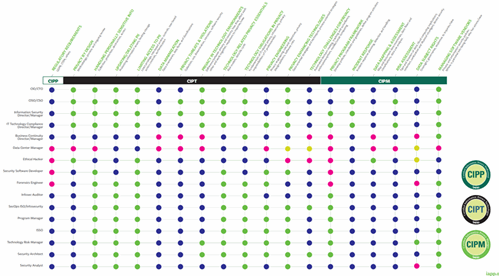
The CIPT course is a robust, interactive opportunity to learn about critical privacy concepts that are also integral to the CIPT exam. While not purely a “test prep” course, this training is appropriate for professionals who plan to certify, as well for those who want to deepen their privacy knowledge.
The IAPP CIPT is quite unique in the practical hands-on approach to privacy security. The main focus is on the implementation of privacy in day-to-day operations and it is perfect for practitioners looking for skills to better apply compliance and risk mitigation strategies.
The CIPT was just revamped with more than 50% new questions in the exam, so even if you´re currently a holder of the coveted certification, you may still want to look into the new CIPT certification. You can get trained and certified in just 2 days!
The CIPT Certification was created by the International Association of Privacy Professionals (IAPP) in 2014. The IAPP The International Association of Privacy Professionals is a not-for-profit organization providing the only globally recognized credentialing programs in information privacy, including the Certified Information Privacy Technologist designation. A vast network of 55,000+ members includes experts and influencers in the field of data protection and offers practitioners a forum to share best practices, track trends, discuss and debate issues, and receive education in the field.
Are you ready to propel your data privacy career into excellence? Then the CIPT is for you.
Stay up to date on current developments in the Tech world related to Skills.
Learn about Strategies, New findings and Tech, and get inside tips and tricks from industry experts and more...
You're viewing our global site from United States
Would you like to view the site in
English
with prices in
Dollar?