



Basket
{{item.CourseTitle}}
Price: {{item.ItemPriceExVatFormatted}} {{item.Currency}}
Browse by Topic
Browse by Vendor

Unlimited Training
Attend all the top-notch LIVE Instructor-led Courses you want for the price of less than one course.

PMP exam readiness is the point where project management experience meets PMI-style scenario reasoning under timed conditions. A delivery manager may have led complex projects for years and read the PMBOK Guide, yet still find practice questions unfamiliar because real-world delivery habits do not always map neatly to the way PMP questions test judgment.
The PMP certification is a professional credential from the Project Management Institute for people who lead projects and want to demonstrate competence across people, process, and business environment responsibilities. Last updated: February 2026. This guide reflects PMI’s current PMP Exam Content Outline, the role of the PMBOK Guide as a reference rather than a question-by-question syllabus, and the practical realities of sitting the exam online or at a test centre.
Demand for project-oriented work remains one reason the credential keeps its relevance. PMI has previously projected nearly 22 million new project-oriented roles by 2027, and project management careers continue to attract attention beyond traditional PMO functions, including product delivery, technology change, construction, financial services, and healthcare. A Forbes article on choosing a career in project management also reflects the broader career interest in the field, although candidates should treat salary and career-value claims as context rather than a guaranteed outcome: project management career guidance.
For many candidates, the more immediate question is whether PMP is the right credential. PMP is aimed at practitioners with documented project leadership experience. CAPM is usually a better fit for early-career practitioners who do not yet meet PMP experience requirements, while PMI-ACP focuses more specifically on agile principles and practices. Readers comparing credentials may find it helpful to review this external overview of PMP, PRINCE2, and CAPM, while always checking current eligibility rules directly with PMI.
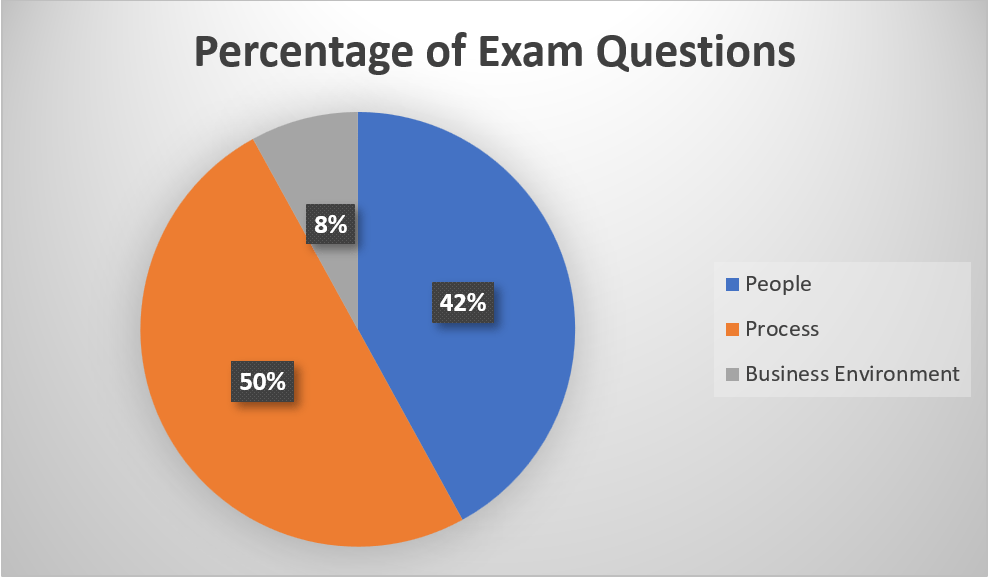
The current PMP exam is built around three domains in PMI’s Exam Content Outline: People, Process, and Business Environment. The exam also expects candidates to work across predictive, agile, and hybrid delivery approaches, which is why preparation based only on traditional waterfall process groups is too narrow. The PMBOK Guide remains useful, but the ECO is the better planning document because it describes the tasks and enablers that shape the exam.
The exam contains 180 questions and is administered over 230 minutes. Candidates receive two optional ten-minute breaks, normally after each block of 60 questions. Once a break begins and the previous section is submitted, those earlier questions are locked, so candidates need to review flagged items before moving on. This makes pacing part of the exam strategy rather than an afterthought.
A practical time plan is to treat the exam as three blocks of roughly 75 to 76 minutes each. That gives about one minute and fifteen seconds per question, with a small review window inside each block. A candidate who spends too long trying to solve the hardest early questions often sacrifices marks later, because the PMP rewards consistent judgement across many scenarios rather than perfection on a few complex items.
The current exam also uses more than standard multiple-choice questions. Candidates may see multiple-response, matching, hotspot, and drag-and-drop item types. A common mistake is preparing as if every question has one obvious answer; in practice, candidates need to read the stem first, identify what the question is really asking, count how many selections are required, and eliminate options that conflict with the ECO task, the stakeholder impact, or the delivery approach in the scenario.
The old style of memorising inputs, tools, techniques, and outputs is no longer enough. Many questions ask for the most appropriate next step, which requires candidates to weigh risk, value, team ownership, stakeholder impact, and governance. A project manager who has handled escalations at work may still choose the wrong exam answer if they jump straight to action before analysing, collaborating, or updating the right artefact.
PMP eligibility depends on a combination of education, project leadership experience, and formal project management education. PMI updates requirements and pricing, so candidates should verify the current application rules, exam fees, and membership pricing on PMI’s site before applying. The original version of this article included country-specific cost examples, but fees can change and should not be treated as evergreen figures.
The required project management education hours are not just a formality. They are often where experienced managers discover the language gap between how their organisation runs projects and how PMI frames responsibilities. A strong preparation route connects day-to-day experience to the ECO rather than asking candidates to memorise isolated definitions.
Structured instruction can help when a candidate needs accountability, guided scenario practice, or a faster way to map weak areas to the exam outline. Readynez offers a PMP training course for candidates who want live preparation aligned to the certification path, but self-study can also work for disciplined learners who use the ECO, a reliable question bank, and timed mixed practice.
Method used for the study plan below: the schedule is built from the PMP ECO domains, the current exam structure, the mix of predictive, agile, and hybrid work, and common preparation pitfalls such as leaving timed practice too late or treating agile content as a small add-on. It is designed for working project managers who can study consistently alongside a full-time role.
A realistic PMP plan gives candidates enough time to move from recognition to judgement. Early study often feels comfortable because concepts such as stakeholder engagement, risk, change control, and team development are familiar. The difficulty appears when the exam asks for a next action in a scenario where several answers are plausible.
In the first two weeks, candidates should map the ECO to their study material and identify gaps across People, Process, and Business Environment. This is also the right time to skim the PMBOK Guide for principles and terminology, while avoiding the trap of treating it as the only source. The goal is to understand how PMI describes project work, not to build a library of memorised phrases.
Weeks three and four should move into domain-based practice. Candidates can study leadership, conflict, stakeholder engagement, risk, schedule, scope, procurement, quality, and business value in focused blocks, then answer scenario questions immediately afterward. When reviewing wrong answers, the useful question is not simply why the correct answer is right, but what assumption made the wrong answer tempting.
Weeks five and six should introduce mixed timed sets. This is where many candidates discover that they understand the content but lose accuracy when predictive, agile, and hybrid situations are mixed together. The review process should classify errors by cause: misread question, weak concept, poor time decision, unfamiliar item type, or overreliance on personal workplace habits.
Weeks seven and eight should focus on full-length stamina and block-level pacing. Candidates should practise 60-question blocks using the same review discipline they will use in the real exam. That means deciding which questions to answer, flag, revisit, and release within roughly 75 minutes, then taking a short break before starting the next block.
If the plan extends to 10 weeks, the final two weeks should be used for targeted repair rather than broad rereading. A candidate who is weak in agile servant leadership, procurement, stakeholder engagement, or benefits realisation should practise those themes in mixed contexts. Repeating notes may feel productive, but scenario review usually produces better exam readiness.
PMP questions often describe a messy project moment: a stakeholder is unhappy, a team is blocked, a risk has materialised, or a sponsor wants a change. The strongest answer is usually the one that fits the project context and preserves good project governance. Candidates should be cautious about answers that immediately escalate, replace a team member, approve a change without analysis, or ignore stakeholder communication.
A useful mental model is to translate personal experience into PMI-style judgement. In real organisations, project managers may be pressured to act quickly, but the exam often rewards first understanding the problem, consulting the right people, checking the plan or backlog, assessing impact, and then taking action. In agile and hybrid scenarios, the answer may involve the team, product owner, backlog, or servant leadership rather than a command-and-control response.
Item type matters as well. In multiple-response questions, candidates should count the required selections before reading the options too deeply. In matching questions, the easiest pairs should be locked first so the remaining choices are easier to reason through. In hotspot or drag-and-drop questions, the wording usually reveals whether PMI is testing sequence, ownership, priority, or classification.
The PMP exam can be taken through approved delivery channels, including remote proctoring where available and test centres. The better choice depends less on convenience and more on risk control. A quiet home office with stable internet, a compliant room setup, and comfort with being monitored may work well. A shared household, unreliable connection, or restrictive corporate laptop can make a test centre the safer option.
Remote proctored exams typically involve identity checks, a room scan, and strict rules about the testing space. Candidates should understand how the online whiteboard or note tool works before exam day, because it is different from writing freely on paper. They should also close background applications, test the system in advance, and avoid using equipment or networks controlled by an employer if security policies may interfere.
At a test centre, the trade-off is travel and a less familiar environment, but candidates gain a controlled setup, standard equipment, and staff support for check-in issues. Either way, the important point is to read the current PMI and testing-provider instructions before the appointment. Exam-day failure caused by identification, workspace, or system problems is avoidable with early checks.
Because the exam is divided into three 60-question blocks, pacing should be planned before the first question appears. A strong approach is to move steadily through each block, flag questions that require extra thought, and preserve a few minutes for review before submitting that section. Once the optional break begins, the submitted section cannot be revisited.
The optional breaks are valuable because fatigue changes judgement. Candidates should use them to reset, not to keep mentally debating locked questions. Leaving the desk must follow the testing rules, especially for online exams, so the break strategy should be simple: finish the block review, submit, take the allowed break, return early enough to settle, and start the next block calmly.
PMI does not publish a fixed passing score, and candidates should be wary of advice that promises a specific percentage target. Results are reported through performance categories such as Above Target, Target, Needs Improvement, and Below Target across domains. The practical implication is that preparation should aim for balanced competence, not a narrow attempt to game a single score.
Passing the exam is not the end of the credential lifecycle. PMP holders need to earn 60 Professional Development Units over a three-year cycle to maintain the certification. Renewal fees and policy details can change, so credential holders should verify the current rules directly with PMI rather than relying on old fee examples.
Renewal does not have to be expensive. Many everyday professional activities may support PDU claims when they fit PMI’s categories and can be documented properly. Reading relevant material, attending webinars, contributing to project management practice, mentoring, creating presentations, or learning new delivery methods can all be useful when they align with PMI’s Talent Triangle and audit expectations.
The best habit is to track PDUs throughout the cycle rather than reconstructing three years of activity near the deadline. Candidates who earn the PMP should create a simple record of activity date, provider or source, topic, duration, category, and evidence. That record protects against stress later and encourages continuing development instead of last-minute compliance.
No. The current PMP exam contains 180 questions over 230 minutes, with two optional ten-minute breaks. Candidates should ignore older preparation material that still describes 200 questions, a four-hour exam, or multiple-choice-only testing.
No. PMI does not publish a fixed passing percentage. Candidates receive performance reporting by proficiency category, so preparation should focus on consistent domain competence and scenario judgement.
The PMBOK Guide is useful, but it should not be the only study source. The PMP Exam Content Outline is the better guide for planning because it defines the domains, tasks, and responsibilities that the exam is designed to assess.
Many working project managers benefit from an 8 to 10 week plan if they can study consistently and include timed practice. Candidates with weaker agile, hybrid, or formal governance experience may need longer.
PMP is broader and is aimed at experienced project leaders across predictive, agile, and hybrid work. PMI-ACP is more focused on agile practices and may suit practitioners whose roles are mainly agile delivery. Some candidates pursue PMP first and then add agile-focused credentials later.
The PMP exam is demanding because it tests judgement under constraints. A candidate needs to understand the ECO, practise beyond standard multiple choice, build timing discipline across the three exam blocks, and connect workplace experience to PMI’s view of responsible project leadership.
A practical next step is to choose a preparation route and commit to the first two weeks of ECO mapping and diagnostic practice. Candidates who want structured teaching can consider Readynez as one option, while every candidate should verify current rules, fees, eligibility, and renewal policy directly with PMI before booking the exam.

Get Unlimited access to ALL the LIVE Instructor-led Microsoft courses you want - all for the price of less than one course.
You're viewing our global site from United States
Would you like to view the site in
English
with prices in
Dollar?