





Basket
{{item.CourseTitle}}
Price: {{item.ItemPriceExVatFormatted}} {{item.Currency}}
Browse by Topic
Browse by Vendor

Unlimited Training
Attend all the top-notch LIVE Instructor-led Courses you want for the price of less than one course.

Microsoft's certifications for data professionals are important, especially if you want to level up in the cloud technology arena. There are two of the most popular ones: DP-203 (Data Engineering on Microsoft Azure) and DP-300 (Administering Relational Databases on Microsoft Azure).
Both tests are a great fit for your career. However, choosing the right one to start with depends. It's about your skills, goals, and what you enjoy doing. Today, we will help you figure out which test makes sense for you. Whether you're new to data or an IT pro looking to grow your career, we will help you to choose the best one.
Microsoft organizes its certifications to match specific data jobs. They start with the basics (fundamentals); then, they move to mid-level (associate); and finally, the advanced level (expert). DP-203 and DP-300 are both associate-level certifications. However, they're built for different roles, including data engineers and database administrators (DBAs).
DP-203 is about creating data solutions. It includes building pipelines to process huge amounts of data. DP-300, on the other hand, is another aspect about managing and keeping databases running smoothly in the cloud. Microsoft split these roles because data work is getting more specialized. Knowing where each fits helps you decide which one to take first.
The DP-203 exam checks if you can design and build data solutions on Azure. It covers aspects like creating pipelines to pull in data, handling batch and real-time data processing, setting up data storage, keeping data secure, and making data workflows efficient.
This test is a great solution for data engineers who love working with big data. If you're into coding, using tools like Azure Data Factory or Databricks, and building systems to handle tons of data, DP-203 is your choice. It's aimed at users who want to design and manage large-scale data projects.
Are you wondering about how many questions there are for the DP-300 exam? You'll face about 40-60 questions. They are all focused on managing relational databases on Azure. The exam tests key skills, including setting up SQL databases for top performance, automating database tasks, setting security and compliance, setting how databases run, and managing databases that work both on-premises and in the cloud.
DP-300 is made for database professionals or users who work with SQL and want to move to the cloud. If you work with SQL Server or Azure SQL Database, this certification fits you. It's all about keeping databases secure, fast, and reliable. It's not just building new systems from scratch.
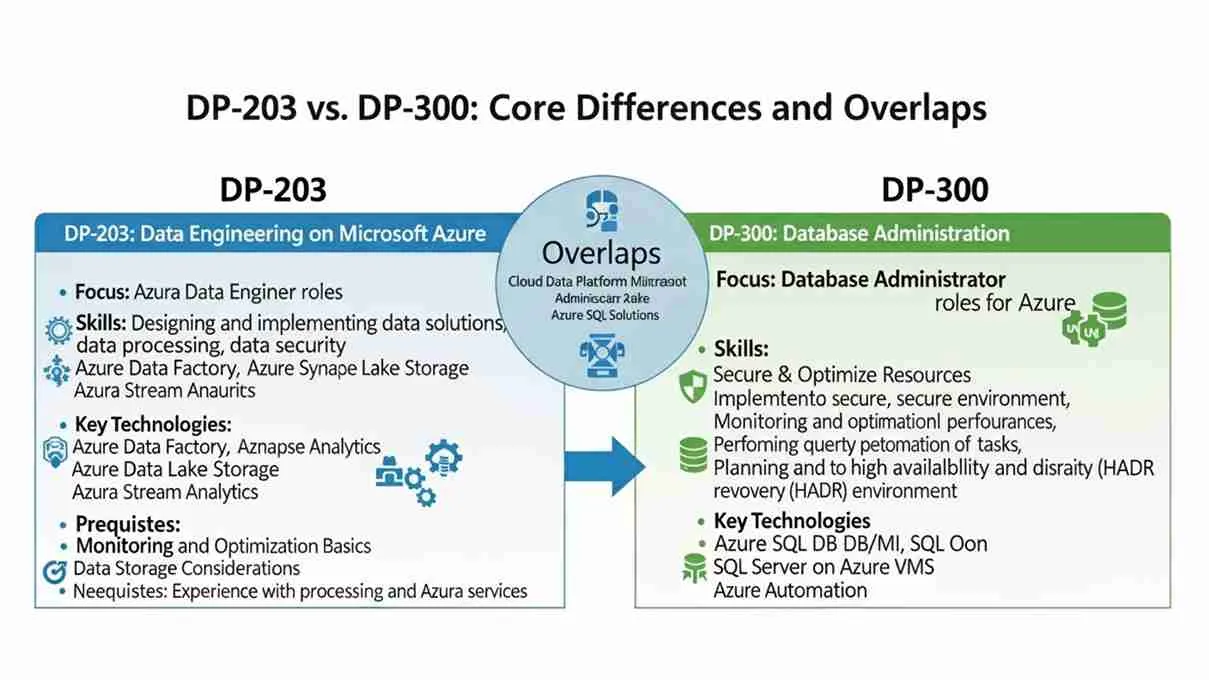
These two certifications serve different purposes. DP-203 is about building data pipelines and solutions. It includes setting up ETL processes or working with data lakes. At the same time, DP-300 is about managing and fine-tuning databases. The professionals in this field ensure they keep them running. That said, they share some common ground. They both are about making sure data is secure, boosting performance, ensuring systems can scale.
The exams aren't the same. The DP-203 exam throws in case studies, multiple-choice questions, and scenarios where you design solutions. DP-300 focuses more on SQL tasks. It includes setting up high availability or fixing performance issues. Both are moderately hard, however, what you need to know before the test is different.
DP-203 certification asks for solid skills in Python or Scala. And additionally, you must have experience with Azure tools. It includes Data Factory, Databricks, or Synapse Analytics. It's best for people who've done some coding or data science. If you're comfortable writing code and designing data flows, the DP-203 exam won't feel too scary. However, you'll need to practice with Azure tools.
DP-300 is all about SQL and database control. You need to know SQL Server, Azure SQL Database, or similar systems. Experience with backups, recovery, and security is a must. If you've worked as a DBA or IT admin, DP-300 will feel familiar.
Your background decides which one's easier. If you're a coder or data scientist, DP-203 might click faster. If you're a DBA or IT pro, DP-300 is probably your starting point.
The DP-203 certification equips you with the skills to design and implement data solutions. It opens doors to various high-demand career paths.
With this certification, you can confidently aim for roles such as Data Engineer. There, you'll build and maintain data pipelines. It ensures efficient data flow and processing for analytics and business intelligence. Another potential role is Data Architect. There, you'll design scalable data systems. You will integrate storage, processing, and analytics solutions to meet organizational needs. Also, you can pursue a career as a Big Data Developer. You will leverage Azure tools to handle large-scale data processing and develop robust apps. The test validates your expertise in data platforms, setting data workflows, and using secure solutions. It will make you a valuable asset in today's data-driven industries.
These jobs are about building systems for data processing, analytics, or even machine learning. Companies are hungry for data engineers to handle their growing data needs.
With DP-300 certification, you can target roles such as Database Administrator. There, you'll oversee database performance, security, and backups. It ensures data integrity and availability for critical business operations. Another key role is Cloud DBA. You'll leverage Azure's cloud infrastructure to design, deploy, and maintain scalable data solutions. You will optimize performance in dynamic environments. Also, you can excel as an Azure SQL Specialist. You will focus on implementing and managing Azure SQL databases. You will integrate advanced analytics and ensure robust security measures.
These focus on keeping databases secure and running smoothly. It's especially true in the cloud. As more businesses move to Azure, DBAs with cloud skills are in high demand.
Both paths lead to great careers. However, it's about what you want to do. You may want to build data systems or keep them running. So, your choice depends on your preferences.
Picking between DP-203 and DP-300 certification comes down to your skills and where you want to go. Here's a quick guide:
Lots of people end up getting both certifications because they work so well together. A data engineer might grab DP-300 later to learn database control. A DBA might go for DP-203 certification to branch out into data engineering. Pick the one that matches your skills now and fits your dream job.
DP-203 is awesome for users who love coding and creating data solutions. It's perfect if you're a developer moving into data roles, a data scientist wanting to master Azure tools, an analytics engineer building ETL pipelines.
This certification teaches you how to handle big data. It ranges from pulling it in to transforming and storing it. If you're excited about tools like Azure Data Factory or Synapse Analytics, DP-203 is your starting point. It's great for working on great projects like real-time analytics or ML.
DP-300 is the go-to for IT pros or DBAs moving to the cloud. It's ideal for SQL Server admins, system admins handling databases, and users working on hybrid cloud setups.
This certification focuses on practical skills. It includes setting up Azure SQL Database, keeping systems available, and automating tasks. If you like solving database problems, securing data, or making systems run faster, DP-300 is for you. It's relevant for companies using relational databases in the cloud.

Getting ready for any of the exams means using good resources and practicing a lot. Microsoft Learn has free courses for both DP-203 and DP-300. Hands-on labs on Azure are a must to get real experience. Here's how to prepare for each.
The DP-203 exam focuses on designing and implementing data solutions using Azure services. It emphasizes data pipelines, storage, and processing. To excel, start by honing your coding skills in Python or Scala. These languages are integral for data manipulation and transformation tasks in Azure environments. Practice writing scripts for data processing. For example, cleaning datasets or performing aggregations. It helps to build confidence in handling real-world scenarios.
Next, focus on building Extract, Transform, Load (ETL) pipelines. For this, use Azure Data Factory or Azure Synapse Analytics. These tools are central to the exam. So, create sample pipelines to ingest data from various sources. Then, transform it and load it into target systems like Azure Data Lake Storage. Experiment with data lakes. For this, set up Azure Data Lake Storage Gen2 and organize data with hierarchical namespaces. It's to understand partitioning strategies and set query performance.
Also, leverage Azure Databricks for hands-on experience with Apache Spark. Create notebooks to process large datasets. Experiment with Delta Lake for reliable data storage. And explore real-time analytics with Spark Structured Streaming. To familiarize yourself with the exam format, take practice tests. You can use platforms like Microsoft Learn, Whizlabs, or Udemy.
These simulate the multiple-choice and case-study questions you'll encounter. It can help you identify knowledge gaps and build time control skills. Consistently review Azure documentation. It's to deepen your understanding of Azure Stream Analytics and Azure Event Hubs. And focus on their practical uses in data workflows.
The DP-300 exam centers on managing and setting Azure SQL Database and related services. It requires proficiency in SQL and database administration.
Begin by mastering SQL queries. Focus on writing efficient, complex queries for data retrieval and manipulation. Practice performance tuning techniques. It includes indexing strategies (clustered vs. non-clustered indexes) and query setting. It can help to enhance database efficiency. Set up Azure SQL Database instances using the Azure portal or CLI. Configure security settings like Azure Active Directory authentication and firewalls.
To prepare for high-availability scenarios, experiment with failover groups and geo-replication. It's to ensure database resilience and minimal downtime. Use Azure labs or a free Azure account to simulate real-world database administration tasks. It includes backup and restore operations, monitoring performance with Azure Monitor, and implementing data encryption for security.
Practice tests are equally critical for DP-300. They help you get accustomed to scenario-based questions. Those test your ability to troubleshoot and set SQL solutions. Supplement your preparation with Microsoft Learn modules and Azure documentation. It's to stay updated on key features like automatic tuning and Always On availability groups.
Steer clear of DP-203 dumps or sketchy shortcuts. They're often outdated or wrong. Practice tests are great for checking your progress. However, real projects on Azure are what make you ready.
Both DP-203 and DP-300 are fantastic for breaking into the data world. They don't compete - they work together. Pick the one that fits your skills and the job you want. If you're a coder or data lover, start with DP-203 to build cool data systems. If you're a DBA or IT pro, go for DP-300 to master cloud databases.
Certifications show you know your stuff. But hands-on Azure projects make you stand out. Build real data solutions, experiment, and apply what you learn. Start with the exam that feels right for you. And then grab the other one later to become a versatile Azure data pro. You've got this - dive in and start building your future.

Get Unlimited access to ALL the LIVE Instructor-led Microsoft courses you want - all for the price of less than one course.