





Basket
{{item.CourseTitle}}
Price: {{item.ItemPriceExVatFormatted}} {{item.Currency}}
Browse by Topic
Browse by Vendor

Unlimited Training
Attend all the top-notch LIVE Instructor-led Courses you want for the price of less than one course.

In today's digital landscape, organizations face an overwhelming number of cybersecurity threats and regulatory requirements. As a result, GRC analysts have become essential to modern business operations. Organizations can no longer afford to neglect data management or regulatory compliance. Governance, risk, and compliance frameworks keep organizations secure and legally compliant, enabling sustainable growth while avoiding legal pitfalls and security breaches. The complexity of modern regulations continues to increase, making specialized expertise more valuable than ever.
This comprehensive guide is designed for anyone interested in becoming a GRC analyst - whether you're a complete beginner, considering a career change, or an early-career IT professional looking to specialize. We'll explore the role's responsibilities and why demand for these professionals is rapidly increasing across all industry sectors. You'll learn about typical career paths, essential GRC skills, and which certifications will help you stand out in the job market. We'll also cover detailed GRC analyst job descriptions and provide a clear picture of expected salaries at different experience levels. By the end of this article, you'll have a complete roadmap for your future career.
To understand this role, let's first break down what GRC means. It stands for Governance, Risk, and Compliance. So what exactly is a GRC analyst? At its core, this professional ensures that an organization adheres to its own policies, manages risks effectively, and remains compliant with external regulations. Think of them as the bridge between technical security teams and business leadership. The analyst focuses on both the rationale behind and implementation of the company's security strategy.
A GRC analyst typically works within a corporate office, government agency, or consulting firm. They don't spend their days writing code or responding to active security incidents. Instead, they focus on strategic, organization-wide challenges that affect the entire business. They ask critical questions such as: "Do we have adequate password management policies?" and "What's our disaster recovery plan if primary systems fail?" This role differs from purely technical security positions because it requires a deep understanding of business processes and regulatory environments. Analysts help design and implement security frameworks proactively, rather than simply auditing them after implementation.
Let’s take a look at the GRC analyst job description. In a business context, Governance refers to the policies, procedures, and organizational structure that guide company operations. Risk encompasses any potential threat to the organization's objectives, assets, or reputation. Compliance means adhering to external regulations and legal requirements, such as HIPAA for healthcare data or GDPR for privacy protection. Understanding how these three elements work together is fundamental to success in this field.
If you are wondering what a GRC analyst does on a day-to-day basis, the answer is quite varied. On any given day, they might interview department heads to understand data workflows, draft new security policies for remote work, or prepare for upcoming audits. Their primary objective is to identify organizational vulnerabilities and recommend risk mitigation strategies that balance security with operational efficiency.
What does a GRC analyst do? Daily tasks often include:
So, what is a GRC analyst doing? A typical day might begin with reviewing recent regulatory updates that could impact the organization. Afternoons often involve meetings with project teams to clarify which security requirements apply to new applications or initiatives. The role requires extensive documentation review, policy writing, and cross-functional collaboration with stakeholders at all organizational levels.
When you look at a typical GRC analyst job description, you seek candidates who can balance technical knowledge with business acumen. The primary responsibility typically involves maintaining the Information Security Management System (ISMS) - essentially the organization's comprehensive security framework. Organizations rely on GRC analysts as the authoritative resource for all risk and compliance matters.
The main deliverables a GRC analyst produces include:
They must translate complex regulatory requirements into actionable tasks for IT teams. When new regulations are enacted, analysts interpret them and advise the organization on necessary compliance measures. This translation role is critical because it prevents misunderstandings that could lead to compliance failures.
The GRC analyst career path is flexible. Many professionals start in entry-level IT roles such as help desk support or junior system administration. Others come from legal or business backgrounds. Because the role requires diverse skills, there's no single "right" entry point. However, career progression follows a clear trajectory with significant growth potential.
As you gain experience, you move through several stages:
Career advancement typically requires exposure to multiple industries and regulatory frameworks. For example, expertise in financial regulations or healthcare compliance can significantly increase your market value. Building a strong reputation for being organized and reliable is key to moving up. Many successful GRC analysts also develop specializations in areas such as cloud security compliance or data privacy.
Do you want to know how to become a GRC analyst? Then, the first step is building a solid foundation in IT and security fundamentals. You don't need to be a coding expert, but you must understand how networks, servers, and cloud systems work. Start with online courses on data security fundamentals and familiarize yourself with frameworks such as NIST and COBIT.
Practical experience for GRC analysts is essential. Consider volunteering to help a nonprofit develop its privacy policies or seeking internships in internal audit departments. Networking is equally important. Joining professional organizations like ISACA or IAPP provides valuable connections with industry professionals. These connections can offer career guidance and alert you to entry-level opportunities.
Success in this field requires a specific GRC skill set. While technical knowledge is important, soft skills are often more critical. You'll need to persuade stakeholders to adopt policies they may view as burdensome. Without clear communication about the rationale behind policies, compliance becomes difficult to enforce. Therefore, communication is at the top of the list of essential skills.
Key GRC analyst skills include:
Combining these skills with technical understanding creates a powerful GRC analyst professional profile. Employers look for organized individuals who can manage multiple projects simultaneously with precision and focus. The ability to remain calm under pressure is also valuable, especially during audit periods.
Professional certifications are one of the most effective ways to demonstrate expertise to employers. Certifications serve as industry-recognized validation of your knowledge and skills. While they demonstrate mastery of established standards, certifications should complement - not replace - practical experience. They're most valuable when combined with hands-on experience.
Many GRC professionals begin with foundational security certifications to build their technical vocabulary. After gaining one to two years of experience, they typically pursue more specialized GRC certifications. These examinations are rigorous and require significant preparation. They provide structured approaches to learning best practices used by leading organizations. Focus on one certification at a time rather than attempting to accumulate multiple credentials simultaneously. Prioritize certifications aligned with your current role or immediate career goals.
Certification choices should align with your career objectives. If you're drawn to auditing and assessment work, CISA (Certified Information Systems Auditor) is the industry gold standard. This globally recognized certification is ideal for audit-focused careers.
For professionals focused on risk management, one of the best GRC certifications is CRISC (Certified in Risk and Information Systems Control). Aspiring leaders should consider earning the CISM (Certified Information Security Manager) designation. The most strategic approach is reviewing job postings for your target roles to identify the most frequently requested certifications.
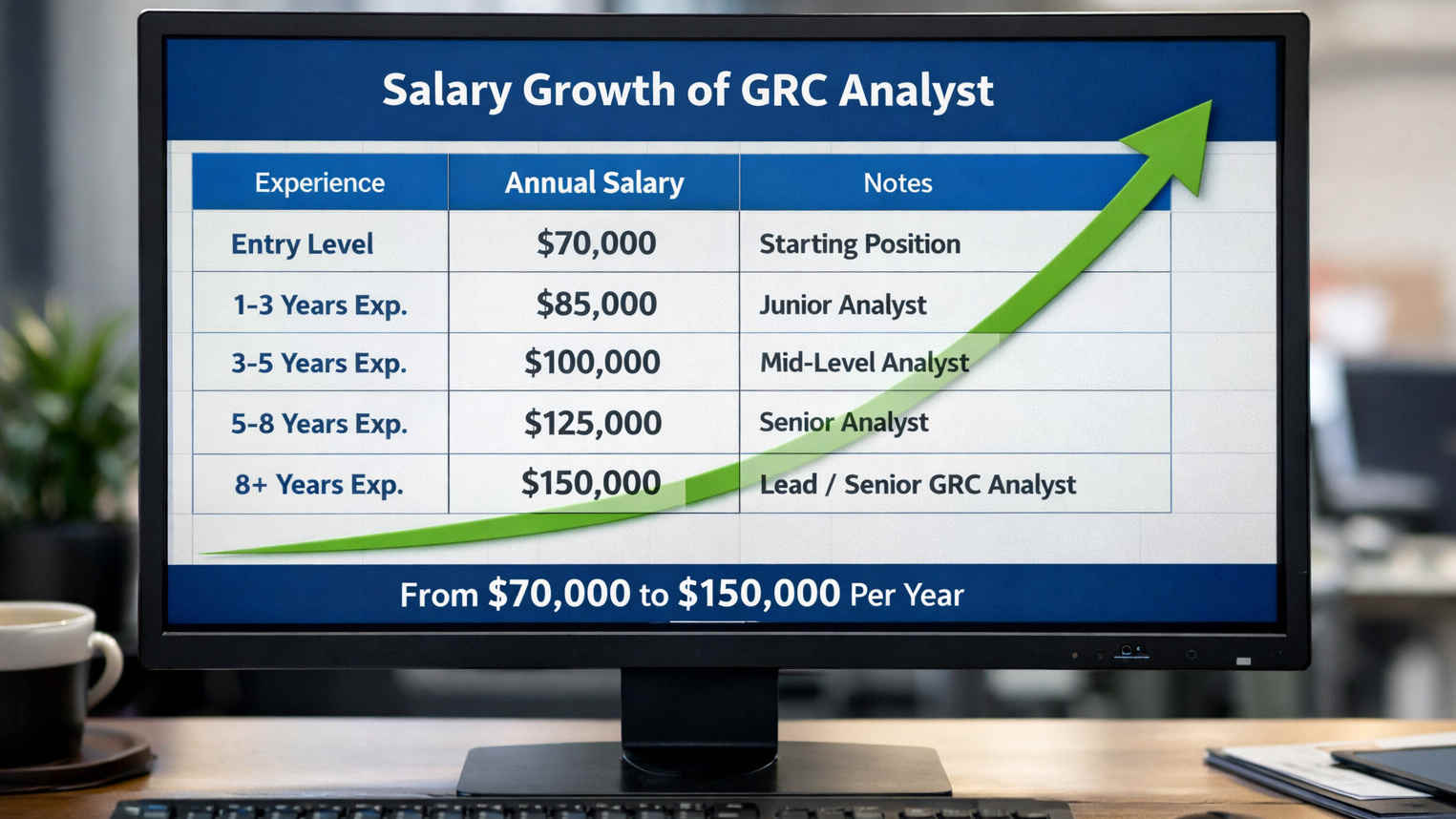
GRC analyst salaries are highly competitive, reflecting the significant responsibility these roles entail. In the United States, entry-level analysts earn between $70,000 and $90,000 annually. With experience and certifications, compensation typically exceeds $120,000 and can reach $150,000 or more.
The job market for GRC professionals remains robust. As governments enact increasingly stringent privacy and security regulations, organizations have little choice but to hire qualified GRC professionals. The healthcare, finance, and technology sectors consistently seek talented professionals. GRC roles offer exceptional job security because regulatory compliance is mandatory, not optional. This creates sustained demand for qualified analysts, supporting strong compensation levels. Remote work opportunities have also expanded significantly in recent years, offering greater flexibility.
Choosing a career is a significant decision. A GRC career is ideal if you enjoy problem-solving and systematic thinking. If you're interested in technology but prefer not to focus exclusively on programming, GRC offers an ideal balance. The work is meaningful - you're protecting both the organization and its clients from security threats and legal risks.
The primary challenge is that GRC work can be methodical and documentation-intensive. You may also encounter resistance from colleagues who view compliance professionals as organizational gatekeepers. However, long-term career prospects are excellent. The role provides deep insights into business operations and creates pathways to executive leadership positions.
The GRC analyst career path offers stability, excellent compensation, and the opportunity to work at the intersection of law, business, and technology. If you're organized, communicative, and intellectually curious, a GRC career could be the beginning of a rewarding professional journey.

Get Unlimited access to ALL the LIVE Instructor-led Security courses you want - all for the price of less than one course.