



Basket
{{item.CourseTitle}}
Price: {{item.ItemPriceExVatFormatted}} {{item.Currency}}
Browse by Topic
Browse by Vendor

Unlimited Training
Attend all the top-notch LIVE Instructor-led Courses you want for the price of less than one course.

In today's interconnected world, Canadian organizations are navigating an increasingly complex environment of digital threats and stringent regulatory demands. Staying secure and compliant is no longer a simple checklist item; it's a core business imperative. Governance, Risk, and Compliance (GRC) professionals are the specialists who guide companies through this landscape, ensuring they can grow sustainably without falling victim to costly security breaches or legal penalties. As regulations like PIPEDA evolve and cyber risks multiply, the need for this expertise has never been more acute.
This guide offers a roadmap for anyone aspiring to a career in GRC analysis. Whether you are new to the workforce, transitioning from another field, or an IT professional seeking a strategic specialization, we will chart a clear course. We'll examine the career progression, the essential skills needed to succeed, and the professional certifications that open doors. We'll also look at typical responsibilities and the strong market demand for GRC talent, giving you a full picture of what this rewarding career path entails.
To grasp the analyst's role, one must first understand the GRC framework. This acronym represents Governance, Risk, and Compliance. But what does that mean for an organization? A GRC analyst is a professional who ensures a company operates according to its own internal policies, effectively manages all forms of risk, and complies with all external laws and regulations. They serve as a critical link between technical implementation teams and executive leadership, focusing on the strategic rationale behind an organization's security posture.
Instead of responding to active security incidents or writing software, a GRC analyst works at a higher level, often from a corporate office, a government agency, or a consulting practice. Their focus is on organization-wide challenges that impact long-term stability and success. They address questions like, "Is our data handling policy compliant with current privacy laws?" or "How would we recover critical business functions after a major cyberattack?" This strategic, proactive approach to designing and maintaining security frameworks distinguishes the role from more reactive, technical security positions.
In a business security context, each element of GRC has a distinct meaning. Governance is the complete set of rules, policies, and structures that direct and control the organization. Risk encompasses any event or condition that could threaten the company’s assets, reputation, or objectives. Compliance involves adhering to external legal and regulatory mandates, such as PHIPA in Ontario healthcare or global standards like GDPR.
The daily activities of a GRC analyst are diverse and dynamic. A typical day might involve interviewing department leaders to map data flows, drafting a new security policy for remote employees, or getting ready for an upcoming external audit. The central goal is to uncover organizational vulnerabilities and propose risk mitigation strategies that protect the company while supporting operational needs.
Core responsibilities often include:
A GRC analyst translates complex legal and technical requirements into understandable, actionable guidance for different business units. When new regulations are passed, the analyst interprets their impact and advises leadership on the necessary steps to remain compliant. This translation function is vital for preventing missteps that could lead to significant financial or reputational damage.
When you examine a typical GRC analyst job description, it calls for a blend of technical literacy and sharp business insight. A primary duty is to help maintain the Information Security Management System (ISMS)—the organization’s holistic framework for managing security. Companies view the GRC analyst as the go-to expert for all questions related to risk and compliance.
The main documents and reports GRC analysts produce are:
The GRC analyst career path is adaptable, with multiple entry points. Many professionals transition from IT support or system administration, while others come from backgrounds in law, finance, or auditing. Because the role demands such a varied skill set, there is no single prescribed path to entry. Once in the field, however, the potential for growth follows a clear and promising trajectory.
As you accumulate experience, your career can progress through several stages:
Advancement often depends on gaining exposure to different industries and regulatory frameworks. Specializing in areas like financial compliance or healthcare privacy can dramatically increase your value in the Canadian job market. Building a reputation for meticulous work and reliability is crucial for career progression.
To excel as a GRC analyst, you need a unique mix of hard and soft skills. While technical fluency is important, interpersonal abilities are often the deciding factor. You must be able to persuade colleagues and leadership to adopt new security measures that may seem inconvenient. Without excellent communication, enforcing compliance becomes a constant struggle.
Key GRC analyst skills include:
Combining these abilities with a foundational understanding of IT creates a compelling professional profile. Employers seek organized individuals who can juggle multiple projects with accuracy and focus. Practical experience is also key; consider volunteering to help a local non-profit with their privacy policy or seeking an internship in an internal audit department to get started.
Professional certifications are a highly effective way to validate your expertise for potential employers. They provide industry-recognized proof of your knowledge and skills in established frameworks. While certifications should always complement rather than replace real-world experience, they signal a commitment to the profession and mastery of best practices.
Your choice of certification should align with your specific career goals. For those interested in a career focused on auditing and assessment, the CISA (Certified Information Systems Auditor) is the global gold standard.
If your focus is primarily on risk management, CRISC (Certified in Risk and Information Systems Control) is one of the best GRC certifications available. Meanwhile, aspiring leaders and managers should aim for the CISM (Certified Information Security Manager) designation. A practical approach is to review job postings in your target market to see which credentials are most in demand.
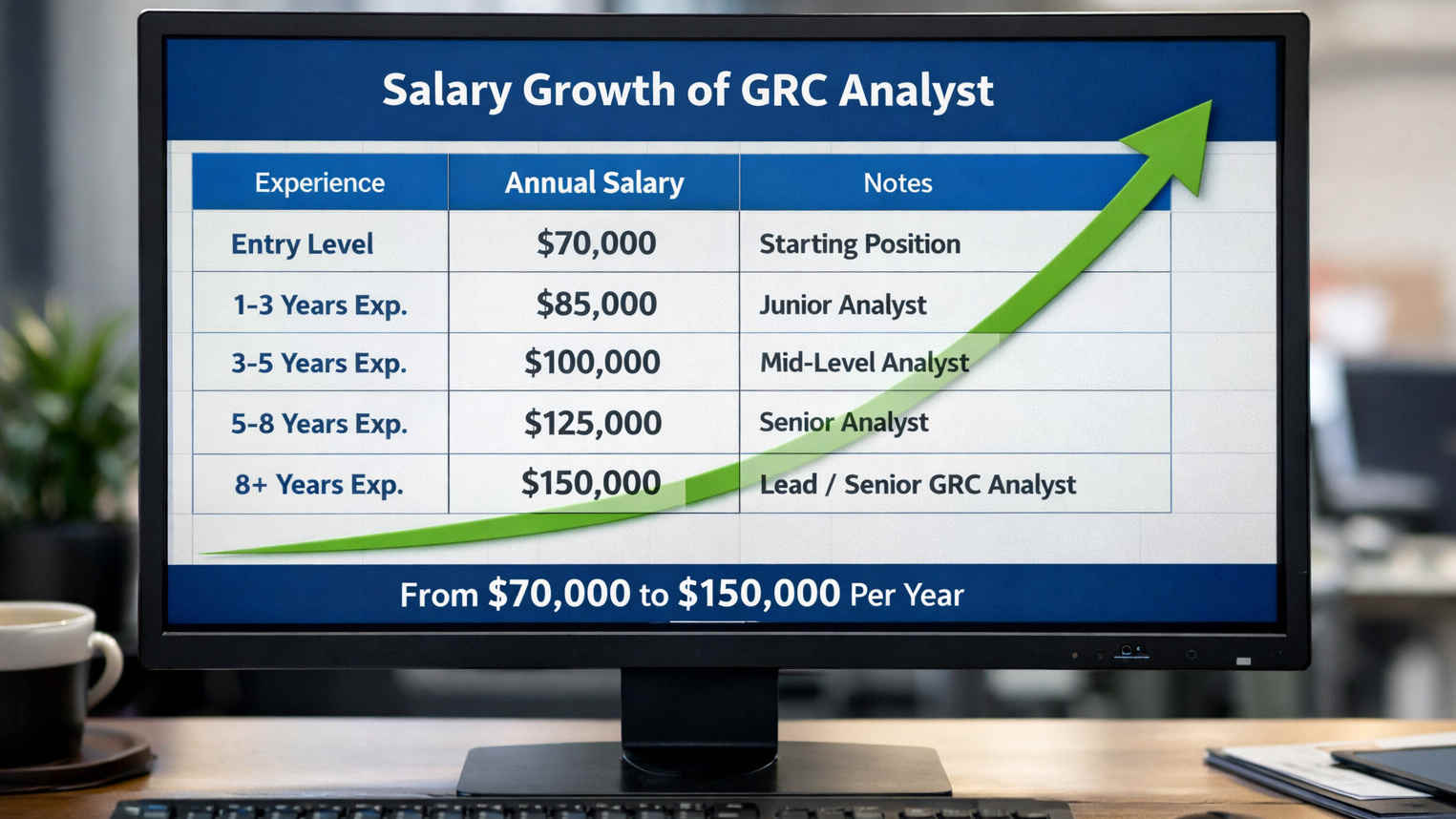
Salaries for GRC analysts are very competitive, reflecting the crucial nature of the work. In major Canadian hubs like Toronto, Vancouver, and Montreal, entry-level analysts can expect strong starting salaries that grow significantly with experience. With a few years of experience and relevant certifications, compensation rises substantially, with senior and managerial roles commanding six-figure incomes.
The job market for GRC professionals across Canada is exceptionally strong. As federal and provincial governments introduce more rigorous privacy and security laws, businesses must hire qualified experts to stay compliant. The finance, healthcare, and technology sectors are in constant need of GRC talent. This career path offers excellent job security because regulatory compliance is a mandatory business function, creating sustained demand and supporting robust compensation.
A career in GRC is an excellent choice if you enjoy structured thinking, problem-solving, and operating at the intersection of business and technology. The work is inherently meaningful—you are on the front lines, protecting your organization and its customers from tangible threats. It offers a way to engage with technology without focusing solely on programming or infrastructure.
The role can be methodical and requires a great deal of documentation. You might also face resistance from colleagues who see compliance as a roadblock. However, the long-term prospects are outstanding. This career provides a deep understanding of how a business truly operates and opens clear pathways to senior leadership roles. If you are organized, a strong communicator, and driven by intellectual curiosity, a career in GRC could be an incredibly rewarding professional journey.

Get Unlimited access to ALL the LIVE Instructor-led Security courses you want - all for the price of less than one course.
You're viewing our Canada (CAD) site from United States
Would you like to view the site in
English
with prices in
Dollar?