



Basket
{{item.CourseTitle}}
Price: {{item.ItemPriceExVatFormatted}} {{item.Currency}}
Browse by Topic
Browse by Vendor

Unlimited Training
Attend all the top-notch LIVE Instructor-led Courses you want for the price of less than one course.

In today’s fast-paced business environment, Canadian companies are increasingly turning to rapid application development and process automation to gain a competitive edge. Microsoft's Power Platform has emerged as a leading low-code/no-code solution, empowering organizations to create powerful business solutions efficiently. For professionals aiming to validate their expertise, a key decision arises: which certification path offers the best return for your career—PL-200 or PL-400?
This guide will help you navigate that choice. Instead of a simple comparison, we’ll explore the distinct career paths each certification unlocks, helping you align your ambitions with the right credential.
Microsoft has established a clear certification framework for Power Platform professionals. While both the PL-200 (Power Platform Functional Consultant Associate) and PL-400 (Power Platform Developer Associate) are associate-level credentials, they cater to fundamentally different skill sets and career trajectories.
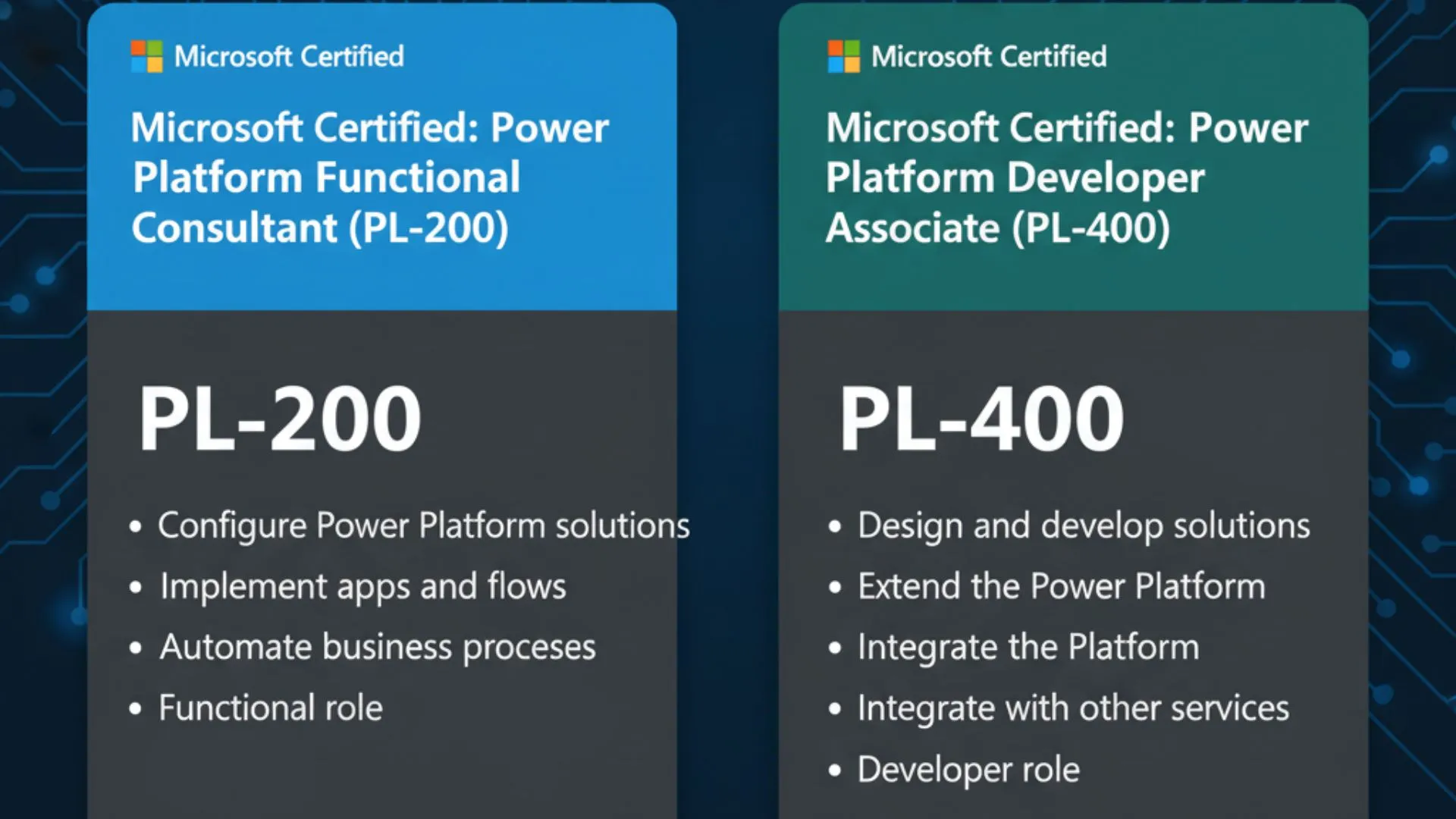
The PL-200 is tailored for the functional consultant—a professional who acts as a bridge between business requirements and technological implementation. They leverage the platform's existing tools to solve organizational challenges. In contrast, the PL-400 is designed for the developer who extends the platform's capabilities through custom code, creating bespoke components and complex integrations. Both are valuable, but they represent two separate areas of expertise.
The PL-200 certification is centred on problem-solving from a business perspective. As a Power Platform Functional Consultant, your primary role involves designing and implementing solutions that address specific operational needs. This credential is ideal for business analysts, IT support personnel, or anyone keen on leveraging technology to improve business processes without deep coding knowledge.
This certification validates your skills in configuring Dataverse, building model-driven and canvas apps with Power Apps, and designing workflows with Power Automate. You’ll also touch on creating simple chatbots using Power Virtual Agents. The emphasis is on translating stakeholder needs into functional, low-code solutions. For instance, you might design an app to manage client data while ensuring it adheres to Canadian privacy laws like PIPEDA. It proves you can turn a business concept into a deployed reality using the out-of-the-box features of the platform.
Where the PL-200 focuses on using existing tools, the PL 400 is about creating new capabilities. This certification is for experienced developers who want to push the Power Platform beyond its standard limits. If your background is in software engineering and you want to apply those skills, this credential validates your expertise in extending the platform.
The curriculum dives into custom development using languages like C# and JavaScript, working with APIs, and integrating with other services, including Azure. A PL-400 certified developer handles complex scenarios that low-code tools alone cannot solve. For example, while a functional consultant builds a user-facing form, the developer might write a custom C# plugin to perform intricate server-side validation against an external system before saving the data. This path is for those who build the powerful engines that drive sophisticated business solutions.
While both certifications share a foundation in Power Platform concepts like Dataverse and solution management, their exam content differs significantly. Understanding these differences is key to choosing the right path.
The PL-200 is widely regarded as the more accessible entry point. Success depends on strong logical reasoning and an understanding of business processes, not coding. This makes it an excellent choice for professionals transitioning into a more technical role.
Conversely, the PL-400 presents a much steeper technical challenge. A solid foundation in programming, particularly with C# and JavaScript, is essential. Familiarity with APIs and cloud platforms like Azure is also expected. The PL-400 is among the more demanding associate-level Microsoft exams because it requires a dual mastery of both the Power Platform and professional development practices.
Your career ambitions should heavily influence your decision. Earning the PL-200 can open doors to roles such as Power Platform Specialist, Functional Consultant, or Business Analyst. In these positions, you’ll collaborate directly with business units to build efficient low-code applications and automations.
A PL-400 certification leads to more development-intensive roles like Power Platform Developer, Solutions Architect, or Integration Specialist. These jobs involve hands-on coding, building custom connectors to legacy systems, and engineering the robust back-end components that power enterprise-grade solutions.
So, where should you begin? If you are new to the platform or come from a non-developer background, the PL-200 provides the ideal starting point. It offers a comprehensive grounding in the platform's capabilities without the prerequisite of coding knowledge.
If you are already a developer, the PL-400 is a direct path to validating your ability to apply your skills within the Power Platform ecosystem. You likely possess the foundational coding skills and can focus on platform-specific development techniques.
Interestingly, many top-tier professionals eventually pursue both certifications. Starting with PL-200 builds a strong functional understanding, which can then be complemented by the deep technical skills validated by PL-400. Holding both credentials signals a versatile and highly valuable expert who can both design a solution with the business and build its most complex technical components.

Success in either exam requires dedicated preparation. Microsoft Learn offers excellent free training paths. However, nothing beats hands-on experience. Set up a trial environment and start building. For the PL-200, focus on creating practical business apps. For the PL-400, your time is best spent in a code editor, practicing with custom plugins and JavaScript.
Ultimately, choosing between the PL-200 and PL-400 is a strategic career decision. The PL-200 is tailored for the business-savvy consultant who excels at transforming operational needs into effective low-code solutions. The PL-400 is the benchmark for the skilled developer who can extend and customize the platform to meet any technical challenge.
Regardless of your choice, a Power Platform certification is a powerful statement. It demonstrates your commitment and officially validates your skills in a technology that is reshaping modern business. Whether you are a low-code innovator or a pro-code developer, the right certification will accelerate your career.
Are you prepared to advance your Power Platform expertise? Our official Microsoft courses provide the focused training you need. With expert instruction and comprehensive practice materials, we equip you with the knowledge and confidence to pass your exam on the first try. Explore our course catalogue today and take the first step toward your certified future.

Get Unlimited access to ALL the LIVE Instructor-led Microsoft courses you want - all for the price of less than one course.
You're viewing our Canada (CAD) site from United States
Would you like to view the site in
English
with prices in
Dollar?