





Basket
{{item.CourseTitle}}
Price: {{item.ItemPriceExVatFormatted}} {{item.Currency}}
Browse by Topic
Browse by Vendor

Unlimited Training
Attend all the top-notch LIVE Instructor-led Courses you want for the price of less than one course.

Canada's healthcare and life sciences sectors are in the midst of a profound digital shift. The long-standing practice of storing patient information and vital research in physical files or on local servers is giving way to the cloud. This evolution is driven by the need for life-saving efficiency, enabling quicker data analysis, seamless collaboration among practitioners, and ultimately better patient care. However, entrusting sensitive health data to the cloud introduces significant responsibilities, making professional cloud certifications a critical requirement for the sector’s workforce.
As Canadian hospitals, pharmaceutical innovators, and biotech researchers transition their infrastructure, they encounter formidable challenges. They must manage vast and complex datasets while adhering to stringent privacy laws like PIPEDA. Professionals who have earned a life sciences certification signal that they possess the specialized skills needed to navigate these intricate systems. These credentials validate an individual’s ability to design, operate, and secure the digital backbone that holds our most private health information.
This guide examines the strategic role of specialized training in bridging the gap between modern technology and medicine. We will explore how different credentials directly address the unique risks in healthcare IT, making them indispensable for anyone in the field. Whether you oversee a hospital's IT department or conduct clinical research, recognizing the value of cloud certifications is the first step toward building a more secure and innovative future for Canadian healthcare.
In the health sector, the tolerance for error is practically non-existent. A system failure or a data security incident is not merely a financial setback; it can postpone critical medical procedures or expose a patient's entire health history. With such high stakes, the demand for healthcare IT certifications has surged. Employers require assurance that their technical teams can manage the intense pressures of a heavily regulated and mission-critical environment.
The cloud unlocks powerful capabilities, from remote patient care to AI-powered medical discoveries. Yet, these advancements depend on a bedrock of trust. Cloud training provides the essential framework for establishing that trust. It instructs professionals on how to deploy services from major providers like AWS, Microsoft Azure, and Google Cloud in a manner that complies with Canada's rigorous medical and privacy standards. A simple database misconfiguration, for example, could leave sensitive records exposed—a risk that certified training helps eliminate.
Furthermore, life sciences research, such as genomic sequencing and clinical trials, demands enormous computational power that requires scalable infrastructure. Cloud-certified professionals possess the expertise to configure these environments for both peak performance and cost-efficiency. Earning these credentials proves they understand and can effectively manage the Shared Responsibility Model, where the cloud vendor secures the underlying infrastructure while the healthcare organization remains responsible for securing its data and applications.
A primary obstacle in healthcare technology adoption is regulatory compliance. In Canada, federal laws like PIPEDA and provincial acts like Ontario’s PHIPA set strict rules for safeguarding patient data. Professionals who pursue healthcare compliance certifications learn how to align these legal frameworks with cloud-based architectures.
This type of training extends far beyond standard IT knowledge, covering crucial topics such as:
By mastering these compliance-focused skills, IT staff evolve into guardians of digital trust, ensuring every operation adheres to regulations and mitigates the risk of costly penalties and reputational damage.
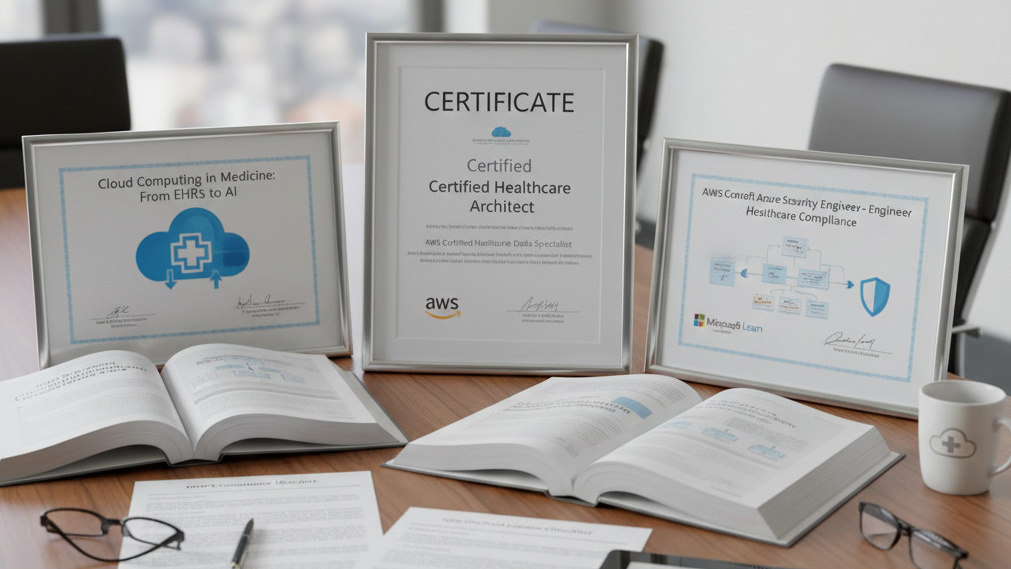
With a wide array of certifications available, selecting the right one can feel overwhelming. For professionals in the Canadian health and biotech sectors, the most impactful credentials combine general cloud proficiency with a deep focus on data security, integrity, and compliance. These certifications validate your capacity to manage high-performance computing workloads and secure complex data pipelines from end to end.
Many individuals begin their journey with a foundational credential from a major provider to gain a broad understanding of cloud services. However, for healthcare, the true value is found in specialty certifications. These demonstrate that you are not just a technologist, but a specialist who understands the distinct demands of a hospital or a research laboratory.
Important areas covered in these cloud training programs include:
Where security focuses on protection, architecture is about building resilient and efficient systems. If you are designing a new provincial telehealth service or a database for storing clinical trial data, an architect is essential. General cloud platform certifications provide the knowledge for designing such systems. Prime examples include the AWS Certified Solutions Architect or the Microsoft Certified: Azure Solutions Architect.
In a healthcare setting, superior architecture must guarantee high availability. This means that if one component of the system goes down, a backup system takes over instantaneously so that medical staff never lose access to critical patient information. Cloud architecture certification teaches professionals how to distribute infrastructure across multiple physical locations to eliminate single points of failure. It also provides strategies for integrating modern cloud services with existing legacy systems, a common challenge in established hospitals.
Innovation in the life sciences frequently requires processing petabytes of data—a task that is impractical for most on-premises servers. The cloud allows research teams to provision powerful virtual computing clusters in minutes, execute complex simulations, and then de-provision them to save costs. Managing this dynamic environment effectively requires the skills honed through cloud certifications.
Certified staff empower organizations to be more agile, enabling faster responses to emerging health crises or new research opportunities. For instance, teams proficient in cloud architecture can more rapidly support scientists, spending less time on infrastructure maintenance and more time driving world-changing discoveries.

For a healthcare organization to truly thrive in the cloud, its expertise cannot be concentrated in just a few individuals. An organizational commitment to upskilling is necessary, which is why leading hospitals and research institutions are implementing structured healthcare certification programs.
To roll out a cloud certification initiative successfully, leaders should adopt a systematic approach:
Promoting a culture of continuous learning through credentials like cloud security certifications helps organizations maintain a competitive edge. This investment also boosts employee retention, as skilled technical professionals are more likely to commit to an employer that actively supports their career growth.
The future of health technology points toward hybrid cloud models, where some data stays on local servers for rapid access while large datasets are processed in the public cloud. Upcoming certifications will likely emphasize skills for managing these complex, interconnected environments.
We are also witnessing the rapid integration of AI and machine learning in healthcare. Very soon, we can anticipate specialized healthcare IT certifications focused on securing AI systems. As artificial intelligence is increasingly used for diagnostics, the data used for training the algorithms must be impeccable and secure. Professionals will need to prove they can manage the massive data lakes that power these next-generation medical tools.
The digital transformation of healthcare and life sciences is an irreversible trend. It holds the potential for personalized medicine, accelerated drug development, and more accessible patient care. However, this potential can only be realized if the people managing the technology are exceptionally skilled and security-conscious.
By investing in recognized healthcare compliance certifications and specialized training, you are not just adding a line to your resume. You are making a firm commitment to patient safety, data integrity, and operational excellence. As the Canadian health sector continues its evolution, professionals with the right credentials will be the ones leading the charge toward a healthier future for all.

Get Unlimited access to ALL the LIVE Instructor-led Microsoft courses you want - all for the price of less than one course.