



Basket
{{item.CourseTitle}}
Price: {{item.ItemPriceExVatFormatted}} {{item.Currency}}
Browse by Topic
Browse by Vendor

Unlimited Training
Attend all the top-notch LIVE Instructor-led Courses you want for the price of less than one course.

For project managers in Canada, from the tech hubs of Toronto and Vancouver to the energy sector in Calgary, a critical career question often arises: is pursuing the Project Management Professional (PMP) certification a worthwhile investment? With numerous credentials available, it’s crucial to analyze the real-world value—in terms of cost, effort, and career returns—before committing. This guide offers a cost-benefit analysis to help you decide if the PMP is your next strategic move.
The demand for skilled project leaders is undeniable. Projections show a staggering need for project-oriented talent, with an anticipated 22 million new roles emerging globally by 2027. In this competitive landscape, a PMP certification acts as a powerful differentiator. It isn’t just a certificate; it’s a globally recognized endorsement of your ability to guide projects to successful completion, a credential that has seen its value grow by over 25% in recent years. This certification, created by project managers for their peers, signals to employers that you possess the leadership and management acumen they need.
The PMP certification delivers tangible benefits that extend far beyond a line on your resume. It validates your existing experience while honing your skills for today’s dynamic work environments. Here’s how it translates into career value:
Before reaping the rewards, it’s important to understand the complete financial and time commitment. The total cost can range from approximately $50 USD to over $3,500 USD, depending on your chosen training path and location.
A membership with the Project Management Institute (PMI) is a key factor. Becoming a member costs $129 USD plus a $10 one-time application fee. While this is an upfront cost, it provides significant savings on the exam itself ($405 for members vs. $555 for non-members in the US) and on re-examination fees ($275 vs. $375). A PMI membership effectively pays for itself through these discounts.
You must also complete 35 hours of formal project management training. This is a core requirement, and you have options. Traditional physical workshops offer valuable face-to-face interaction and networking opportunities. Alternatively, online training provides a more flexible and often less expensive route, allowing you to prepare from anywhere. The best choice depends on your personal learning style and budget.
The PMP certification is not a one-time achievement. To maintain your credentials, you must engage in continuous learning. This involves earning 60 Professional Development Units (PDUs) over a three-year cycle and paying a renewal fee of $129 USD. This process ensures your skills remain current and aligned with the evolving demands of the profession, eliminating the need to re-take the exam.
Eligibility for the PMP exam is straightforward. If you hold a high school diploma or an equivalent credential, you will need five years of project management experience (including at least 7,500 hours leading projects) and 35 hours of formal project management education.
The PMP exam is a four-hour, closed-book test consisting of 200 multiple-choice questions. It's important to know that 25 of these are "pretest" questions used for research purposes and do not count toward your final score. However, since they are distributed randomly, you must treat every question with equal importance.
The exam content is structured around three key domains that reflect the real-world responsibilities of a project manager:
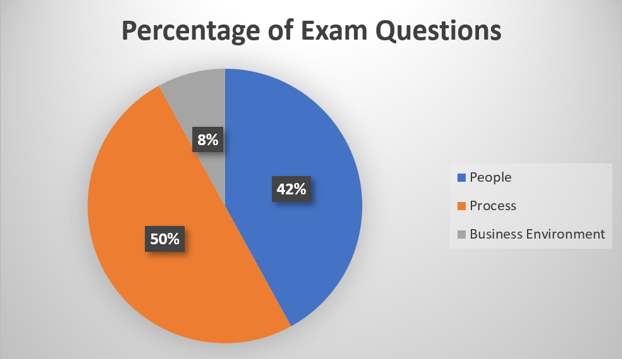
Image Source: Peak Business
After the exam, your performance in each domain is graded on a four-point scale: Above Target, Target, Needs Improvement, or Below Target. Achieving "Target" or "Above Target" across the board is the goal. While the exact passing score hasn't been public since 2007, historical data suggests a benchmark of around 61%, meaning you should aim to answer at least 106 of the 175 scored questions correctly.
Passing the PMP exam requires more than just memorization; it demands a true understanding of project management principles in various scenarios. Your professional experience is a significant asset, as the exam tests your ability to apply knowledge to practical situations.
The exam now incorporates Predictive (waterfall), Agile, and Hybrid approaches, so your preparation must be comprehensive. Many questions are situational and may include extraneous details designed to test your ability to identify what truly matters.
Here are some key strategies:
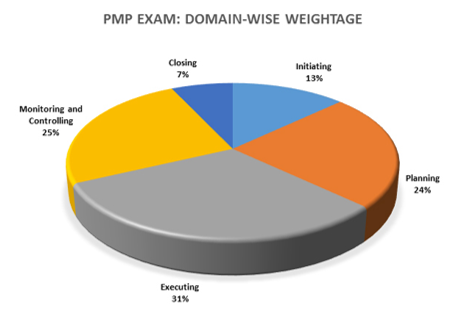
Source: Simplilearn.com
The PMP certification is a significant undertaking in terms of time and money, but its value in the global and Canadian job markets is unquestionable. For project managers looking to secure their career, command a higher salary, and prove their expertise, the return on this investment is substantial.
If you are ready to take this step, robust preparation is key. At Readynez, we provide expert guidance to help you pass the PMP exam with confidence. Our instructors are leading PMP-certified professionals who deliver the training and skills needed for success. Many employers recognize the value of PMP certification and are willing to fund the training for their employees, so consider discussing this opportunity with your manager. Whether you prefer online classes or an in-person course at a training centre, we are here to support your journey to becoming a PMP Certified Project Manager.

Get Unlimited access to ALL the LIVE Instructor-led Microsoft courses you want - all for the price of less than one course.
You're viewing our Canada (CAD) site from United States
Would you like to view the site in
English
with prices in
Dollar?