





Basket
{{item.CourseTitle}}
Price: {{item.ItemPriceExVatFormatted}} {{item.Currency}}
Browse by Topic
Browse by Vendor

Unlimited Training
Attend all the top-notch LIVE Instructor-led Courses you want for the price of less than one course.

In Canada’s competitive labour market, the departure of a skilled employee is more than just a vacancy—it is a significant business disruption. The costs associated with recruiting, hiring, and onboarding a replacement are substantial, but the loss of institutional knowledge and the impact on team morale can be even more damaging. Forward-thinking companies are realizing that the most effective way to combat rising turnover is to invest in their existing talent. Offering structured certification training is emerging as a powerful strategy for building a more loyal and capable workforce.
When an organization commits to its employees' professional growth, it fundamentally changes the relationship. It shifts from a simple transactional arrangement of work for pay to a collaborative partnership in career advancement. Employees today seek opportunities to expand their expertise. If they don’t find a path to grow within your company, they will inevitably seek one elsewhere. Professional development training that leads to recognized credentials provides a compelling reason for your best people to stay and grow with you.
To solve the turnover problem, you must first understand its roots. Employees often leave not because of a single issue, but due to a growing feeling of stagnation. Without a clear direction for their career, their initial enthusiasm wanes. Formal employee training programs counter this by creating visible pathways for advancement. A certification isn’t just another line on a CV; it is third-party validation of an individual’s skills, transforming them into a verified expert.
Furthermore, a lack of investment makes employees feel undervalued. When a business pays for a team member to earn a certification—be it in project management, cloud computing, or cybersecurity—it sends an unambiguous message of value. This cultivates a "psychological contract" where the employee feels appreciated and is more motivated to apply their new abilities to benefit the company that sponsored them. This environment of support is a powerful defence against quiet quitting and poaching by competitors.
Meaningful professional growth is a powerful motivator. Participating in high-quality professional development training reframes an employee's perspective on their daily responsibilities, turning routine tasks into steps toward mastery. Engagement levels are consistently higher in workplaces that prioritize upskilling. Knowing the company is willing to invest significantly in their future through certification dramatically increases job satisfaction and commitment.
These credentials serve as vital career development tools. In many fields, certifications are prerequisites for senior roles. By integrating these into employee development programs, a company enables its staff to build their professional capital while contributing to organizational goals. This results in a clear win-win: the employee gets a portable, industry-recognized credential, and the organization benefits from an expert with up-to-date skills. An analyst who sees a clear path to a leadership role via a series of company-sponsored certifications is far more likely to plan a long-term future with that employer.
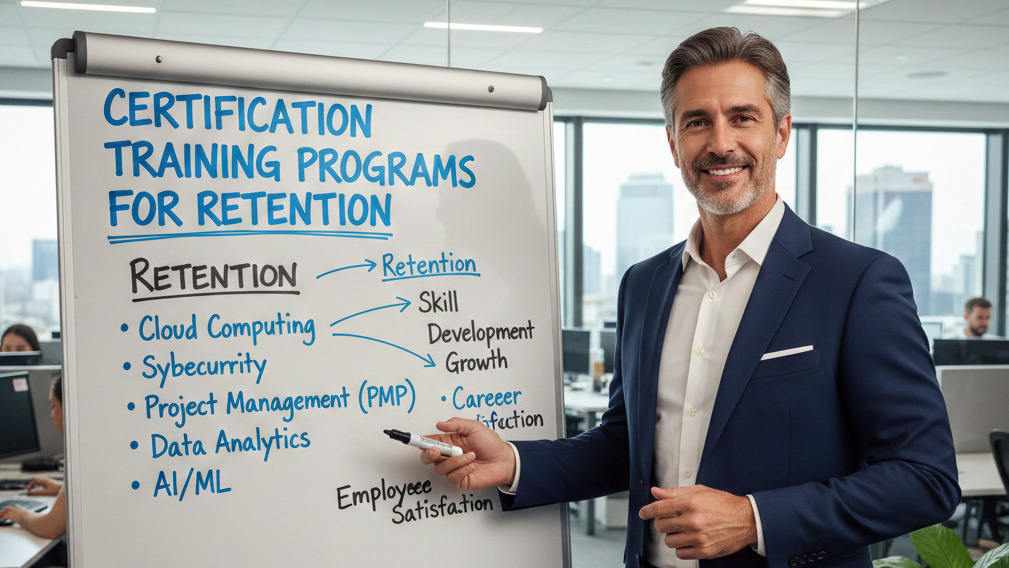
Simply providing access to online courses isn’t enough. An effective program requires a thoughtful employee engagement strategy. A poorly planned initiative can feel like a chore, leading to frustration. The first step is to ensure the certifications offered are aligned with both the company’s strategic objectives and the employee’s career goals. If your organization is migrating to a new platform, offering credentials from providers like Google or Amazon is a logical fit.
A one-size-fits-all model seldom succeeds. Workforce certification programs must be tailored. A junior developer requires a different learning path than a senior IT manager. Customizing these journeys demonstrates respect for individual contributions and aspirations. When a manager collaborates with a team member to map out a custom certification journey, it fosters immense trust.
To ensure widespread adoption, companies must address common obstacles:
To justify the investment in your talent development, you need clear data. Proving the value of your employee engagement strategy requires tracking specific KPIs. The most direct indicator is the retention rate: compare the turnover of employees who have earned certifications with those who have not. A significant positive difference is a strong sign of success.
Beyond retention, other key metrics provide a fuller picture:
Analyzing these figures allows your HR and leadership teams to refine your training initiatives and double down on what works.
Key Performance Indicators for a Training Program:
| Indicator | Pre-Implementation | Post-Implementation (Year 1) |
| Voluntary Turnover Rate | 25% | 15% |
| Internal Leadership Hires | 10% | 35% |
| Employee Training Satisfaction | 4/10 | 8.5/10 |
| Average Employee Tenure | 2.1 Years | 3.4 Years |

The nature of work is evolving rapidly. With automation, AI, and the prevalence of hybrid work models, the most effective employee retention strategies are those built on continuous learning. The focus is shifting from occasional training events to an ongoing culture of professional development. Digital credentials and micro-certifications are becoming standard, allowing staff to display new skills in real-time on professional networks, which in turn enhances your company’s reputation as a great place to work.
As the shelf-life of technical skills shortens, training can no longer be a one-time event. It must become a cyclical process of learning, applying, and re-certifying. By weaving certification opportunities into the fabric of your corporate culture, you do more than just build skills—you build a resilient organization where employees feel capable, valued, and deeply committed to growing alongside the business.

Get Unlimited access to ALL the LIVE Instructor-led Microsoft courses you want - all for the price of less than one course.