





Basket
{{item.CourseTitle}}
Price: {{item.ItemPriceExVatFormatted}} {{item.Currency}}
Browse by Topic
Browse by Vendor

Unlimited Training
Attend all the top-notch LIVE Instructor-led Courses you want for the price of less than one course.

In today’s hyper-competitive business landscape, the capacity to upskill entire departments is not just an advantage—it’s a prerequisite for survival. When a company needs to certify thousands of employees on new technologies or compliance standards, the stakes are enormous. A poorly executed program can result in wasted resources, inconsistent skills, and disengaged staff. Conversely, a successful large-scale certification initiative can build a formidable, future-ready workforce.
The challenge escalates dramatically when moving from training a handful of employees to certifying a global workforce. Common pain points for leaders include managing complex logistics, ensuring uniform quality across diverse teams, and sustaining learner motivation over the long haul. This guide offers a strategic blueprint for transforming mass certification from a logistical hurdle into a core competitive asset, ensuring your teams are not just trained, but verifiably proficient.
The first step in achieving certification at scale is to move away from ad-hoc training sessions toward a unified corporate learning and development strategy. This approach functions like a finely tuned operational process, built on a foundation of modularity and standardization. By deconstructing complex certification pathways into smaller, manageable learning units, organizations can distribute content more effectively and allow teams to learn at a pace that suits their needs.
Standardization ensures that every employee, whether in Toronto or a satellite office, receives the same high-quality curriculum. This guarantees that your corporate training certification programs produce a consistent level of expertise across the entire organization. Aligning these learning objectives with both company goals and individual job requirements is crucial for buy-in. When people see the direct relevance of a certification to their role, engagement naturally follows.
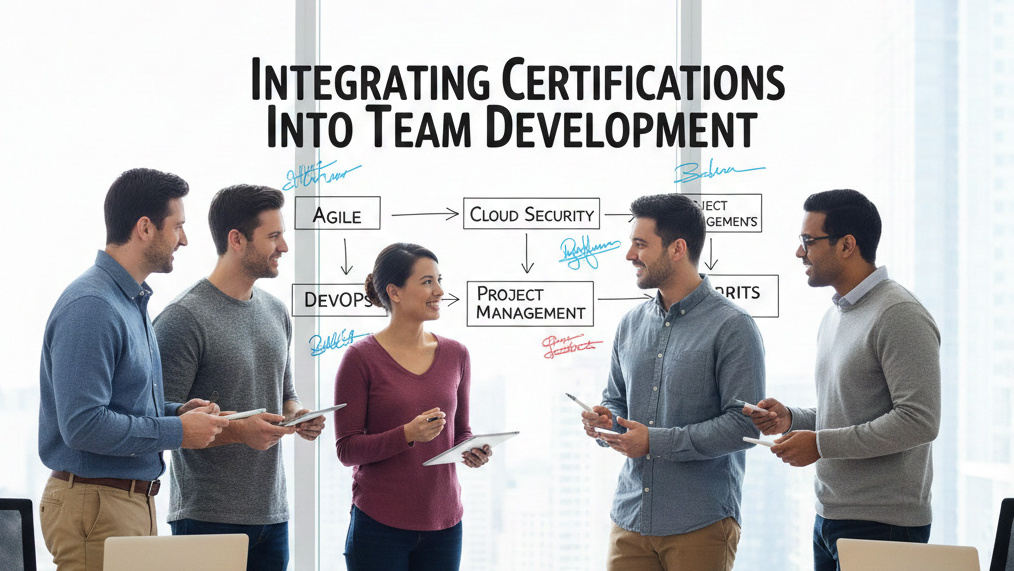
A powerful Learning Management System (LMS) serves as the central nervous system for any large-scale training initiative, especially for corporate training certification online. It provides a single repository for all training materials and enables the instantaneous deployment of content to thousands of users. More importantly, a modern LMS delivers sophisticated progress-tracking capabilities, allowing managers to monitor team advancement, identify at-risk learners, and resolve potential roadblocks before they derail the program.
Automation within the LMS is key to managing a large cohort efficiently. Features like automated grading, certificate issuance, and personalized learning path recommendations based on performance significantly reduce the administrative burden. By offloading these tasks, learning and development leaders can dedicate their time to more strategic activities, such as mentoring and program refinement.
When training thousands, the biggest threat is anonymity. If learners feel like they are just a name on a list, their motivation can plummet. To counteract this, a proactive and multi-channel communication plan is essential. Regular check-ins, celebrating progress milestones, and sharing success stories can keep the certification program at the forefront of employees' minds, even amidst competing priorities.
Equally critical are clear and accessible support channels. A learner struggling with a difficult concept or a technical issue needs immediate assistance. Without it, frustration builds and dropout rates increase. A combination of a dedicated help desk, comprehensive FAQs, and community forums can create a robust support network that empowers learners to overcome obstacles and maintain their momentum toward certification.
In a scaled environment, L&D staff cannot provide one-on-one support to everyone. This is where creating a community of practice becomes an invaluable strategy. By facilitating study groups, internal forums, or team-based projects, you empower learners to help each other. This peer-to-peer interaction is often highly effective, as colleagues can explain complex topics using shared workplace context and language.
Mentorship programs that pair certified employees with those still in training can also strengthen this learning ecosystem. This social learning approach transforms a solitary endeavour into a collective mission, boosting both completion rates and the practical application of newly acquired knowledge. When seeking the best corporate training certification practices, fostering this collaborative spirit is paramount.

The true measure of a successful corporate learning and development program extends beyond simple course completions. To demonstrate real-world value and justify the investment, organizations must track key performance indicators (KPIs) that reflect both efficiency and impact. Important metrics to monitor include:
Leveraging data analytics allows you to move from reactive problem-solving to proactive program optimization. For instance, if analytics reveal that a significant portion of learners are failing a specific practice exam within your corporate training certification online program, it provides a clear mandate to review and revise that module. This data-driven cycle of feedback and refinement ensures your program remains effective and evolves with the needs of the business.
Scaling any major initiative introduces predictable obstacles, from budget limitations to the diverse needs of a large workforce. A "start small, scale fast" pilot approach is often the most effective way to manage resource constraints. By testing and refining the program with a smaller group, you can identify and solve problems before committing to a full-scale rollout, ensuring a more efficient use of your budget.
Another significant hurdle is learner variability. A single program must cater to employees with different backgrounds, skill levels, and learning preferences. Adaptive learning paths within an LMS can solve this by allowing experienced staff to test out of initial modules while providing foundational support for beginners.
Finally, no large-scale corporate training certification initiative can succeed without visible and sustained leadership support. When managers champion the program and provide their teams with the dedicated time and resources to study, it sends a powerful message that learning is a priority. Demonstrating a clear line between certification and positive business outcomes is the best way to secure this essential buy-in.
In short, preparing large teams for certification on a massive scale is a strategic imperative that blends technology, thoughtful instructional design, and robust human support. By building a standardized framework, fostering a collaborative learning culture, and using data to continually improve, organizations can create a workforce that is not only certified but also more capable, confident, and ready for the future.

Get Unlimited access to ALL the LIVE Instructor-led Microsoft courses you want - all for the price of less than one course.