





Basket
{{item.CourseTitle}}
Price: {{item.ItemPriceExVatFormatted}} {{item.Currency}}
Browse by Topic
Browse by Vendor

Unlimited Training
Attend all the top-notch LIVE Instructor-led Courses you want for the price of less than one course.

In today's interconnected business world, technology is the engine of productivity. However, this reliance on digital systems exposes Canadian organisations to a constant barrage of threats from cyber criminals. While technical safeguards like firewalls and antivirus software are crucial, they are not foolproof. Experience shows that the most persistent vulnerability is often human behaviour. A single, unintentional mistake by an employee can render even the most sophisticated security technology useless.
This is where the paradigm shifts from passive defence to proactive resilience. Instead of viewing employees as a security liability, forward-thinking businesses see them as their most critical line of defence. Equipping your staff with knowledge through effective cybersecurity training for employees is the key to this transformation. When people can identify and appropriately react to potential threats, they become a human firewall, safeguarding the company's data, finances, and reputation.
This guide explores how to build that human firewall. We will delve into creating a robust security culture, establishing customised training programs, and the significant benefits that come from investing in your people. For modern Canadian businesses, managing cyber risk effectively means empowering your entire workforce.
The global threat landscape is dynamic and increasingly sophisticated. Cybercrime has evolved into a professional industry, with organised groups launching relentless attacks. While major data breaches make headlines, countless smaller Canadian firms are targeted daily. To build an effective defence, you must first understand the common ways employees can inadvertently open the door to attackers.
Most security incidents stem from a few common behaviours:
The consequences of a breach extend far beyond immediate financial costs. They include regulatory fines under laws like Canada's PIPEDA, reputational damage that erodes client trust, and significant business disruption. This is why a comprehensive cybersecurity training for employees program is not just an IT issue—it’s a core business continuity strategy.

An impactful information security awareness training program is not a one-time event; it's a continuous cycle of learning and reinforcement. A successful framework requires a multi-layered approach that addresses the needs of different roles within the organisation.
The baseline for all employees, regardless of role, should be a strong understanding of core security principles. This is the primary goal of broad employee security awareness training. Key topics must include:
A one-size-fits-all approach is not sufficient. Training content must be tailored to the specific risks faced by different departments. For example, HR personnel need in-depth knowledge of handling sensitive employee data in compliance with privacy laws like PHIPA in Ontario. The finance team requires specialised training on preventing wire transfer fraud and invoice scams. By making training relevant to daily tasks, you increase retention and effectiveness.
While general staff need awareness, your IT teams require deep technical expertise to manage and defend your infrastructure. Their training focuses on implementing security controls and responding to incidents. This often involves pursuing specialised curriculums and professional certifications to validate their skills. Industry-recognized certifications play a critical role in building a highly competent technical team.
Programs such as CompTIA Security+ provide a foundational understanding of security concepts, while advanced certifications like the Certified Information Systems Security Professional (CISSP) and Certified Information Security Manager (CISM) are designed for leaders responsible for designing and managing an organisation's security posture. These certifications ensure your team operates according to globally recognized standards of excellence.
Investing in training employees on cybersecurity delivers measurable benefits that contribute directly to the bottom line and long-term stability of the business.
A primary benefit is the significant reduction in the risk of data breaches. Since human error is a factor in the vast majority of incidents, a well-trained workforce is a powerful preventative measure. This directly saves the organisation from the enormous costs associated with breach remediation, legal fees, and regulatory penalties.
Furthermore, a strong security posture enhances your company’s reputation and builds client trust. In a competitive market, demonstrating a serious commitment to data protection can be a key differentiator. Clients and partners in Canada are increasingly scrutinizing the security practices of their vendors, making a trained workforce a valuable business asset.
Finally, structured online cybersecurity training programs are essential for meeting regulatory compliance obligations. Canadian laws like PIPEDA, and industry standards such as ISO 27001, mandate that organisations take appropriate measures to protect personal information. A documented training program provides tangible proof to auditors and regulators that you are meeting these legal requirements, as advised by bodies like the Canadian Centre for Cyber Security.
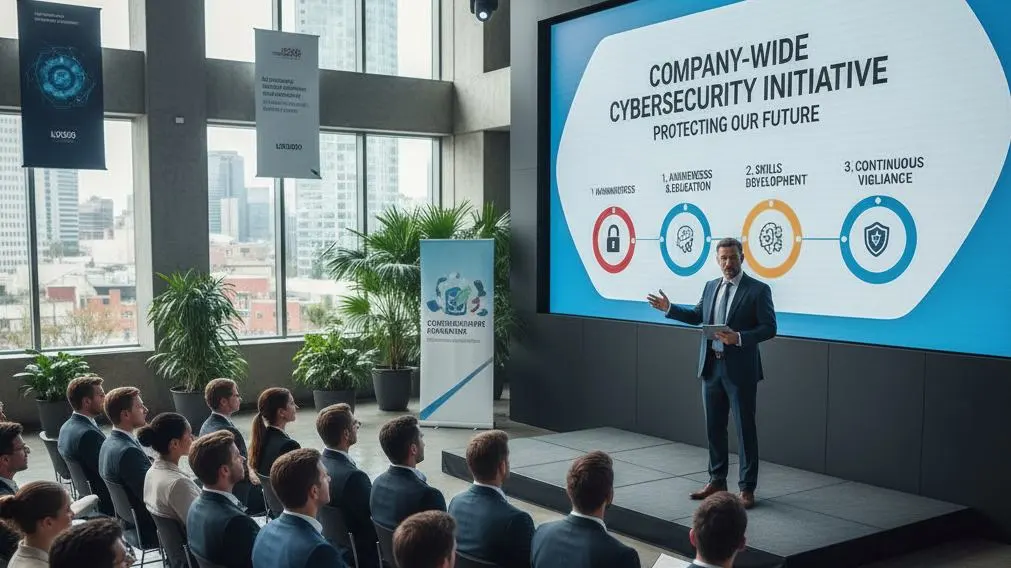
A successful program is an ongoing initiative, not a one-off project. To create lasting change and build a true security-first culture, organisations must focus on continuous improvement and engagement.
The journey begins with a needs assessment to identify your organisation's unique risks. From there, you can develop customised content and select a delivery method—such as flexible online cybersecurity training modules, interactive workshops, or a blended approach. Once launched, the key to success lies in persistence:
As work models evolve, so must your training. With many Canadian companies embracing remote and hybrid work, cybersecurity awareness programs must address the unique challenges of a distributed workforce, such as securing home networks and mobile devices. Looking ahead, technologies like AI-driven adaptive learning will further personalise training, making it even more effective at turning every employee into a capable defender of the organisation’s digital assets.

Get Unlimited access to ALL the LIVE Instructor-led Microsoft courses you want - all for the price of less than one course.