



Basket
{{item.CourseTitle}}
Price: {{item.ItemPriceExVatFormatted}} {{item.Currency}}
Browse by Topic
Browse by Vendor

Unlimited Training
Attend all the top-notch LIVE Instructor-led Courses you want for the price of less than one course.

In the American technology sector, the rise of cloud computing has fundamentally altered the professional landscape. At the forefront of this evolution is Microsoft Azure, a powerful public cloud platform used by organizations of every size. For any IT professional looking to advance, gaining proficiency in Azure is no longer a suggestion—it’s a career imperative. This is precisely where a strategic approach to the Microsoft Azure certification journey becomes essential.
Earning a credential like the Microsoft Certified: Azure Fundamentals is more than a simple resume enhancement. These certifications serve as formal proof of your technical knowledge and ability to handle specific cloud-related tasks. Obtaining the right certification can unlock new career opportunities in high-demand fields and assures employers that you possess the necessary skills to navigate real-world cloud environments successfully.
Microsoft has designed a clear progression, moving from foundational concepts to specialized and expert-level skills. This guide provides a strategic roadmap to help you navigate this path, from understanding the core structure to realizing the significant career advantages that await.
Microsoft has evolved its certification program from product-centric exams to a modern, role-based model. This critical change ensures that each certification aligns directly with real-world job functions. The daily tasks of a cloud administrator, for instance, are vastly different from those of a data scientist or an AI engineer. The Azure certification structure reflects these practical distinctions.
This framework is organized around key professional domains, including:
This alignment means that a certified professional is demonstrably job-ready for their designated role, a fact highly prized by hiring managers who need to guarantee a baseline of relevant skills. As the cloud industry changes rapidly, Microsoft keeps its certifications current with regular updates. This ensures that credential holders are always equipped with knowledge of the latest Azure services and best practices, making these certifications a durable asset throughout your career.
The Azure certification hierarchy is designed to accommodate everyone, from those new to the cloud to seasoned experts managing vast enterprise systems. It is divided into four primary tiers, each serving a specific purpose.
Microsoft’s role-based strategy is centered on creating defined learning paths that match common job titles. By aligning credentials with roles like Administrator or Developer, the system streamlines professional development and boosts the career impact of each certification.
These three roles represent the core functions of most organizations leveraging Azure. Each requires a unique skill set validated by a specific certification.
As cloud adoption matures, specialized roles have become increasingly critical. These certification paths cater to the fast-growing domains of data analytics, machine learning, and cybersecurity.
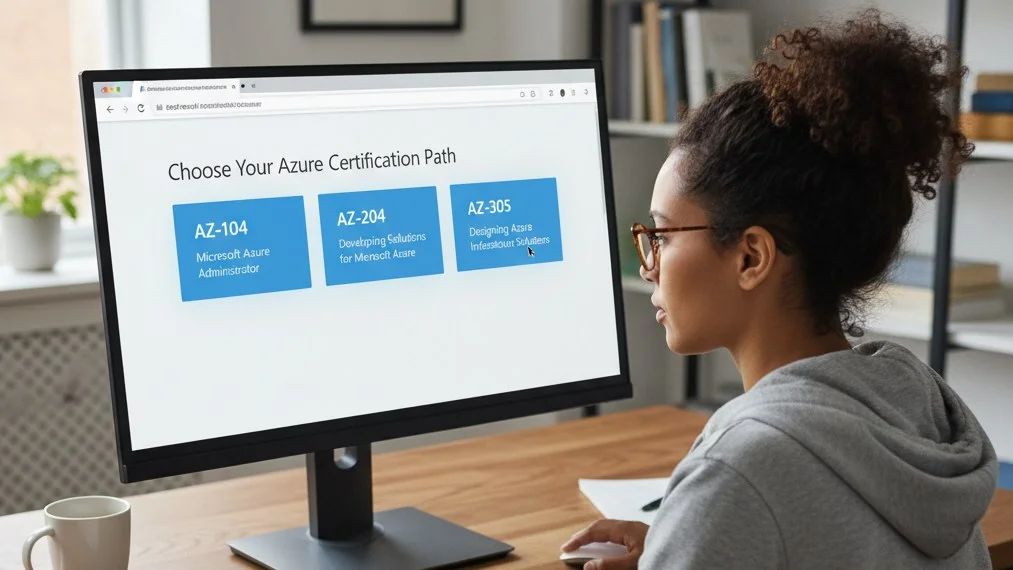
Choosing the correct Azure cloud certification path begins with a clear assessment of your career goals and current experience level. It is a strategic journey, not a race.
For nearly everyone, the recommended starting point is the Azure fundamentals course and the AZ-900 exam. This provides a baseline understanding of cloud terminology and the Azure platform, which is an invaluable prerequisite before tackling more complex, job-specific material. Once you have that foundation, your path will diverge based on your career interests:
To prepare, start with the official Microsoft Learn study guides, which are free and map directly to exam objectives. Crucially, complement this with hands-on practice. An Azure Free Account and online labs allow you to apply concepts without risk. To maintain your credentials, Microsoft requires an annual renewal for most Associate, Expert, and Specialty certifications. This is a free online assessment that ensures your skills remain current. The foundational Microsoft Certified: Azure Fundamentals, however, does not require renewal.
The long-term advantages of earning Azure certifications are significant. In the competitive job market, they are often tied to higher salaries and are frequently a prerequisite for senior cloud positions. For organizations, having a certified workforce means they can undertake ambitious cloud transformations with confidence, knowing their team is equipped to build secure, scalable, and economical solutions.
Ultimately, the investment you make in pursuing credentials from the Azure Fundamentals certification to Expert level pays lasting dividends, helping you construct a resilient and future-proof career in the ever-evolving world of technology.

Get Unlimited access to ALL the LIVE Instructor-led Microsoft courses you want - all for the price of less than one course.