



Basket
{{item.CourseTitle}}
Price: {{item.ItemPriceExVatFormatted}} {{item.Currency}}
Browse by Topic
Browse by Vendor

Unlimited Training
Attend all the top-notch LIVE Instructor-led Courses you want for the price of less than one course.

In today's fast-paced business environment, organizations are under constant pressure to innovate, automate processes, and launch applications with unprecedented speed. Microsoft’s Power Platform has emerged as a critical driver for this transformation, enabling companies to develop powerful solutions with minimal coding. For professionals looking to validate their expertise on this platform, a key decision looms: choosing between the PL-200 (Power Platform Functional Consultant Associate) and the PL-400 (Power Platform Developer Associate) certifications.
This guide offers a new perspective. Instead of just listing features, we’ll help you determine which certification aligns with your career ambitions and existing skill set. Are you destined to be the strategic link between business needs and technology, or are you the developer who builds the advanced components that power it all?
Microsoft has structured its certification path to recognize two distinct but equally vital professional profiles within the Power Platform world. The PL-200 and PL-400 are both associate-level credentials, but they cater to different expert archetypes.
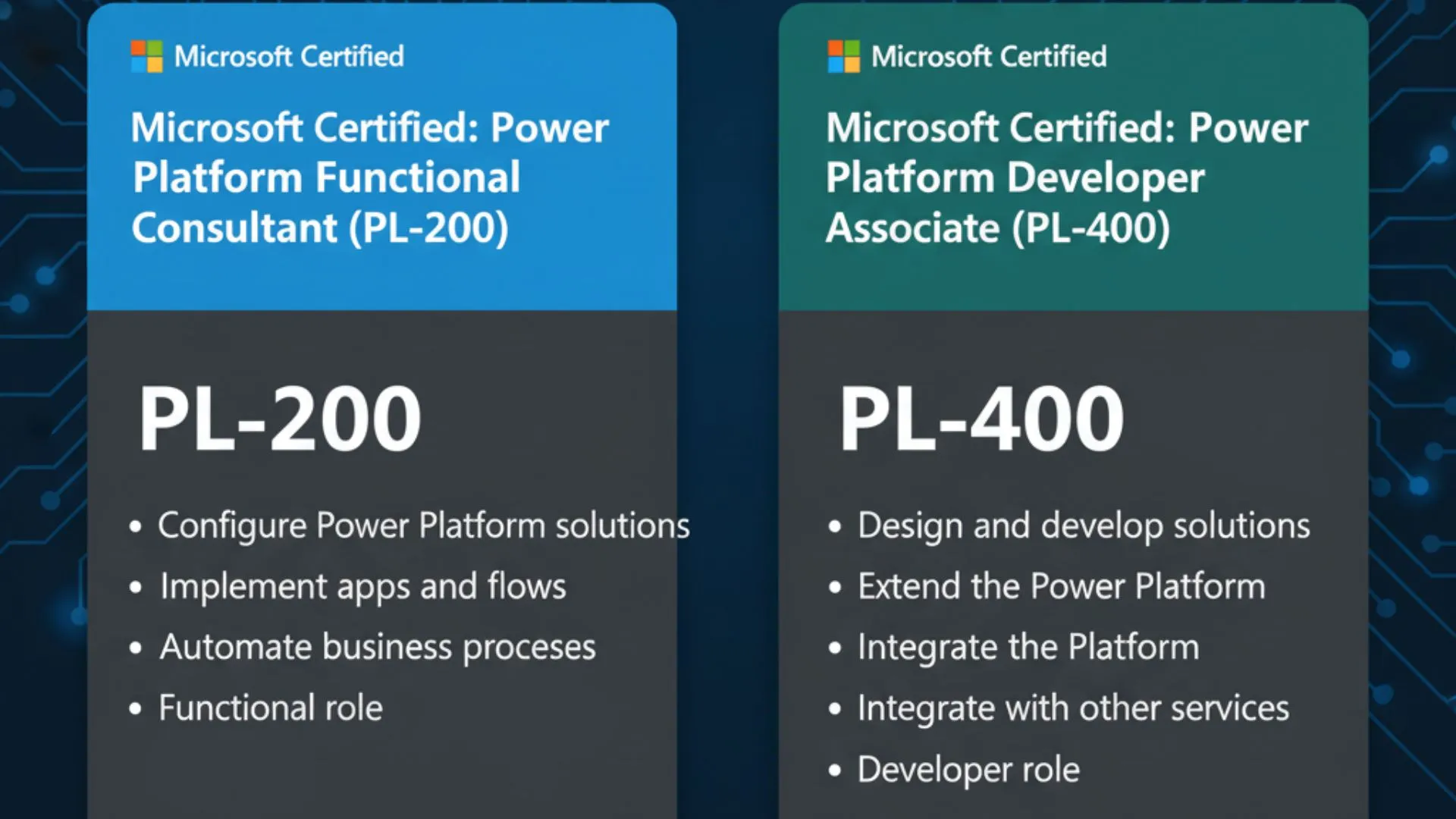
The PL-200 Functional Consultant is a business-facing problem solver. This individual excels at understanding organizational challenges and translating them into effective solutions using the out-of-the-box capabilities of the platform. They are the bridge between a business vision and a functional reality.
In contrast, the PL-400 Developer is a technical specialist who extends the platform beyond its standard features. This role involves writing code, creating custom connectors, and building sophisticated integrations to handle complex requirements. These two certifications represent two different but complementary philosophies of using the Power Platform.
The PL-200 certification is designed for professionals who orchestrate solutions. As a Power Platform Functional Consultant, your primary responsibility is to configure and implement applications that address specific business needs. The exam validates your skills across the platform’s major components.
You will need a deep understanding of Dataverse, the foundational data service, as well as proficiency in building applications with Power Apps and designing automation with Power Automate. The curriculum also includes creating conversational bots using Power Virtual Agents to streamline user interactions. The emphasis is squarely on leveraging the platform's low-code features to deliver value without extensive programming.
This certification proves you can effectively gather stakeholder requirements, architect a cohesive design, and manage the deployment of a solution. It’s about being a trusted advisor who can transform a business need into a practical tool, all while working within the platform's standard framework.
Where the PL-200 focuses on using existing tools, the PL-400 is for those who create new ones. This certification is for developers who push the boundaries of the Power Platform. It centers on your ability to extend the platform’s capabilities through custom code and advanced integrations.
To succeed, you must be proficient in programming languages like JavaScript and C#, understand how to work with APIs, and have experience integrating with other services, including those in Microsoft Azure. The PL-400 curriculum dives into technical tasks like creating custom plugins to enforce complex business logic in Dataverse or building custom connectors to link Power Apps with proprietary systems.
A developer’s role is to construct the high-performance engine that drives the platform. They tackle challenges that low-code solutions cannot solve alone. For instance, while a functional consultant might configure a business process flow, a PL-400 certified developer would write a custom script to perform an intricate data validation against an external database.
While some overlap exists—both certifications require a baseline knowledge of Dataverse and solution management—their focus is fundamentally different. The PL-200 exam tests your configuration and implementation skills, while the PL-400 is a test of your coding and development prowess.
Your choice should be guided by your background and career goals. The PL-200 is generally considered more accessible, requiring strong logical thinking and business process knowledge but no prior coding experience. This makes it an ideal credential for business analysts, IT managers, and other non-developer roles. The PL 400, however, is a significantly more technical challenge. It demands a solid foundation in software development, including familiarity with C#, client-side scripting, and API consumption. It is one of the more rigorous associate-level exams offered by Microsoft.
Your certification choice directly influences your career path. Earning the PL-200 can open doors to roles such as Power Platform Specialist, Functional Consultant, or Business Analyst. In these positions, you’ll work closely with business units to optimize processes and build transformative low-code solutions.
Achieving the PL-400 sets you on a course for positions like Power Platform Developer, Technical Architect, or Integration Specialist. These roles are deeply technical, involving hands-on coding, systems integration, and solving the most complex architectural puzzles. Both credentials are in high demand, but they prepare you for different professional journeys.
For many professionals, the ultimate goal is to obtain both certifications. This combination creates a uniquely powerful skill set that is highly sought after in the industry. A professional holding both the PL-200 and PL-400 can bridge the entire gap between business strategy and deep technical implementation.
A common strategy is to start with the PL-200 to build a strong functional understanding of the platform and its business applications. With that foundation, you can then tackle the PL-400 to add development skills to your repertoire. An individual with both credentials can lead a project from initial client conversations all the way through to the delivery of a complex, custom-coded solution, making them an invaluable asset to any organization.

Success on either exam requires dedication and practical experience. Microsoft Learn provides excellent free learning paths for both. The most critical study tool is a hands-on trial environment where you can build, experiment, and troubleshoot.
The decision between PL-200 and PL-400 is a personal one, rooted in your career aspirations. The PL-200 is tailor-made for business-oriented professionals who excel at translating needs into functional low-code solutions. The PL-400 is the benchmark for developers who possess the technical depth to customize and extend the platform with code.
Whichever direction you take, earning a Power Platform certification is a powerful statement about your commitment to professional growth. It validates your skills in a technology that is fundamentally reshaping how modern organizations operate. Whether you are a low-code innovator or a pro-code developer, the right certification will accelerate your journey to success.
Are you prepared to take the next step in your Power Platform career? Our portfolio of Microsoft courses provides the expert-led training you need to succeed. We offer comprehensive materials, including practice exams, to ensure you are fully prepared for every aspect of the test. Secure your future and achieve certification with confidence. Explore our course catalog today and begin your path to becoming a certified professional.

Get Unlimited access to ALL the LIVE Instructor-led Microsoft courses you want - all for the price of less than one course.