





Basket
{{item.CourseTitle}}
Price: {{item.ItemPriceExVatFormatted}} {{item.Currency}}
Browse by Topic
Browse by Vendor

Unlimited Training
Attend all the top-notch LIVE Instructor-led Courses you want for the price of less than one course.

Navigating a career in cloud data services can feel like charting a course through a vast new territory. For professionals leveraging Microsoft Azure, two key credentials mark critical milestones on this journey: the DP-203 for Data Engineering and the DP-300 for Database Administration. While both are highly respected, they represent distinct specializations.
Your choice isn't just about passing an exam; it’s about aligning your skills with a specific career trajectory. Are you passionate about building massive data processing systems from the ground up, or are you driven to ensure those systems run with flawless performance and security? This guide will help you map your professional goals to the right Azure certification.
Microsoft structures its associate-level certifications around specific, real-world job functions. Data engineering and database administration represent two fundamental pillars of any data-driven organization. The DP-203 and DP-300 certifications are designed to validate expertise in one of these two domains.
The DP-203 certification focuses on the creation and implementation of data solutions. Think of this as the architectural and construction side of data. In contrast, the DP-300 credential centers on the operational management and maintenance of cloud-based relational databases. Microsoft’s decision to separate these certifications reflects the growing specialization within the data field, allowing professionals to signal deep expertise in either building or managing data infrastructure.
The DP-203 exam is your pathway to validating your skills as a data architect and builder. It rigorously tests your ability to design and implement comprehensive data solutions within the Azure ecosystem. Core competencies include designing data storage structures, creating data processing pipelines for both batch and real-time streams, ensuring data security, and optimizing data workflows for efficiency.
This certification is tailored for data professionals who are comfortable with code and enjoy constructing complex systems. If your passion lies in using tools like Azure Data Factory or Databricks to build scalable data platforms, or if you have a background in software development or data science, the DP-203 is a natural fit. It certifies your ability to manage large-scale data engineering projects from conception to deployment.
If the DP-203 is for the builders, the DP-300 is for the guardians of the data. The exam, which typically contains 40-60 questions, concentrates on the administration of relational databases on the Azure platform. It is designed for database administrators (DBAs) and IT professionals who want to apply their expertise to the cloud.
Key skills validated by the DP-300 certification include configuring SQL databases for optimal performance, automating administrative tasks, implementing robust security and compliance measures, planning and configuring high availability, and managing hybrid data platforms that span on-premises and cloud environments. If you have a background working with SQL Server or Azure SQL Database, this certification directly aligns with your experience. It proves you have the skills to keep an organization's most critical data assets secure, available, and performant.
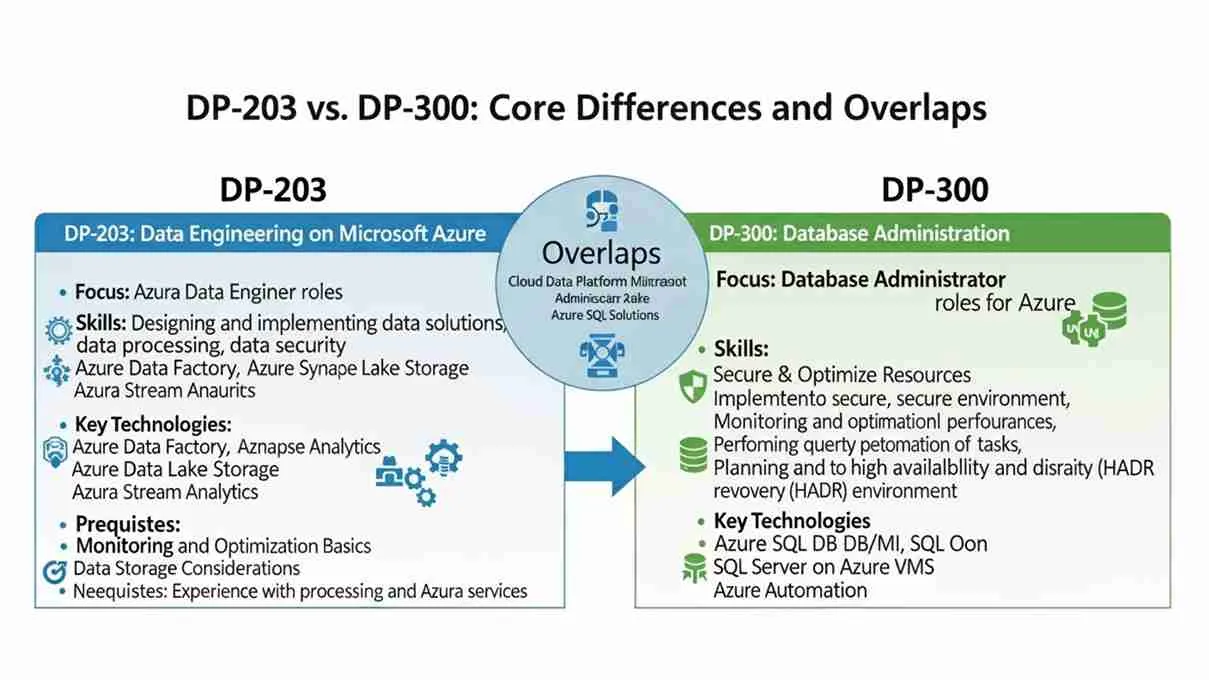
While these two certifications chart different career courses, they serve complementary functions. The DP-203 focuses on constructing data pipelines and architectures, such as setting up ETL processes and managing data lakes. The DP-300 is concerned with the ongoing health and performance of the databases where data is stored and accessed. However, they share foundational concerns around data security, performance optimization, and system scalability, which are critical in any modern data role.
The exams reflect these differing focuses. The DP-203 includes case studies and solution-design scenarios, while the DP-300 is more centered on practical SQL-based tasks like configuring high availability or resolving performance bottlenecks. Both are considered moderately difficult, but the required background knowledge is distinct.
For the DP-203 path, a strong foundation in a language like Python or Scala is highly recommended, along with hands-on experience in Azure data services like Data Factory, Databricks, and Synapse Analytics. This track leads to data-centric development roles.
A DP-203 certification opens doors to high-demand roles like Data Engineer, where you will build and maintain the data pipelines essential for analytics. You could also pursue a position as a Data Architect, designing scalable systems that integrate storage, processing, and analytics, or as a Big Data Developer, leveraging Azure's powerful tools to build robust data applications.
The DP-300 track, conversely, demands deep expertise in SQL and database management principles. Experience with SQL Server, Azure SQL Database, and concepts like backups, recovery, and security are essential. This is the ideal path for existing DBAs or systems administrators transitioning to cloud-focused roles.
With a DP-300 certification, you can target roles such as Database Administrator, overseeing database performance and security, or Cloud DBA, where you'll design and manage scalable database solutions in Azure. Another valuable role is Azure SQL Specialist, focusing on advanced implementation and management of Azure SQL databases, often in environments with strict compliance needs like those governed by HIPAA.
Choosing between DP-203 and DP-300 depends entirely on your existing skill set and your ultimate career ambition.
Many senior professionals ultimately earn both certifications to develop a comprehensive understanding of the entire data lifecycle. A data engineer with DP-300 knowledge can build more database-aware solutions, while a DBA with a DP-203 background can better support the data engineering teams. Begin with the certification that best aligns with your current role and immediate career goals.

Success on either exam requires a combination of theoretical knowledge and practical, hands-on experience. Microsoft Learn provides excellent free learning paths for both DP-203 and DP-300, but real-world practice on the Azure platform is non-negotiable.
To succeed with DP-203, focus your efforts on developing strong coding skills in Python or Scala. Next, gain practical experience building Extract, Transform, Load (ETL) pipelines with Azure Data Factory and Azure Synapse Analytics. Create hands-on projects involving Azure Data Lake Storage to understand data organization and partitioning. Use Azure Databricks to work with Apache Spark and Delta Lake. Finally, use reputable practice tests from providers like Whizlabs or Udemy to get familiar with the exam format, which includes case studies and design questions.
For the DP-300 exam, your preparation should be rooted in SQL mastery. Practice writing complex queries and focus on performance tuning techniques like indexing. Get hands-on with the Azure portal or CLI to deploy and configure Azure SQL Database instances, paying close attention to security settings. Use an Azure free account to run drills on high-availability configurations, backup and restore procedures, and performance monitoring. Scenario-based practice questions are crucial for this exam, as they test your real-world troubleshooting and optimization abilities.
Be wary of "exam dumps," which are often inaccurate and outdated. True readiness comes from applying your knowledge in a live Azure environment.
Both the DP-203 and DP-300 certifications are incredible assets for anyone serious about a career in data. They are not competing credentials but complementary specializations. The key is to select the one that aligns with your current skills and future aspirations. If you are a builder at heart, start your journey with DP-203. If you are a guardian of systems and data integrity, begin with DP-300.
While a certification is a powerful validator, your expertise truly shines through hands-on projects and continuous learning. Dive into the Azure platform, experiment with its services, and start building the skills for your future. The path you choose today is the first step on a rewarding career journey.

Get Unlimited access to ALL the LIVE Instructor-led Microsoft courses you want - all for the price of less than one course.