





Basket
{{item.CourseTitle}}
Price: {{item.ItemPriceExVatFormatted}} {{item.Currency}}
Browse by Topic
Browse by Vendor

Unlimited Training
Attend all the top-notch LIVE Instructor-led Courses you want for the price of less than one course.

In today's tech-driven economy, the ability to leverage data is paramount. This has given rise to two pivotal and often confused professions: data science and data engineering. While both are critical for turning raw data into business value, they represent fundamentally different approaches and skill sets. For those looking to enter this lucrative field, understanding the distinction between a data engineer and a data scientist is the first step toward a successful career.
Are you a builder who loves designing robust systems, or are you an investigator who enjoys uncovering hidden narratives within complex datasets? Think of it this way: data engineers are the farmers who design, build, and manage the irrigation systems to grow and harvest crops (data). Data scientists are the chefs who then take those raw ingredients and creatively transform them into a gourmet meal (actionable insights). Both are essential for a five-star dining experience, but their daily tasks and tools are worlds apart.
Making the right choice early on can significantly impact your career trajectory and earning potential. Professional certifications are essential in this process, offering a clear roadmap for acquiring necessary skills and validating your expertise to employers. This guide will help you align your personal interests and abilities with the right certification path for a data-focused career.
The best way to decide between these two career paths is to understand your own professional inclinations. Which set of challenges and responsibilities excites you more?
You might be a future data engineer if:
You are likely a future data scientist if:
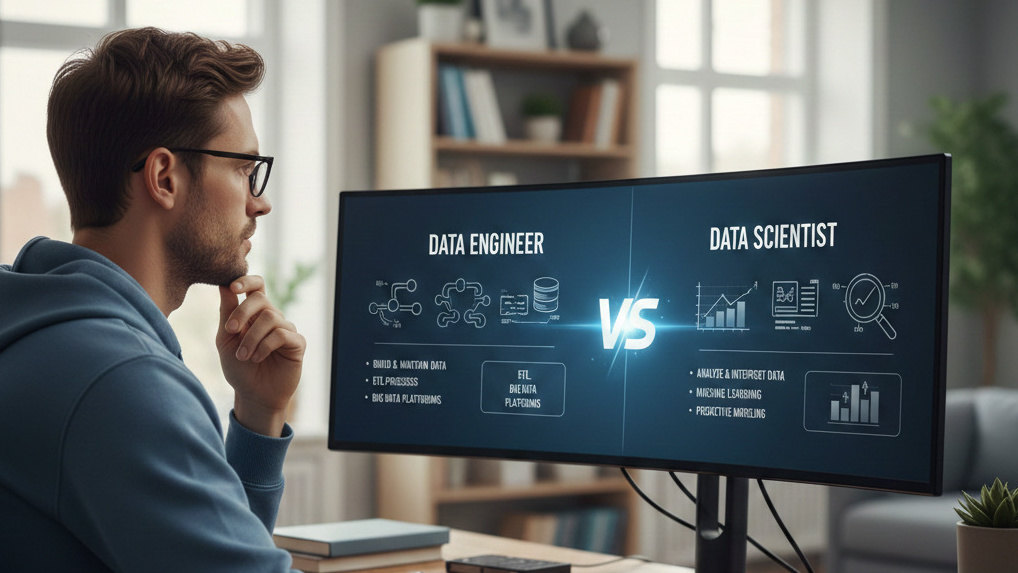
To make an informed decision, it's crucial to understand the day-to-day realities of each role. While they are collaborators on data projects, their core functions are distinct.
Data engineers are the architects and construction crew of the data world. Their primary skill is designing, building, and maintaining the infrastructure that allows data to be collected, stored, and prepared for use. They are specialized software developers focused on data pipelines and warehousing. Their main responsibilities include:
Once the data infrastructure is in place, the data scientist steps in to conduct experiments and find meaning. Their job is to analyze the prepared data to extract insights that drive strategic business decisions. They are a unique mix of mathematician, computer scientist, and business consultant. Their focus involves:
In these highly technical fields, certifications offer tangible proof of your skills. Employers across the United States look for these credentials as verification that a candidate is job-ready.
For Aspiring Data Engineers: A data engineer certification demonstrates your ability to manage the data lifecycle on a specific platform. Highly respected options include:
For Aspiring Data Scientists: A data scientist certification proves your capability in analysis, modeling, and machine learning. Popular credentials are:
Both data engineering and data science offer outstanding growth potential and lucrative salaries, but their career ladders have different rungs.
Ultimately, choosing a path isn't a lifelong commitment. The lines between these roles are blurring, and many professionals develop a "T-shaped" skill set: deep expertise in one domain and broad knowledge of the other. An engineer might learn more about machine learning to better serve their scientist colleagues, or a scientist might pick up cloud architecture skills to deploy their own models. This versatility makes you an invaluable asset to any data-driven organization.
Whether you choose to build the systems or interpret the stories they hold, your journey begins with a single step. Select a foundational certification that aligns with your passion, master the material, and you'll be well on your way to a thriving career in the digital economy.

Get Unlimited access to ALL the LIVE Instructor-led Microsoft courses you want - all for the price of less than one course.