





Basket
{{item.CourseTitle}}
Price: {{item.ItemPriceExVatFormatted}} {{item.Currency}}
Browse by Topic
Browse by Vendor

Unlimited Training
Attend all the top-notch LIVE Instructor-led Courses you want for the price of less than one course.

In our hyper-connected economy, technology is the engine of business, but it also creates a complex web of risks. From potential data breaches and system outages to navigating stringent regulations like HIPAA or NIST frameworks, organizations face constant threats. To counter these challenges, companies require professionals with specialized skills in technology, security, and risk governance. This is the precise arena where ISACA certifications excel, offering a globally respected standard for IT professionals. Among its premier credentials, the CISA, CRISC, and CISM certifications stand out.
These credentials are far more than resume builders; they signify a deep-seated expertise and a commitment to proven methodologies. They empower professionals to develop the critical competencies needed to oversee a modern technology ecosystem. While CISA hones skills in IT auditing and assurance, CRISC centers on the strategic management of IT risk, and CISM prepares individuals to spearhead comprehensive information security programs.
Ultimately, a team fortified with these skills is what forges a "risk-ready" enterprise—an organization capable of not just identifying threats but also possessing the talent, structure, and processes to proactively manage them. As businesses accelerate their adoption of AI and cloud computing, the imperative for such readiness has never been more urgent. Professionals holding these certifications are the architects of secure and sustainable innovation.
To build a resilient organization, leaders must first diagnose their specific needs. ISACA’s core certifications address distinct but related challenges in the realms of audit, risk, and security. Understanding which credential maps to your pain points is key to making the right hiring or training investment.
While each certification has a unique focus, they collectively represent the full lifecycle of IT governance, from assessment and mitigation to overarching strategy.
Let's explore the specific domains and career paths associated with each certification. Though distinct, they often create a powerful career trajectory, with many professionals holding more than one to broaden their expertise.
|
Certification |
Primary Focus |
Common Job Titles |
|
CISA |
IT Audit, Assurance, and Control Verification |
IT Audit Manager, Compliance Officer, Information Security Analyst |
|
CRISC |
IT Risk Identification, Assessment, and Mitigation |
IT Risk Manager, Operational Risk Officer, Business Analyst |
|
CISM |
Information Security Program Management and Governance |
Information Security Manager, Security Director, Chief Information Security Officer (CISO) |
The CISA certification is globally recognized as the benchmark for professionals in IT audit and assurance. A CISA holder is trained to provide objective feedback to leadership on the state of IT controls, which is fundamental for good governance. Their expertise covers five job practice domains, including the process of auditing, IT governance, systems acquisition and development, IT operations, and the protection of information assets. By performing risk-based audits, they help organizations focus resources on the most critical areas and identify control weaknesses before they can be exploited.
The ISACA CRISC credential equips professionals to act as the crucial link between IT operations and executive leadership. Their work revolves around a four-part lifecycle: identifying risks, assessing their potential impact, crafting a response, and monitoring controls. This ensures that business decisions, like migrating to a new cloud platform, are made with a full understanding of the associated risks. A holder of this enterprise risk management certification quantifies threats in business terms, enabling prioritized investments that deliver a clear return on investment.
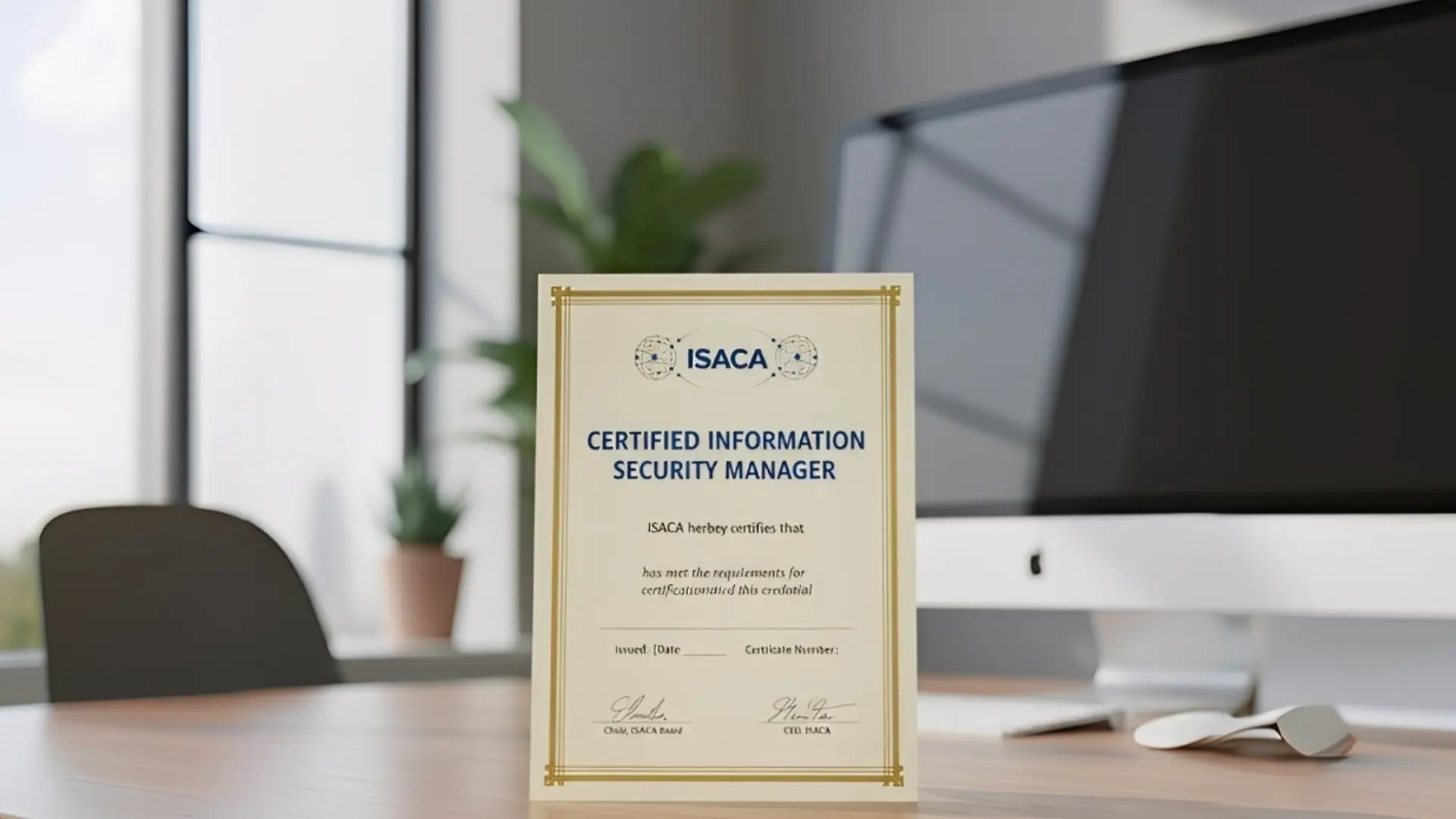 While CISA audits what exists and CRISC manages potential threats, the ISACA CISM professional directs the entire security program. This is a leadership-focused cybersecurity management certification that validates an individual's ability to build and run an information security strategy that supports business goals. The CISM curriculum focuses on four key areas: Information Security Governance, Information Risk Management, Program Development, and Incident Management. Holding this credential signals readiness to not only manage security tools but also establish governance, secure funding, and report meaningful metrics to the board.
Imagine a U.S.-based SaaS company planning to integrate a new AI-driven analytics feature that processes sensitive customer data. This single initiative triggers the need for all three ISACA skill sets.
Investing in ISACA-certified personnel delivers compounding returns. For the organization, it builds a more defensible and compliant security posture. For the individual, it opens doors to career advancement and leadership roles.
Firms with these professionals demonstrate a mature approach to risk, which can be a key differentiator. For example, technology companies rely on CISM leaders to build security programs that can scale with rapid growth, while financial institutions use CISA and CRISC teams to navigate the heavily regulated banking landscape. Government agencies often require the ISACA CISA for roles involving the integrity of public systems. This demand translates into tangible benefits for certified individuals, including enhanced employability, higher salary potential, and a clear pathway to senior management positions in risk, audit, and security.
 The risk landscape is not static. The rise of sophisticated cyber threats, tightening regulatory pressures, and the continuous push of digital transformation mean that the expertise validated by ISACA credentials will only become more essential.
The structured knowledge base of these certifications provides the framework needed to manage emerging technologies and threats. The roles of these professionals will continue to evolve strategically:
In short, as long as technology advances, the need for qualified professionals to audit, manage, and lead its secure implementation will grow. The ISACA CISA, CRISC, and CISM certifications provide a clear, proven path to developing and validating that competence, creating a foundation for a truly risk-ready organization.

Get Unlimited access to ALL the LIVE Instructor-led Microsoft courses you want - all for the price of less than one course.