





Basket
{{item.CourseTitle}}
Price: {{item.ItemPriceExVatFormatted}} {{item.Currency}}
Browse by Topic
Browse by Vendor

Unlimited Training
Attend all the top-notch LIVE Instructor-led Courses you want for the price of less than one course.

In today's interconnected economy, reliance on digital systems is total. Unfortunately, this universal dependence also creates significant vulnerabilities for cyber criminals to exploit. The critical importance of robust security is no longer up for debate; organizations of all sizes face a daily barrage of evolving threats that endanger their data, financial stability, and the trust they've built with customers. The reality is that no business is immune to these risks.
While technical safeguards like firewalls and antivirus software are fundamental, they are incomplete. The most frequently exploited vulnerability in any security framework is human behavior. This is precisely why cybersecurity training for employees is not just beneficial, but absolutely essential. A single employee misstep, such as clicking a malicious link in a phishing email, can circumvent millions of dollars in technology investments. This stark fact highlights the need to shift from a purely reactive security posture to a proactively resilient one.
An educated workforce becomes your first and most effective line of defense. When employees are trained to identify and respond to threats appropriately, they transition from being a potential liability to a powerful security asset. This article provides a strategic guide to creating a "human firewall." We will explore how to structure training, differentiate programs for various roles, and realize the tangible benefits of prioritizing human-centric security in your risk management strategy.
The global cyber threat environment is more sophisticated and hostile than ever before. Cybercrime has matured into a multi-billion-dollar industry driven by organized syndicates that constantly refine their attack methods. While major data breaches make headlines, countless smaller-scale attacks compromise local businesses every day, proving that no organization is too small to be targeted. Effective employee security awareness training is the critical factor in defending against these threats.
Pervasive dangers like phishing remain one of the most effective attack vectors because they exploit human psychology. Attackers use carefully crafted messages that mimic legitimate communications to trick an employee into divulging credentials or deploying malware. Ransomware presents another severe threat, capable of encrypting a company's entire data infrastructure and holding it hostage for a substantial ransom, bringing operations to a standstill.
It’s also crucial to recognize that threats aren’t always external. Whether malicious or purely accidental, insider threats from current or former employees with system access can be just as devastating.
The business impact of these risks is profound, affecting both finances and reputation. A successful breach can trigger:
Beyond the immediate financial damage, the harm to a company's reputation can be severe and long-lasting. When sensitive client information is compromised, trust evaporates, and rebuilding that goodwill can take years. This is why a well-informed staff is a non-negotiable component of a proactive defense. By equipping employees with the right knowledge, you transform their behavior, turning them into active defenders rather than potential victims. Effective cybersecurity training for employees directly addresses and mitigates the human factors that cyber criminals are so adept at exploiting.
Establishing a security-conscious culture requires more than an annual presentation; it necessitates a dynamic and continuous information security awareness training program. A successful program must be engaging, practical, and directly relevant to an employee's daily responsibilities.
Several key topics form the foundation of a strong curriculum. Phishing simulations are invaluable for testing employees' ability to spot and report suspicious emails within a controlled environment. The data gathered from these tests helps identify individuals or departments needing more focused coaching. Instruction on password hygiene is another cornerstone, covering the creation of strong, unique passphrases, the use of password managers, and the absolute necessity of multi-factor authentication (MFA). Furthermore, a critical part of training employees on cybersecurity involves establishing clear incident reporting procedures. Every employee must know exactly who to notify and what details to provide the moment a security issue is suspected, as speed is crucial to minimizing potential damage.
Customizing training content for different job functions is essential for effectiveness. A generic, one-size-fits-all approach rarely works. Sales teams, for example, might need specific training on secure communications with clients, while HR personnel require in-depth knowledge of handling sensitive employee data. Developers, in turn, need education focused on secure software development lifecycles. This tailoring ensures the training is applicable and results in better knowledge retention.
In terms of format, a blended approach is often most effective. Online cybersecurity training programs provide flexibility, allowing staff to learn at their own pace and are ideal for deploying foundational knowledge across a large organization. Live instructor-led workshops, whether in-person or virtual, can drive deeper engagement, facilitate discussion, and provide hands-on practice for more complex subjects.
The educational needs across an organization vary significantly. A clear distinction must be made between the training provided to general employees and that designed for specialized IT teams.
For most non-technical staff, the primary goal is building security awareness. The objective is for them to understand common risks and integrate safe behaviors into their daily work. This is the domain of employee security awareness training, which focuses on practical skills like:
For IT teams, training must go deeper to build advanced technical competencies. Their education focuses on implementing, managing, and defending the organization's digital infrastructure. This includes specialized modules on:
Role-based responsibilities clarify these differences. A marketing specialist needs to understand the data privacy risks associated with using third-party analytics tools. A financial analyst must be expert in the policies for encrypting and sharing budget documents. Meanwhile, an IT security administrator must know the precise protocol for patching a critical server vulnerability under a strict deadline. Defining these roles ensures everyone understands their specific security obligations.
Beyond foundational awareness, fostering a culture of continuous improvement often involves professional development through business-focused certifications. This is particularly vital for IT, security, and compliance personnel. Industry-recognized credentials like CompTIA Security+, Certified Information Systems Security Professional (CISSP), and Certified Information Security Manager (CISM) are benchmarks of expertise.
These structured programs serve a critical function by validating skills against established industry standards. An employee who earns a certification has demonstrated a high level of competency in specific security domains. This not only fuels their individual career growth but also significantly elevates the organization's internal expertise. For roles with direct compliance or infrastructure responsibilities, certifications may be a mandatory requirement to ensure the company possesses the necessary skills to navigate complex regulatory and technical challenges.

The advantages of a well-executed program go far beyond technical defense. When you are training employees on cybersecurity, you are making a direct investment in your company's operational stability and longevity.
The most tangible benefit is the reduced likelihood of data breaches and associated financial devastation. With human error being a factor in the vast majority of security incidents, empowering employees with vigilance dramatically lowers the success rate of phishing and malware attacks. This proactive measure can save an organization from the exorbitant costs tied to a full-blown security crisis.
Moreover, a commitment to security enhances company reputation and strengthens client trust. An organization known for prioritizing data protection gains a significant competitive advantage. Customers and partners are more willing to entrust their sensitive information to a business that demonstrates its responsibility through a well-trained workforce. This commitment is a powerful tool for building brand loyalty.
In the United States, the regulatory environment for data privacy and security is intricate and strict. Various federal and state laws impose specific obligations on how organizations must protect information. Key examples include:
Failure to comply can result in severe penalties, including multi-million dollar fines and legal action. Formal, documented security awareness training is a core requirement across nearly all of these frameworks. By implementing and tracking regular cybersecurity training for employees, a business can demonstrate due diligence and prove it has taken "reasonable and appropriate measures" to safeguard data—a crucial defense in the event of a breach. Therefore, effective training is not merely a best practice; it is a legal and operational necessity.
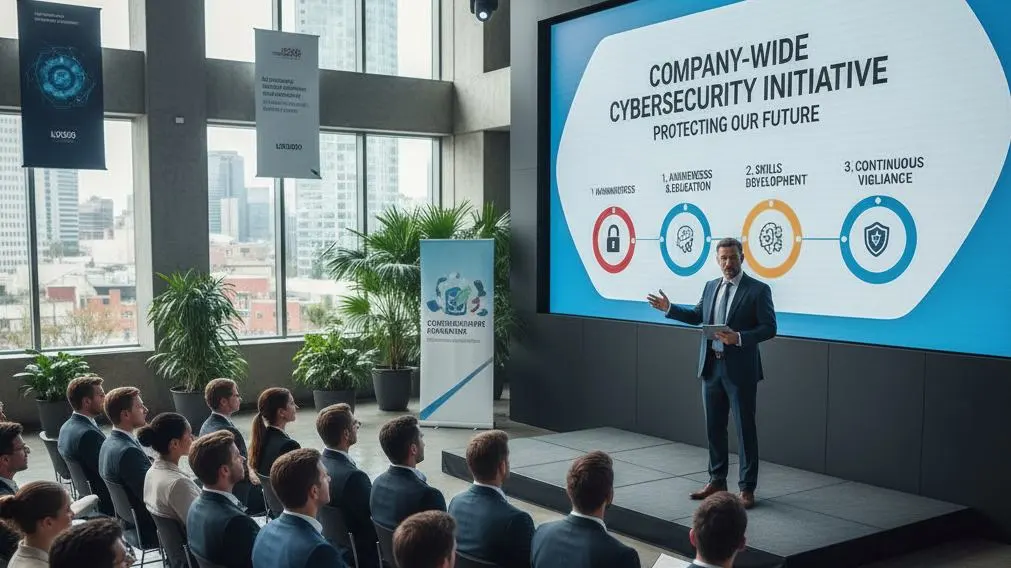
Deploying a successful cybersecurity compliance training program that truly changes behavior requires thoughtful planning and sustained effort. Follow this step-by-step guide to launch an initiative that makes a lasting impact.
Step 1: Conduct a Needs Assessment. Start by identifying the most pressing security risks unique to your organization. Analyze past security incidents, if any, and survey employees to establish a baseline of their current security knowledge. This assessment will guide the focus and content of your training.
Step 2: Develop and Customize Content. Based on your assessment, create or source training material tailored to different roles within your company. Decide on the best mix of delivery methods, such as online modules for foundational concepts and live workshops for interactive, role-specific scenarios. Leveraging online cybersecurity training platforms can streamline this process with built-in tracking and reporting.
Step 3: Launch with Executive Backing. Roll out the program with clear and visible support from senior leadership. Frame the training as a protective measure for both the company and its employees, rather than a punitive chore. C-suite participation sends a powerful message about the program's importance.
Step 4: Measure, Iterate, and Reinforce. Security training is a continuous process, not a one-time event. Corporate cybersecurity training should be conducted annually at a minimum, supported by regular mini-campaigns and updates as new threats arise. Track key metrics like phishing simulation click rates, module completion rates, and quiz scores. Use this data to refine your content and identify areas needing reinforcement.
To maximize engagement, consider these tips:
As cyber threats constantly evolve, so must the cybersecurity awareness programs designed to combat them. Several emerging trends and technologies are set to revolutionize how organizations deliver security education.
Technologies such as Artificial Intelligence (AI) and virtual reality are making training more personalized and immersive. An AI-driven platform can analyze an employee's performance on a phishing test and automatically generate follow-up simulations that target their specific vulnerabilities. Virtual labs create safe, sandboxed environments where staff can practice responding to security incidents without any risk to the live network. This hands-on, active learning is far more effective than traditional lectures.
The widespread shift to remote and hybrid work models has also reshaped the role of enterprise cybersecurity training. With the corporate security perimeter dissolved, training must now put greater emphasis on securing home networks, using VPNs consistently, and being aware of physical security risks like "shoulder surfing" in public spaces. Training must be accessible from anywhere and address the distinct challenges of a distributed workforce.
Looking ahead, the emphasis on the human element of security will only grow stronger. As automated defenses improve, attackers will increasingly focus on social engineering, targeting the path of least resistance: the person at the keyboard. This guarantees that ongoing, adaptive training will remain a cornerstone of any effective security strategy. The future of cybersecurity is a symbiotic one, where intelligent technology and an educated workforce collaborate to create the final and most formidable layer of defense.

Get Unlimited access to ALL the LIVE Instructor-led Microsoft courses you want - all for the price of less than one course.