





Basket
{{item.CourseTitle}}
Price: {{item.ItemPriceExVatFormatted}} {{item.Currency}}
Browse by Topic
Browse by Vendor

Unlimited Training
Attend all the top-notch LIVE Instructor-led Courses you want for the price of less than one course.

In today's competitive business landscape, the "war for talent" is more than a buzzword—it's a significant operational risk. Losing a valued employee drains financial resources, institutional knowledge, and team momentum. Many organizations find themselves caught between driving for results and creating an environment that convinces their best people to stay. This is where strategic investment in certification training emerges as a powerful retention tool.
When an organization commits to funding its employees' professional growth, it communicates a vital message: "We are invested in your career path, not just your immediate productivity." Modern professionals seek more than just compensation; they want opportunities for advancement. If they feel their growth has stalled, they are more likely to seek challenges elsewhere. By offering clear pathways to gain industry-respected credentials through professional development training, a company can build profound loyalty.
What pushes a great employee to start looking for a new job? More often than not, the primary driver is a perceived lack of growth opportunities. When professionals feel they have hit a professional ceiling with no clear route for advancement, their engagement wanes. Employee training programs directly counter this by creating a visible roadmap for progress. Earning a certification does more than update a resume; it formally validates an employee's growing expertise, making them feel like a valued specialist.
This investment cultivates a powerful psychological bond. When a company facilitates an employee becoming a certified project manager or a licensed data scientist, the employee feels a reciprocal sense of commitment to apply these newly acquired skills for the organization's benefit. This dynamic fundamentally lowers turnover, as the prospect of leaving means forfeiting a supportive and career-building ecosystem.
Moreover, these employee training programs are the perfect solution for closing internal skill gaps. Instead of relying on external hires to fill senior positions, organizations can cultivate talent from within. This practice of internal promotion is a major attraction for ambitious individuals. Leading tech companies like Google and Amazon have successfully used internal training academies to build and retain elite teams. They proactively give their staff compelling reasons to envision their future within the company, focusing their ambition on the next internal achievement rather than external job postings.
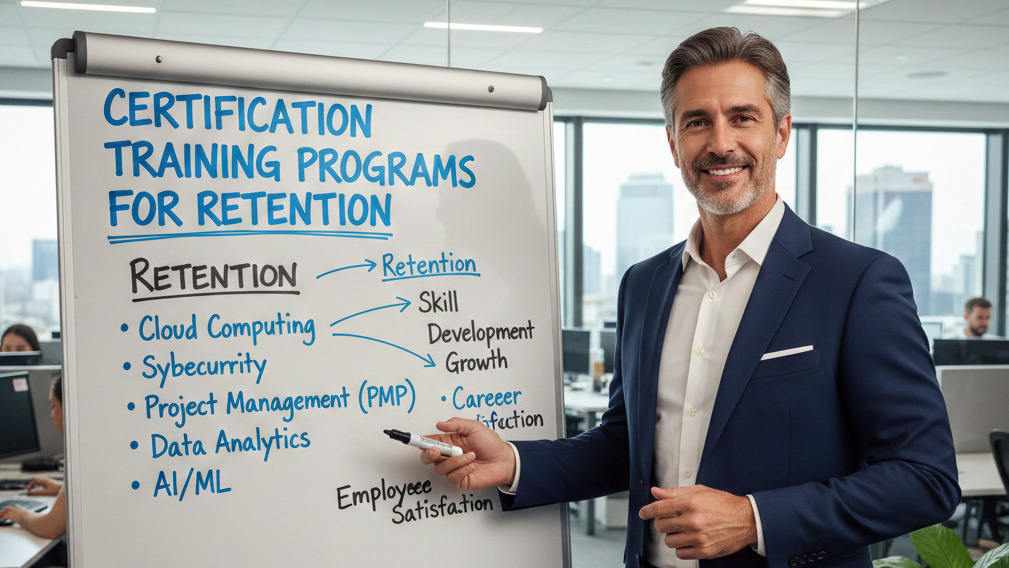
To be an effective retention tool, a program requires more than just access to a course catalog; it demands a thoughtful employee engagement strategy. A poorly planned initiative can backfire, leaving employees feeling that their time is being wasted on irrelevant tasks. Success starts with aligning the offered certifications with both the organization's strategic goals and the individual's career aspirations. For instance, if your company is migrating to a new cloud platform, offering relevant cloud architect certifications is a clear win-win.
The perceived benefits of corporate training become tangible when the program is structured for accessibility and fairness. Leaders must address common hurdles like cost, time, and motivation. While some businesses worry that a newly certified employee might leave, the greater risk lies in retaining a workforce with stagnant skills. To manage this, ensure employees have dedicated time for study, ideally during work hours. Cover all costs associated with exams and materials, and consider rewards like a bonus or salary increase upon completion to celebrate the achievement.
To overcome time constraints, break down learning into manageable micro-lessons. For employees who fear exams, create a supportive culture with study groups and mentorship from colleagues who have already earned the credential. When the process is transparent and encouraging, professional development becomes a celebrated company perk, not an obligation.
A generic, one-size-fits-all approach to training is rarely effective. The skill requirements for a junior marketing coordinator are vastly different from those of a senior IT director. Effective workforce certification programs should be tiered to meet employees where they are:
Personalizing these learning journeys demonstrates a profound respect for the individual. When a manager collaborates with an employee to map out a custom certification journey, it builds a foundation of trust and shows that the company is invested in their specific career goals.
How do you confirm that your investment in training is impacting retention? Relying on gut feelings isn't enough; you need data to prove the return on investment of your employee engagement strategy. The most telling metric is a direct comparison of retention rates between employees who have participated in the program and those who have not. If 90% of your certified staff remain with the company for over two years, compared to just 60% of non-certified staff, the program's value is clear.
Other key performance indicators to track include:
By analyzing these figures, an organization can continuously refine its employee engagement strategies to maximize impact. The data below illustrates a typical scenario:
|
Metric |
Before Program |
After Program (Year 1) |
|
Annual Turnover Rate |
25% |
15% |
|
Internal Promotion % |
10% |
35% |
|
Training Satisfaction |
4/10 |
8.5/10 |
|
Average Tenure |
2.1 Years |
3.4 Years |

The nature of work is evolving rapidly, influenced by AI, hybrid work models, and a gig-based economy. In this new landscape, employee retention strategies must be more adaptive than ever. The focus is shifting from occasional training events to a culture of continuous, lifelong learning.
Emerging trends like digital badges and micro-credentials allow employees to showcase their evolving skill sets on professional networks, which in turn enhances the company’s employer brand. When prospective hires see that your team is constantly upskilling, your organization gains a reputation as a center for excellence.
As the shelf-life of technical skills shortens, certification cannot be a one-time event. It must become an ongoing cycle of learning, validation, and application. Ultimately, to build a loyal and capable workforce, you must help your employees become the most skilled and confident versions of themselves. By embedding certification into your company culture as a core part of your employee retention strategy, you build a competitive advantage that is difficult to replicate—a team that feels valued, engaged, and committed for the long term.

Get Unlimited access to ALL the LIVE Instructor-led Microsoft courses you want - all for the price of less than one course.