





Basket
{{item.CourseTitle}}
Price: {{item.ItemPriceExVatFormatted}} {{item.Currency}}
Browse by Topic
Browse by Vendor

Unlimited Training
Attend all the top-notch LIVE Instructor-led Courses you want for the price of less than one course.

In today’s competitive business landscape, the mandate to upskill an entire workforce is no longer a distant goal—it's an urgent operational necessity. As organizations adopt advanced technologies and align with new industry benchmarks, a structured approach to corporate training certification is essential for verifying that thousands of employees possess critical, standardized skills. But the leap from training a single team to certifying a global workforce introduces significant operational hurdles.
Many business leaders find themselves unprepared for the logistical complexity of managing certification programs at an enterprise scale. The primary challenge isn't just the volume of learners; it's maintaining consistency, tracking progress effectively, and preventing engagement from plummeting. Without a cohesive strategy, companies risk fragmented skill development, wasted resources, and high attrition rates. This guide offers a comprehensive framework for designing, deploying, and optimizing a certification program that can successfully scale across your entire organization.
Expanding any educational initiative presents inherent difficulties. When rolling out corporate training certification programs, these challenges are magnified. What works for a team of 20 often breaks down completely when applied to a workforce of 2,000. Issues like inconsistent teaching methods across regions, a lack of centralized progress visibility, and learner disengagement can quickly derail a large-scale program, undermining its potential ROI.
The solution lies in shifting from an instructor-centric model to a systems-based approach. A scalable program functions like an efficient operational process, built on a foundation of standardization, automation, and robust support systems. By treating enterprise learning as a core business function, organizations can overcome these hurdles and ensure every employee receives a consistent, high-quality experience.
A successful enterprise certification initiative requires a deliberate, phased strategy. Rather than launching everything at once, building a scalable framework involves architecting the core components, engineering a delivery system, and fostering a supportive learning environment. This methodical approach ensures sustainability and effectiveness.
The bedrock of any scalable program is consistency. Every employee, regardless of their location—be it in New York or Singapore—must work with the same core curriculum to ensure that a corporate training certification signifies a uniform standard of excellence. This begins with rigorous version control for all study guides, videos, and documentation. Inconsistency is the primary enemy of reliable, large-scale assessment.
Equally critical are uniform assessment criteria. To protect the credibility of the certification, the performance bar must be identical for all participants. Key practices include:
This corporate learning and development strategy moves beyond simple content delivery; it creates a single source of truth for what competence looks like in your organization.
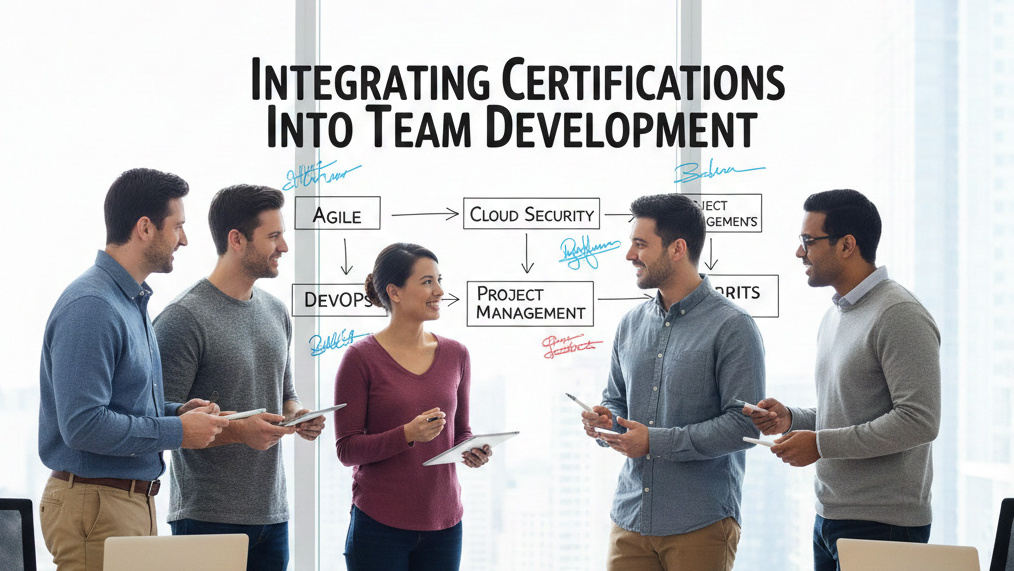
A modern Learning Management System (LMS) is the engine of a large-scale certification initiative. It serves as the central hub for managing corporate training certification online, enabling the instant distribution of materials to a global workforce. More importantly, a powerful LMS provides sophisticated tracking capabilities, allowing program managers to monitor learner progress in real-time and proactively identify potential roadblocks.
Process automation within the LMS is key to reducing the administrative load. Features like automated grading for practice quizzes and the automatic issuance of certificates save enormous amounts of time. Advanced platforms can also leverage AI to create personalized learning paths, recommending content based on an individual’s performance. This ensures that even within a massive cohort, each learner receives targeted support, blending scalability with individual attention.
A common failure point in scaled programs is learner isolation. To counteract this, a proactive communication strategy is vital. A continuous stream of updates, milestone celebrations, and motivational messages helps keep the certification program visible and relevant to employees juggling daily responsibilities. Clear support channels, such as a dedicated help desk or a comprehensive FAQ database, are also crucial for resolving issues quickly and preventing frustration.
Harnessing the power of peer learning is another effective technique. The L&D team cannot provide one-on-one support to everyone, but learners can support each other. Internal community forums, dedicated chat channels, or formal study groups empower employees to answer each other’s questions and share insights. Encouraging mentorship, where certified employees guide their colleagues, transforms individual study into a collaborative team effort, boosting both completion rates and knowledge retention.

To justify and refine your best corporate training certification program, you must measure what matters. Success metrics go far beyond simple completion rates and should be tied to business outcomes. Key Performance Indicators (KPIs) to track include:
Data analytics offer powerful insights for program optimization. If analytics reveal a specific module is a common stumbling block, it signals a need for content revision. This data-driven, iterative approach ensures the program evolves and remains effective over time, adapting to the organization's changing needs.
Even with a solid framework, challenges will arise. Budget limitations are a frequent concern. A pragmatic approach involves a phased rollout, starting with a pilot group to test and refine the process before expanding. This "prove and scale" model minimizes risk and uses resources more effectively.
Learner diversity is another factor. A large workforce will include people with varying backgrounds, skill levels, and native languages. Adaptive learning paths, enabled by technology, can customize the journey, allowing novices to get the support they need while experts can accelerate through familiar topics. This personalization is key for maintaining engagement across the board in corporate training certification.
Finally, securing and maintaining leadership buy-in is non-negotiable for successful corporate learning and development. Active support from management, including allocating protected time for employees to study, is often the deciding factor. By clearly demonstrating the link between certification and tangible business results—such as improved productivity, fewer errors, or faster project delivery—L&D leaders can secure the backing needed for long-term success. As these programs grow, so does the need for skilled professionals in corporate learning and development jobs, from data analysts to instructional designers, who ensure these educational initiatives deliver strategic value.
In conclusion, preparing large teams for certification at scale is a strategic challenge that blends operational planning, robust technology, and human-focused engagement. By creating a standardized curriculum, utilizing a powerful LMS, encouraging a collaborative culture, and continuously measuring results, an organization can transform a daunting task into a powerful engine for building a more skilled, confident, and future-proof workforce.

Get Unlimited access to ALL the LIVE Instructor-led Microsoft courses you want - all for the price of less than one course.