





Basket
{{item.CourseTitle}}
Price: {{item.ItemPriceExVatFormatted}} {{item.Currency}}
Browse by Topic
Browse by Vendor

Unlimited Training
Attend all the top-notch LIVE Instructor-led Courses you want for the price of less than one course.

The transition of healthcare and life sciences to the cloud is creating unprecedented opportunities alongside significant responsibilities. In the past, medical records and vital research data were confined to on-site servers or even filing cabinets. Now, this sensitive information lives in the cloud, a move that accelerates life-saving data analysis, fosters global collaboration, and improves patient care. However, migrating protected health information (PHI) into a cloud environment carries immense risk, making specialized cloud certifications an indispensable asset for today's workforce.
Hospitals, pharmaceutical giants, and biotech startups all encounter unique hurdles as they modernize their infrastructures. They must manage vast and complex datasets while adhering to stringent federal regulations like HIPAA. An individual holding a life sciences certification signals to employers they possess the expert knowledge needed to navigate these intricate systems. These credentials validate a professional's ability to architect, manage, and secure the digital backbone that supports our nation's most private health data.
This guide explores how targeted training programs are closing the knowledge gap between clinical practice and cloud technology. We will investigate the key certifications available and explain why they have become a baseline requirement for anyone pursuing a career in healthcare IT. Whether you are an IT director or a clinical researcher, recognizing the importance of cloud credentials is the foundational step toward building a more secure and innovative future in medicine.
In the medical field, there is no room for mistakes. A server outage or a data breach can have catastrophic consequences, potentially delaying critical medical procedures or exposing a patient's genetic makeup. With such high stakes, the demand for healthcare IT certifications has surged. Organizations need assurance that their personnel can operate effectively within the pressures of a highly regulated American industry.
While the cloud unlocks remarkable advances like remote patient monitoring and AI-powered drug development, these innovations are built on a bedrock of trust. Formal cloud training provides the blueprint for establishing and maintaining that trust. It instructs professionals on how to deploy services from major providers like AWS, Microsoft Azure, and Google Cloud in a manner that fully complies with strict medical and privacy standards. A simple database misconfiguration, for example, could expose sensitive data to the public, leading to severe HIPAA penalties.
Moreover, professionals with advanced cloud training prove they grasp the Shared Responsibility Model, a critical concept where the cloud vendor secures the underlying infrastructure while the healthcare organization is responsible for protecting its own data. Earning these credentials shows a professional is ready to manage this responsibility, especially for computationally intensive tasks in the life sciences like genomic sequencing, which demand powerful and scalable environments. Certified individuals know how to configure these systems for both high performance and cost efficiency.
These certifications are also crucial for career advancement. As the industry shifts away from traditional on-premise data centers, roles for IT staff are evolving. Mastering cloud technologies is no longer a niche skill but a fundamental requirement for leadership at the intersection of technology and biology.
A primary challenge in adopting cloud technology within healthcare is ensuring regulatory compliance. In the United States, the Health Insurance Portability and Accountability Act (HIPAA) sets the national standard for protecting PHI. Professionals pursuing healthcare compliance certifications learn to translate these complex legal frameworks into technical controls within a cloud setting.
This specialized training goes far beyond general IT knowledge, covering essential skills such as:
By mastering compliance, these professionals become invaluable assets who protect their organizations from steep fines and reputational damage.
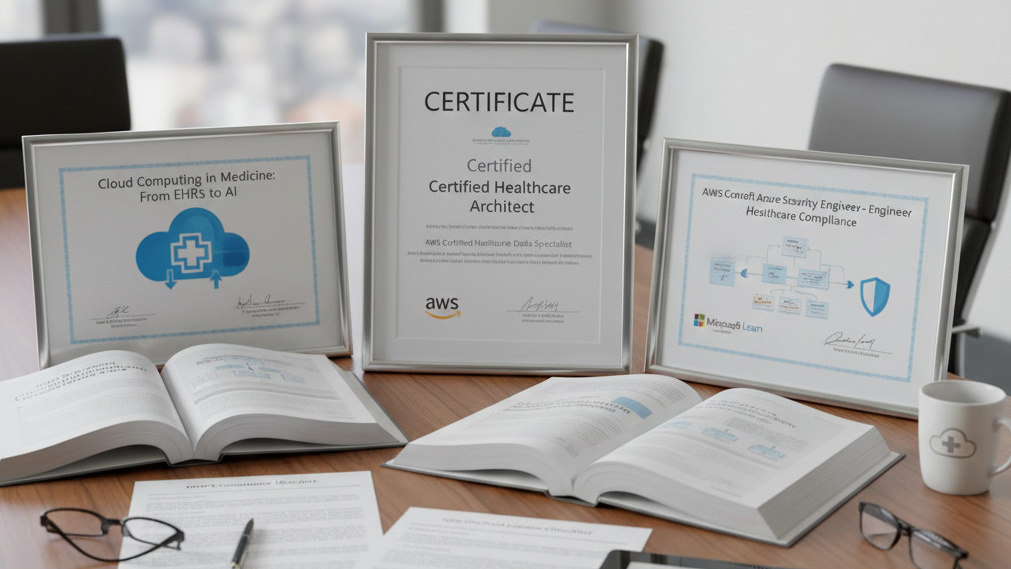
With numerous certifications available, selecting the right educational path can be challenging. For professionals in medical and biological fields, the most impactful cloud training programs are those combining general architectural knowledge with a sharp focus on data security and integrity. It is wise to begin with a foundational or associate-level credential from one of the major cloud providers to gain a broad understanding of the ecosystem.
However, the greatest value for healthcare careers comes from specialty certifications. These credentials demonstrate that you are not merely a technologist but a specialist who understands the unique demands of a hospital, lab, or research environment. Key competencies covered in this cloud training include creating Virtual Private Clouds (VPCs) for isolated research, implementing end-to-end encryption, and maintaining meticulous access logs.
While security focuses on defense, architecture is about creating resilient and efficient designs from the ground up. Professionals who build telehealth platforms or clinical trial databases act as the architects of modern healthcare. General credentials like the AWS Certified Solutions Architect or Microsoft Certified: Azure Solutions Architect provide the necessary blueprinting skills.
In a clinical setting, superior architecture ensures high availability; if one system component fails, a backup takes over instantaneously, preventing any disruption to patient care. Cloud architecture certification tracks teach professionals how to design for this level of reliability, often by distributing data across multiple physical locations and integrating cloud services with existing legacy systems.
For any industry governed by strict regulations, security remains the foremost concern. Cloud security certifications are engineered to train professionals in building a robust defensive perimeter around sensitive data. Within a healthcare context, this involves sophisticated identity and access management—for instance, ensuring a physician has different data access rights than a billing administrator.
These advanced security courses cover critical threat mitigation techniques, including:
Holding a security-centric healthcare certification is a powerful indicator of expertise and is especially valuable for those seeking leadership positions in health IT.
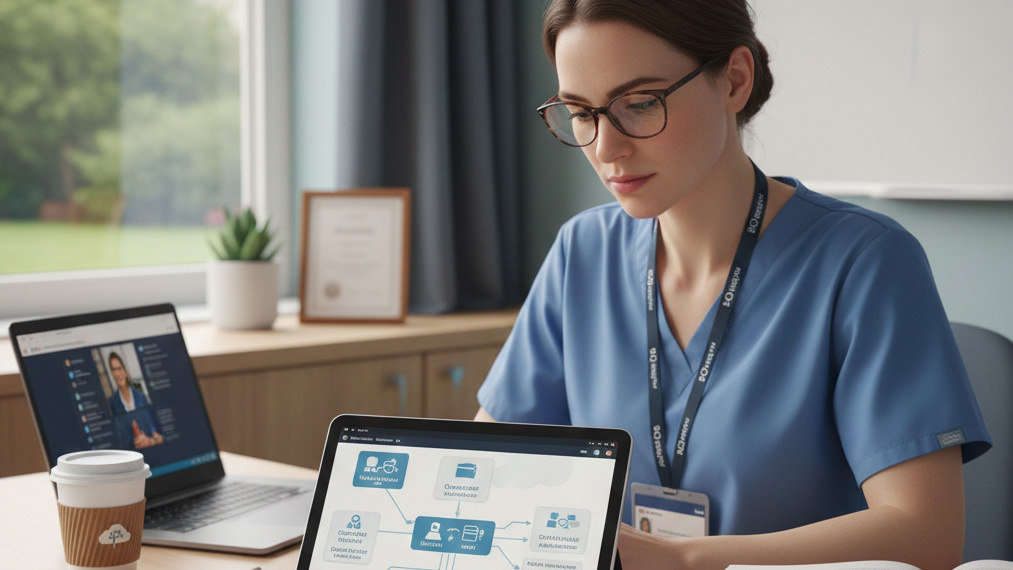
True organizational transformation requires a collective effort, not just reliance on a few key individuals. Forward-thinking hospitals and research institutions are establishing formal healthcare certification programs to elevate the skills of their entire IT departments.
To successfully roll out cloud security certification initiatives, organizations should adopt a methodical approach:
Promoting a culture of ongoing learning through cloud security certifications helps organizations stay competitive and compliant. This investment also boosts employee retention, as skilled tech professionals are more likely to remain with an employer that actively supports their career growth.
Innovation in life sciences depends on processing petabytes of data, a task that traditional data centers cannot perform efficiently. Cloud platforms enable researchers to provision immense computing power on demand, run complex simulations, and then de-provision those resources to control costs. Managing this dynamic environment is a high-level skill validated by cloud certifications. By becoming certified, professionals empower their organizations to be more agile and responsive to emerging opportunities, such as a new drug discovery or a public health crisis.
Looking ahead, the industry is moving toward a hybrid cloud model, where some data stays on-premise for rapid access while other workloads are pushed to the cloud. Future certifications will increasingly focus on managing these complex, distributed environments. We are also witnessing the explosion of AI and machine learning in medicine, which will soon spawn specialized healthcare IT certifications for securing AI models and the data they are trained on.
The unstoppable move to the cloud in healthcare and life sciences promises a future of personalized medicine, accelerated research, and more accessible patient care. However, this vision can only be realized if the people managing the technology possess world-class skills. By pursuing specialized training and earning recognized healthcare compliance certifications, professionals can position themselves to meet the challenges of tomorrow. These credentials represent more than a line on a resume—they signify a deep commitment to security, innovation, and patient well-being. As the industry advances, it is the certified experts who will lead the charge toward a healthier future for all.

Get Unlimited access to ALL the LIVE Instructor-led Microsoft courses you want - all for the price of less than one course.