



Basket
{{item.CourseTitle}}
Price: {{item.ItemPriceExVatFormatted}} {{item.Currency}}
Browse by Topic
Browse by Vendor

Unlimited Training
Attend all the top-notch LIVE Instructor-led Courses you want for the price of less than one course.

In the face of relentless digital threats and a complex web of regulations, UK businesses are searching for a new kind of professional. This isn't just another IT role; it’s a strategic function for building corporate resilience. Organisations today must navigate a minefield of legal requirements and security risks, from UK GDPR to international standards. This has created massive demand for Governance, Risk, and Compliance (GRC) analysts—individuals who can build the frameworks that enable secure, sustainable growth.
This guide offers a complete roadmap for anyone aspiring to enter this field. Whether you are taking your first career steps, transitioning from another industry, or an IT professional looking to specialise, we will explore the core responsibilities of a GRC analyst. You will gain insight into typical career trajectories, the skills that matter most, and the certifications that will get you noticed. With a clear view of job descriptions and UK salary expectations, you will have a practical plan for launching your career.
Before diving into job descriptions, it's worth considering if this career aligns with your natural abilities. A path in GRC is ideal if you are a systematic thinker who thrives on solving complex problems. It offers a unique blend of technology, business strategy, and law, making it perfect for those who enjoy the big picture but don’t want to spend all day coding. The work is incredibly meaningful; you are on the front line, protecting your organisation and its customers from significant financial and reputational harm.
The main challenge is that GRC work is methodical and requires meticulous documentation. You may also face resistance from colleagues who see compliance as a barrier rather than a business enabler. However, the long-term prospects are outstanding. The role provides a deep understanding of business operations and can serve as a launchpad to executive positions. The GRC analyst career path offers stability, competitive compensation, and a chance to make a tangible impact.
To appreciate this profession, we must first break down the acronym. GRC stands for Governance, Risk, and Compliance. But what exactly is a GRC analyst in practice? This professional ensures an organisation operates according to its own internal policies, manages strategic risks, and complies with all external legal and regulatory obligations. They act as the critical link between the technical implementers in IT and the strategic decision-makers in leadership.
A GRC analyst focuses on the "why" and "how" of a company's security posture. They investigate crucial questions like: "Are our data protection policies compliant with UK GDPR?" or "How would we recover if our central data centre was compromised?" Their work is proactive, focused on designing and embedding security frameworks rather than just reacting to incidents. This strategic focus separates the role from purely technical security positions, demanding a strong grasp of both business processes and the regulatory environment, from frameworks like Cyber Essentials to global standards.
Understanding these three interconnected elements is key. In a business context, Governance refers to the internal rules, policies, and structures that direct and control the organisation. Risk covers anything that could threaten the company's objectives, from cyber-attacks to supplier failure. Compliance involves adhering to non-negotiable external laws and regulations, such as those mandated by the Information Commissioner's Office (ICO) in the UK.
The daily life of a GRC analyst is diverse. One day might involve interviewing department managers to map data flows, while the next could be spent drafting a new policy for secure remote working or preparing evidence for an upcoming audit. The overarching goal is always to identify organisational weaknesses and propose risk mitigation strategies that protect the business without hindering its operational needs.
Core day-to-day responsibilities often include:
When you examine a typical GRC analyst job description, it calls for a unique mix of technical literacy and business savvy. A primary duty is often the maintenance of the Information Security Management System (ISMS), which is the organisation's master plan for security. They translate complex legal jargon into practical tasks for IT teams, ensuring that new legislation is understood and acted upon correctly.
The GRC analyst career path is not rigid. Many professionals enter from IT support roles, while others transition from legal, audit, or business analysis backgrounds. Because the role demands such a varied skillset, there is no single entry point. However, once in the field, progression can be swift.
A typical career ladder looks like this:
The first step is to build a robust understanding of IT and security principles. While you don't need to be an elite coder, you must be comfortable with concepts related to networks, cloud services, and data management. Familiarise yourself with key frameworks like COBIT and NIST through online courses. Practical experience is invaluable; consider volunteering for a charity to help them create a privacy policy or look for internships within internal audit teams. Joining professional bodies like ISACA or IAPP is also crucial for networking and discovering opportunities.
To succeed as a GRC analyst, certain skills are non-negotiable. While technical familiarity is a prerequisite, your soft skills will truly set you apart. You will need to influence stakeholders and clearly articulate why a new security policy is necessary, even if it seems inconvenient. Excellent communication is arguably the most vital GRC skill.
Other crucial proficiencies include:
Professional certifications are a powerful way to validate your expertise. For those focused on auditing, the CISA (Certified Information Systems Auditor) is the industry benchmark. If your interest lies in risk management, the CRISC (Certified in Risk and Information Systems Control) is one of the best GRC certifications available. For aspiring leaders wanting to demonstrate strategic management skills, the CISM (Certified Information Security Manager) is highly respected. A smart approach is to review job adverts for roles you want and prioritise the GRC certifications that appear most frequently.
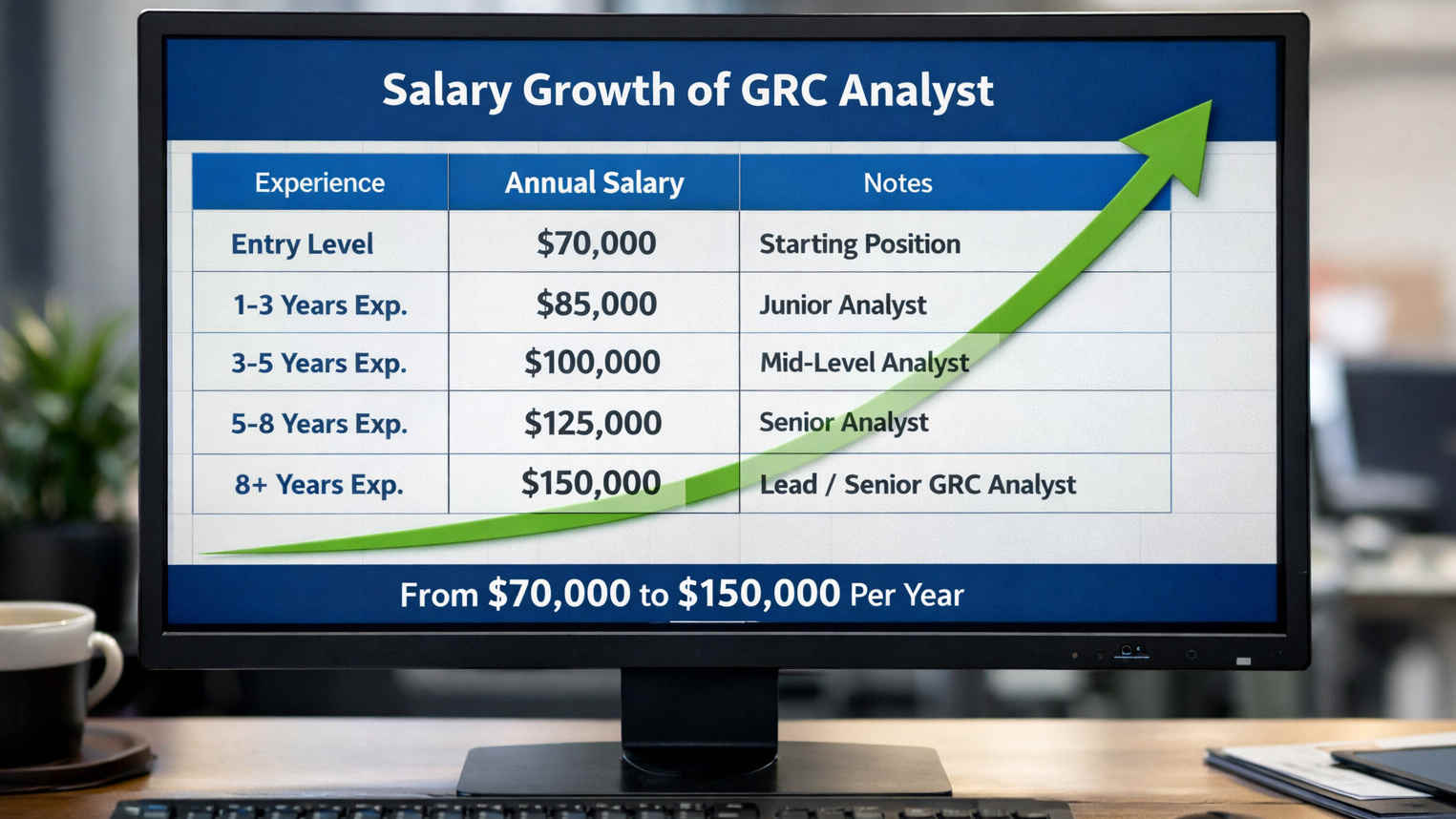
Salaries for GRC analysts in the UK are strong, reflecting the critical importance of the role. An entry-level analyst can expect to earn between £40,000 and £55,000 per year. With a few years of experience and a key certification, that figure often rises to between £60,000 and £80,000. Senior and managerial roles regularly command salaries exceeding £85,000.
The job market for GRC professionals is exceptionally healthy. As regulatory pressures from bodies like the ICO intensify, organisations must invest in qualified compliance experts. The finance, healthcare, and technology sectors are always hiring, and because compliance is a mandatory function, the role offers excellent job security. This sustained demand ensures that compensation remains competitive and that opportunities, including remote ones, are plentiful.
If you are an organised, intellectually curious person who enjoys bridging the gap between technology and business, a GRC career could be an excellent fit. It provides a structured path to a senior position where you can make a real difference, protecting organisations from the inside out. By building a solid foundation of technical knowledge, honing your communication skills, and pursuing a relevant certification, you can start a rewarding professional journey in this dynamic and essential field.

Get Unlimited access to ALL the LIVE Instructor-led Security courses you want - all for the price of less than one course.
You're viewing our UK (GBP) site from United States
Would you like to view the site in
English
with prices in
Dollar?