



Basket
{{item.CourseTitle}}
Price: {{item.ItemPriceExVatFormatted}} {{item.Currency}}
Browse by Topic
Browse by Vendor

Unlimited Training
Attend all the top-notch LIVE Instructor-led Courses you want for the price of less than one course.

In today's fast-paced business environment, organisations depend on rapid application development and process automation to maintain a competitive edge. Microsoft’s Power Platform is a leading tool in this space, offering a low-code environment that empowers companies to build powerful solutions efficiently.
For professionals looking to formalise their expertise and advance their careers, a key decision emerges: which certification path to follow? The choice often comes down to the PL-200 (Power Platform Functional Consultant Associate) and the PL-400 (Power Platform Developer Associate). This guide will help you decode these certifications by aligning them with distinct career roles and objectives.
To choose the right certification, it helps to first understand the two primary roles they represent. Microsoft has designed these associate-level qualifications to validate separate but equally crucial skill sets within the Power Platform world.
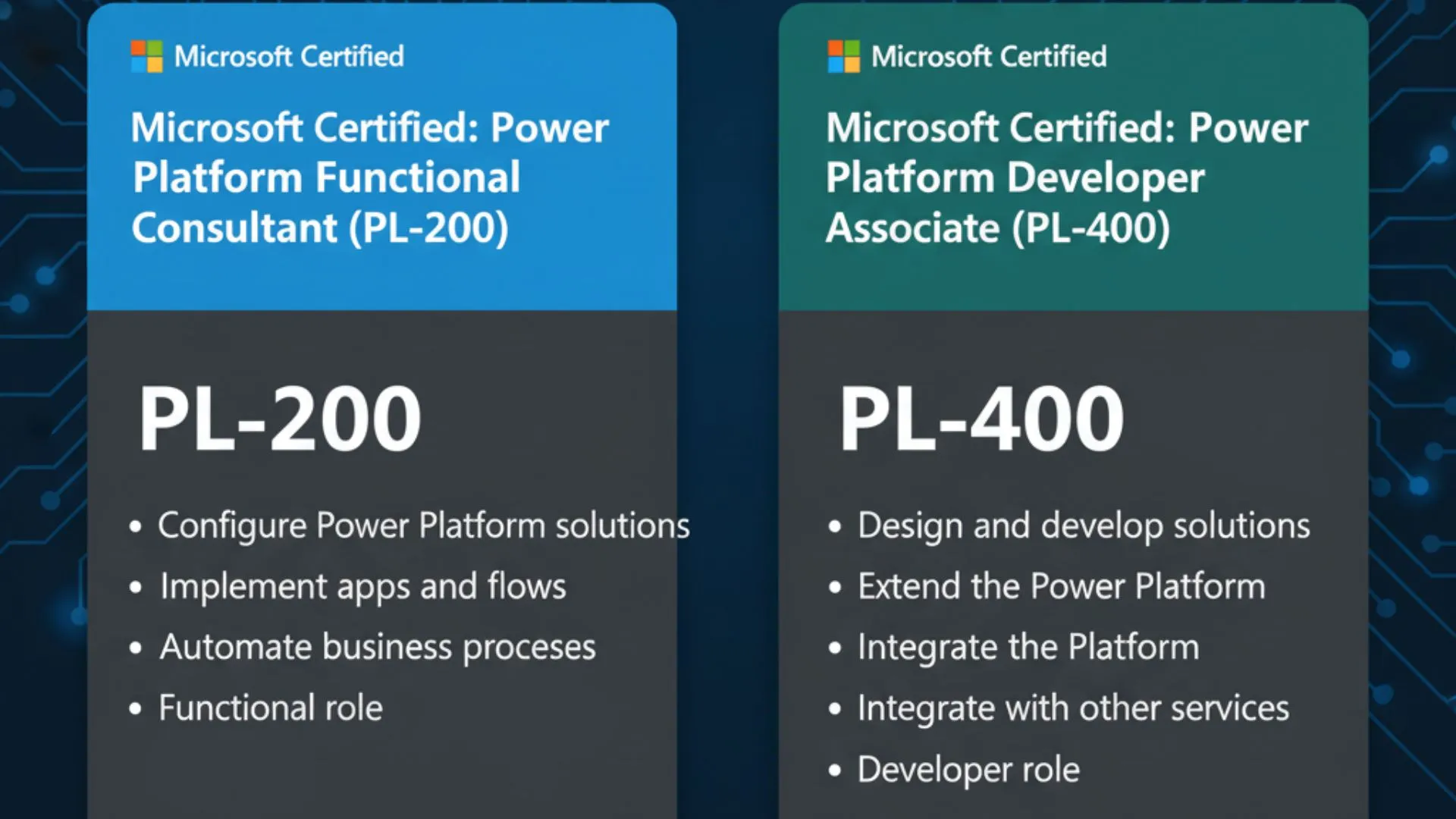
Are you the person who bridges the gap between business challenges and technical solutions? The PL-200 is designed for professionals who excel at understanding stakeholder needs and using the out-of-the-box features of the Power Platform to solve them. This path is less about writing code and more about strategic implementation.
The certification validates your ability to work with Dataverse, the platform's data backbone, build model-driven and canvas apps with Power Apps, and streamline operations with Power Automate. You'll also touch upon creating chatbots using Power Virtual Agents. Essentially, you become an expert at configuring the platform to meet specific business requirements, turning ideas into tangible, functional applications without needing deep development knowledge.
If your passion lies in extending capabilities and writing code, the PL-400 is your destination. This certification is for the developer who sees the boundaries of low-code tools and knows how to push past them. The role involves building custom components and creating robust integrations that the standard feature set cannot handle alone.
The PL 400 curriculum dives into developer-centric tasks, such as creating custom connectors, writing client-side scripts with JavaScript, building server-side logic with C# plugins, and integrating with Azure services. A PL-400 certified developer provides the foundational engineering that functional consultants can then build upon. For instance, while a consultant might design a user-friendly form, a developer writes the complex, back-end code that ensures data integrity through sophisticated business rules.
While both certifications share a foundational understanding of the Power Platform, such as solution management and Dataverse principles, their focus diverges significantly. Your choice should directly reflect the career path you envision.
Earning the PL-200 certification opens doors to roles like Power Platform Functional Consultant, Business Analyst, or Low-Code App Maker. In these positions, you will work closely with business units to analyse processes, gather requirements, and deploy solutions that enhance efficiency. You become the go-to expert for implementing digital transformation projects using the platform's configurable tools.
With a PL-400 certification, you are positioned for more technical roles such as Power Platform Developer, Solution Architect, or Integration Specialist. These jobs require a strong coding background and involve building the complex, bespoke parts of a solution. You will be responsible for tackling advanced challenges, like connecting to legacy databases, designing complex APIs, or developing custom user interface elements.
The PL-200 exam scrutinises your ability to configure and implement solutions. Questions revolve around creating business process flows, customising app layouts, and setting up automation. In contrast, the PL-400 exam is a test of your development prowess. It will require you to demonstrate your ability to write code for custom plugins and manage technical integrations, which naturally presents a steeper learning curve for those without a programming background.
Your existing experience is the most reliable guide for deciding your starting point. The goal is to build a comprehensive skill set that serves your career ambitions.
If you come from a non-technical background—perhaps as a business analyst, IT support professional, or project manager—the PL-200 is the ideal first step. It provides a solid grounding in the platform's capabilities without the prerequisite of coding knowledge. This certification proves you can deliver immediate business value by translating user needs into working solutions.
For existing software developers proficient in languages like C# and JavaScript, jumping straight to the PL-400 is often the most logical move. Your programming skills are directly transferable, and this certification will validate your capacity to apply them within the Power Platform. It demonstrates to employers that you can handle the most technically demanding projects.
Many top-tier professionals eventually earn both certifications. Starting with the PL-200 provides business context, which can then be complemented by the deep technical skills validated by the PL-400. An individual holding both qualifications is highly sought after, as they can both strategise with stakeholders and build the sophisticated architecture needed to execute their vision.

Successful certification requires both theoretical knowledge and practical application. Microsoft Learn offers excellent, free learning paths for both exams. The most critical resource, however, is a trial environment where you can get hands-on experience.
Ultimately, your choice between the PL-200 and PL-400 certifications should be driven by your career goals and current skill set. The PL-200 is tailored for the business-minded professional who excels at building solutions with low-code tools. The PL-400 is the benchmark for developers who extend and fortify the platform with code.
Whichever path you select, gaining a Power Platform certification is a powerful statement. It signals your dedication and verifies your skills in a technology that is fundamentally changing how organisations operate. Both certifications pave the way for a successful and rewarding career.
Are you prepared to take the next step in your Power Platform career? Our expert-led Microsoft courses offer the focused training you need. We provide comprehensive materials and practice exams to ensure you have the confidence and knowledge to pass your exam on the first attempt. Explore our course catalogue today and start your journey towards certification.

Get Unlimited access to ALL the LIVE Instructor-led Microsoft courses you want - all for the price of less than one course.
You're viewing our UK (GBP) site from United States
Would you like to view the site in
English
with prices in
Dollar?