





Basket
{{item.CourseTitle}}
Price: {{item.ItemPriceExVatFormatted}} {{item.Currency}}
Browse by Topic
Browse by Vendor

Unlimited Training
Attend all the top-notch LIVE Instructor-led Courses you want for the price of less than one course.

The departure of a key team member is more than an inconvenience; for many UK businesses, it represents a significant financial and operational blow. In today’s competitive talent market, the high cost of recruitment, lost institutional knowledge, and the negative impact on team morale can be crippling. While many leaders attribute staff turnover to salary, the reality is often more complex. A primary driver for employees seeking new opportunities is a feeling of stagnation and a lack of clear progression. This is where strategic investment in professional development through certification training becomes a powerful retention tool.
By funding and supporting formal certification paths, an organisation sends a clear message to its workforce: "We are invested in your long-term growth." This commitment builds a culture where employees see a future within the company, not just a temporary role. It transforms the employer-employee relationship from a simple transaction into a partnership for professional advancement, giving your most valuable people compelling reasons to stay and grow with you.
Why do talented people really leave their jobs? More often than not, it’s because they feel they’ve reached a professional dead-end. When the path to advancement is unclear or non-existent, even a competitive salary loses its appeal. Introducing structured employee training programmes tackles this issue head-on by providing a tangible roadmap for career development.
When an organisation invests in helping an employee achieve a recognised credential—be it in project management, cloud computing, or cybersecurity—it fosters a powerful sense of mutual commitment. The employee feels valued and is motivated to apply their newly validated skills for the benefit of the company that supported them. This calculated investment directly lowers the likelihood of them leaving, as the cost of departure now includes abandoning a supportive and enriching learning environment. In essence, you are not just hoping for loyalty; you are actively building it.
Lasting motivation within a business is rarely sustained by surface-level perks. It is fuelled by a sense of meaningful progress and personal accomplishment. When employees engage in high-quality professional development training, their perspective on their day-to-day responsibilities changes. Their work becomes an integral part of a journey toward mastery, boosting engagement and job satisfaction.
This sense of forward momentum is a powerful antidote to "quiet quitting" and makes staff less susceptible to offers from competitors. When an employee knows their company is willing to invest significantly in their future through certification, it builds an emotional connection that a simple salary increase cannot replicate. People are naturally inclined to remain in an environment where they are actively being developed into more capable professionals.
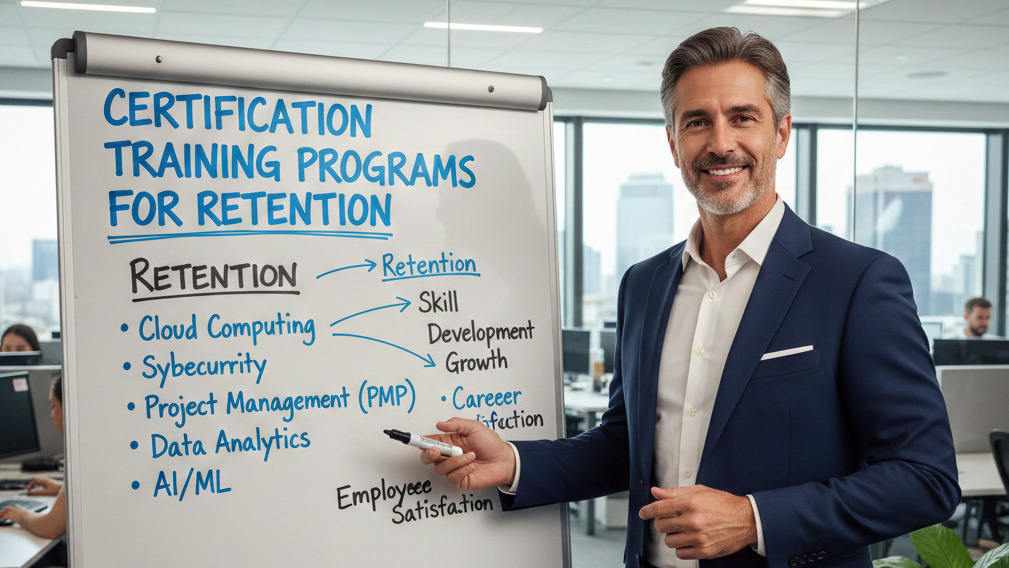
A successful retention strategy requires more than just offering access to online courses. To truly make an impact, a programme must be built with a clear employee engagement strategy. An ill-conceived or irrelevant training scheme can backfire, leaving employees feeling that their time is being wasted.
The cornerstone of an effective programme is alignment. The certifications offered must support the organisation's strategic goals while also catering to the employee's career aspirations. For instance, a business migrating its infrastructure should prioritise offering certifications from vendors like Google or Amazon.
The best corporate training benefits are realised when the programme is structured with fairness and clarity:
A generic, one-size-fits-all approach to training is ineffective. Workforce certification programmes must be tailored to an individual's role and experience level to be meaningful. Consider a tiered structure:
When a manager collaborates with a team member to map out a custom certification journey, it demonstrates a profound level of investment in that individual's future, building a foundation of trust and loyalty.
To secure ongoing budget and executive buy-in, it's crucial to demonstrate the commercial return of your employee engagement strategy. This requires moving beyond anecdotal evidence and focusing on hard data.
The most direct indicator is a comparative analysis of retention rates between certified and non-certified staff. If employees who complete a certification are significantly more likely to stay with the company for two or more years, the programme’s value is clear. Other vital metrics to track include:
Tracking these figures allows HR and leadership teams to refine their development programmes and allocate resources to the certifications that deliver the greatest impact.
A snapshot of programme impact might look like this:
| Indicator | Pre-Programme Baseline | 12 Months Post-Implementation |
| Annual Staff Turnover | 25% | 15% |
| Senior Roles Filled Internally | 10% | 35% |
| Employee Training Satisfaction | 4/10 | 8.5/10 |
| Average Staff Tenure | 2.1 Years | 3.4 Years |

As remote working and AI continue to reshape the professional landscape, the nature of employee loyalty is evolving. Future-proof employee retention strategies must embrace a model of continuous, accessible learning. The focus is shifting from occasional training events to an ongoing culture of upskilling.
The rise of digital credentials and micro-certifications allows employees to visibly track and share their progress, which simultaneously enhances your organisation's brand as an excellent place to work. When your staff are constantly developing new, validated skills, your company gains a reputation as a centre for industry excellence.
Ultimately, to build a loyal and highly capable workforce, you must create an environment that champions personal and professional development. By embedding certification training into your corporate DNA, you build a powerful defence against staff turnover—creating a growth-focused culture that talented people will not want to leave.

Get Unlimited access to ALL the LIVE Instructor-led Microsoft courses you want - all for the price of less than one course.