



Basket
{{item.CourseTitle}}
Price: {{item.ItemPriceExVatFormatted}} {{item.Currency}}
Browse by Topic
Browse by Vendor

Unlimited Training
Attend all the top-notch LIVE Instructor-led Courses you want for the price of less than one course.

As UK organisations increasingly migrate their core operations to the cloud, the complexity of securing digital assets grows exponentially. A robust defence is no longer a luxury but a necessity. At the heart of this defence is the cybersecurity architect, a professional tasked with designing, building, and maintaining an organisation's entire IT security ecosystem. Within the vast Microsoft and Azure environments, validating this expertise is paramount.
A formal Microsoft certification provides clear evidence to employers that you possess the advanced skills required for this critical role. For seasoned IT professionals, the Microsoft Cybersecurity Architect Expert certification represents the pinnacle of designing, implementing, and managing intricate security solutions across Microsoft 365, Azure, and hybrid platforms. This guide explores the pathway to achieving this credential, focusing on the strategic thinking and practical skills needed to become a leader in the field.
Earning this certification confirms your ability to translate an organisation’s business objectives into a coherent security strategy, leveraging the full power of Microsoft’s security portfolio. It is a vital step for any IT professional seeking a top-tier role in cybersecurity architecture.
This is a senior-level credential created to validate the advanced capabilities needed to design and evolve security for complex Microsoft cloud and hybrid infrastructures. The scope extends beyond single products to encompass a holistic security framework. Key responsibilities include:
This certification is aimed squarely at experienced professionals. The ideal candidates are security engineers, consultants, and cloud architects ready to specialise in high-level security design. It is assumed that candidates already possess a deep knowledge of security operations, identity management, and the functionality of Microsoft's security toolset. This is not an entry-level credential; it builds upon existing expertise.
To sit the exam, you must first hold a prerequisite certification, such as the Security Engineer Associate or Identity and Access Administrator Associate. Furthermore, Microsoft suggests a minimum of three to five years of hands-on experience in cybersecurity and architecture design before attempting this expert-level validation.
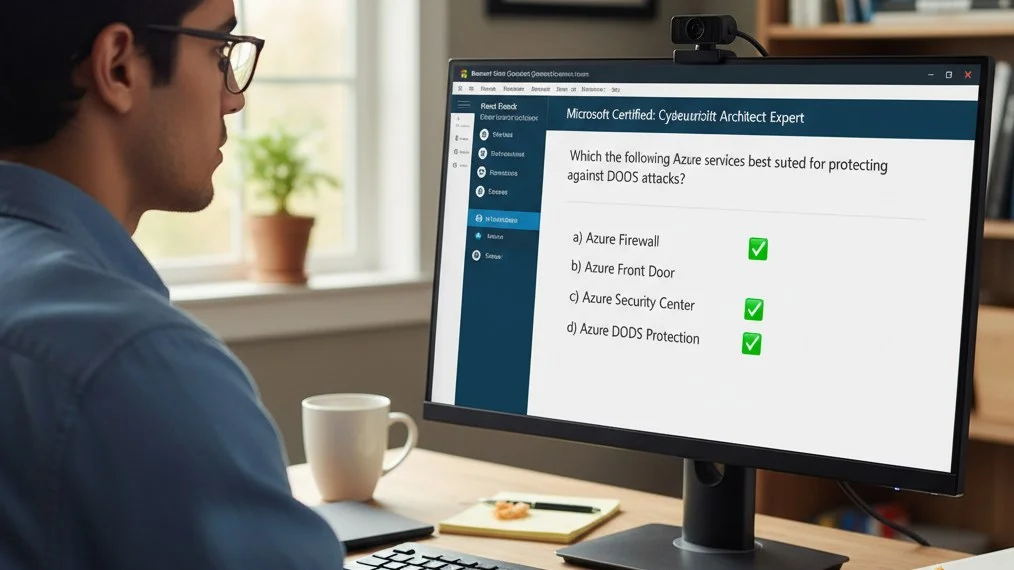
The sole requirement for earning the Microsoft Cybersecurity Architect Expert certification is passing the SC-100: Microsoft Cybersecurity Architect exam. This is a difficult test that measures your ability to translate high-level business requirements into a technical security blueprint spanning Microsoft Azure, Microsoft 365, and Microsoft Defender.
While there are no formal blocks to registering for the exam, progression is gated by prerequisites. Microsoft strongly advises candidates to hold one of the following associate-level certifications:
Without the foundational knowledge from one of these, you will likely struggle with the strategic depth of the SC-100. The exam typically consists of 40-60 questions, including multiple-choice, drag-and-drop, and in-depth case studies. A score of 700 out of 1000 is required to pass. The exam lasts 150 minutes, providing ample time to analyse the complex scenarios presented.
The cybersecurity certification exam is divided into four primary knowledge domains, each with a different weighting. Mastery across all areas is essential for success:
Preparing for the Microsoft Cybersecurity Architect certification demands a strategic plan that goes beyond rote memorisation. The goal is to cultivate practical, architectural design skills. There are several effective pathways to help candidates get ready for the SC-100 exam and obtain the Azure Security Certification.
For those who thrive in a structured environment or require an accelerated route, instructor-led training is an outstanding choice. Microsoft’s official courses, delivered by certified partners, condense the material into a focused format. The primary benefit is direct interaction with a subject-matter expert, allowing you to ask questions and gain insights from their experience.
These online courses and bootcamps are particularly valuable for their emphasis on hands-on labs. An Azure security architect must be proficient in designing comprehensive security architectures, implementing Zero Trust frameworks, and evaluating Microsoft security certification tools. These abilities can only be honed through practical application.
Self-paced learning offers a cost-effective and flexible method of preparation. The official Microsoft Learn platform is the ideal starting point, with structured learning paths that map directly to the SC-100 objectives. These modules cover everything from designing a Zero Trust strategy to governing security posture.
To supplement this, high-quality third-party resources and practice exams are crucial. Practice tests help you acclimate to the exam format and pinpoint areas needing further study. A disciplined self-study approach, combining Microsoft’s free materials with premium practice tests, provides comprehensive coverage for the Microsoft cybersecurity certification.
Passing the SC-100 exam requires a multi-faceted approach. Follow these tips for success:

Earning the Microsoft Cybersecurity Architect certification is a major career achievement, unlocking doors to senior and highly rewarding roles. This credential signals to employers that you can manage enterprise-scale security design. Popular career paths include:
Demand is high for professionals who can connect organisational strategy with security technology. The Azure security architect role is among the best-compensated and most sought-after in IT. Salaries reflect the critical nature of protecting an organisation's most valuable assets.
Cybersecurity is a rapidly evolving field. For a certified professional, ongoing learning is essential. The Microsoft Cybersecurity Architect Expert certification is valid for one year, and you must complete a free online renewal assessment on Microsoft Learn to maintain it. This ensures your skills remain current.
Best practices for maintaining your edge include staying updated with Microsoft product changes, pursuing complementary security architecture certifications (e.g., CISSP or offensive security credentials), seeking practical project experience, and engaging with the security community through conferences and forums. This commitment ensures that your security architecture certification is the start of a long and successful career journey.

Get Unlimited access to ALL the LIVE Instructor-led Microsoft courses you want - all for the price of less than one course.
You're viewing our UK (GBP) site from United States
Would you like to view the site in
English
with prices in
Dollar?