





Basket
{{item.CourseTitle}}
Price: {{item.ItemPriceExVatFormatted}} {{item.Currency}}
Browse by Topic
Browse by Vendor

Unlimited Training
Attend all the top-notch LIVE Instructor-led Courses you want for the price of less than one course.

The digital revolution across the UK's healthcare and life sciences sectors is well underway. Not long ago, patient records, clinical trial data, and genomic research were confined to on-premise servers and filing cabinets. Now, the cloud is the new home for this critical information. This migration is driven by the need for faster data analysis, enhanced collaboration between researchers and clinicians, and ultimately, better patient outcomes. However, hosting the nation's most sensitive health data in the cloud introduces profound responsibilities, making professional cloud certifications an indispensable asset for the modern workforce.
Hospitals, pharmaceutical innovators, and biotech start-ups face a unique set of hurdles. They must manage vast and growing datasets while adhering to stringent UK legal frameworks. An IT professional holding a specialised life sciences certification signals that they possess the specific knowledge required to navigate these intricate systems. These credentials provide verifiable proof that an individual knows how to design, manage, and defend the digital infrastructure entrusted with protecting our health information.
This article examines how targeted training programmes close the knowledge gap between advanced technology and medical practice. We will explore the various types of certifications available and clarify why they have become a prerequisite for anyone pursuing a career in UK healthcare IT. From IT managers in an NHS trust to clinical researchers, grasping the value of cloud qualifications is the foundational step towards a more secure and innovative future in medicine.
In the healthcare sphere, there is no tolerance for error. A system failure or a data leak is not merely a financial setback; it could compromise a patient's confidential history or delay urgent medical procedures. Given these high stakes, the demand for healthcare IT certifications has surged. Employers need assurance that their teams can operate effectively within this highly regulated and pressurised environment.
One of the greatest challenges in adopting cloud technology is ensuring regulatory compliance. In the United Kingdom, the UK GDPR, enforced by the Information Commissioner's Office (ICO), sets the legal standard for protecting personal sensitive data. Professionals who obtain healthcare compliance certifications are trained to translate these complex legal obligations into technical controls within cloud platforms. This involves more than just foundational IT abilities; it’s about becoming a guardian of patient privacy.
Such specialised training covers critical compliance tasks, including:
By mastering these skills, certified staff reduce the organisation's risk of incurring substantial fines and reputational damage from regulatory bodies.
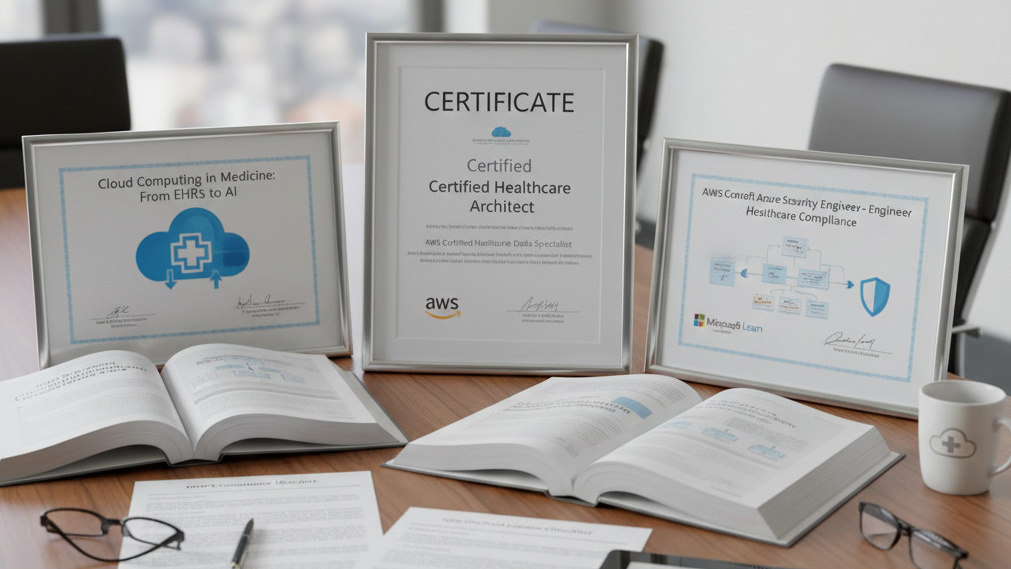
With a wide array of options, selecting the right certification pathway can be daunting. For individuals working in medicine and bioscience, credentials relevant to life sciences often build upon general cloud skills but demand a sharper focus on data integrity and security. The most respected qualifications are those that prove a professional's competence in managing high-performance computing alongside secure data pipelines.
Typically, a professional journey begins with an entry-level or associate certification from a major provider like AWS, Microsoft Azure, or Google Cloud. While these offer a solid overview, the real advantage for healthcare and life sciences comes from specialised credentials. These prove you are not just a generalist but an expert who understands the distinct challenges of a clinical or laboratory setting.
While security focuses on defence, architecture is about creating resilient and efficient systems from the outset. If your objective is to build a new telehealth service or a database for managing clinical trial outcomes, you need an architect's vision. Foundational cloud platform certifications provide the blueprint for designing such systems. Leading examples include the AWS Certified Solutions Architect or the Microsoft Certified: Azure Solutions Architect.
In a healthcare setting, a well-designed architecture must ensure high availability. This concept means if one component of the system goes offline, a backup takes over immediately so that medical staff never lose access to critical patient information. Cloud architecture training teaches professionals how to distribute data across multiple physical locations to eliminate single points of failure and prevent downtime. It also provides vital skills for integrating modern cloud services with existing legacy systems that many UK healthcare organisations still rely on.
For any organisation operating under strict regulatory oversight, security is the foremost priority. Cloud security certifications are specifically designed to teach IT professionals how to construct a multi-layered defensive perimeter around sensitive data. In a healthcare context, this includes sophisticated identity management—for instance, a consultant requires a different level of data access compared to a member of the administrative staff.
These advanced security courses teach vital threat mitigation techniques, such as:
Holding a security-centric healthcare certification is one of the most powerful indicators of expertise, particularly for those aspiring to leadership positions in healthcare technology.
For any healthcare organisation to thrive in the cloud, it cannot depend on the knowledge of a few individuals. The entire technology department must share a common understanding and skill set, which is why many NHS trusts and research institutions are now establishing formal healthcare certification programmes.
To roll out cloud security certification programmes effectively, organisations should adopt a structured plan:
By promoting a culture of ongoing education through cloud security certifications, these organisations can better protect their systems and improve staff retention. Tech professionals are far more likely to remain with an employer that actively invests in their skills and career trajectory.

The next frontier for healthcare technology is the hybrid cloud—a model where some data is kept on local servers for rapid access, while other large datasets are processed in the public cloud. Future qualifications will increasingly concentrate on the skills needed to manage these complex, blended environments.
We are also witnessing the rapid ascent of AI and machine learning in medicine. It is likely that we will soon see specialised healthcare IT certifications focused on securing AI systems. As artificial intelligence is used to help diagnose conditions, the integrity and security of the data used for training these models become paramount. Professionals will need to prove they can manage the vast data lakes that power these intelligent systems.
The unavoidable shift to the cloud is reshaping healthcare and life sciences in the UK. This transition holds the promise of personalised medicine, accelerated drug discovery, and more accessible patient care. Yet, this promise can only be realised if the people responsible for the technology are exceptionally skilled and prepared.
By investing in specialised training and earning recognised healthcare compliance certifications, IT professionals can demonstrate they are ready for the complex challenges that lie ahead. These credentials are far more than a line on a CV; they represent a deep commitment to excellence, robust security, and the safety of every patient.

Get Unlimited access to ALL the LIVE Instructor-led Microsoft courses you want - all for the price of less than one course.