





Basket
{{item.CourseTitle}}
Price: {{item.ItemPriceExVatFormatted}} {{item.Currency}}
Browse by Topic
Browse by Vendor

Unlimited Training
Attend all the top-notch LIVE Instructor-led Courses you want for the price of less than one course.

In the current UK business landscape, reliance on digital infrastructure is absolute. However, many organisations find their governance, risk, and security functions operate in disconnected silos. You may have stringent IT audits, detailed risk registers, and advanced security tools, yet still lack a cohesive strategy to manage technology risk effectively. The result is a constant state of reaction, rather than proactive resilience. The key to breaking this cycle lies in embedding specialised expertise at critical points in your operating model. This is the strategic value offered by professionals holding ISACA certifications, particularly the CISA, CRISC, and CISM certifications.
These credentials signify more than just technical knowledge; they represent distinct capabilities that address specific business challenges. A CISA professional provides assurance, a CRISC specialist translates risk into business terms, and a CISM leader directs the overall security programme. By understanding where and when to leverage these skills, an organisation can build a truly risk-aware culture, ensuring it can innovate and grow securely in a complex regulatory environment like the UK.
The foundational question for any technology-dependent organisation is: "Are our controls actually working as intended?" Without a confident "yes," any security or risk management strategy is built on sand. For professionals in IT audit and assurance, the Certified Information Systems Auditor (CISA certification) is the globally recognised standard for answering this question. It equips them with a formal framework to assess the integrity, effectiveness, and security of an organisation's information systems.
A CISA-certified professional offers critical assurance, especially in the context of UK regulations like UK GDPR and standards such as Cyber Essentials. Their role involves:
By verifying that systems and controls are functioning correctly, the ISACA CISA holder provides the reliable data upon which all other risk and security decisions are made. They ensure the information presented to management about the organisation's risk posture is accurate.
The CISA exam validates expertise across five job practice domains, covering the full spectrum of IT audit and assurance:
An audit report filled with technical findings is of little use if it doesn't drive business decisions. This is where many organisations falter. The Certified in Risk and Information Systems Control (ISACA CRISC) certification was created to fill this exact gap. It positions a professional to act as the crucial liaison between the technical IT world and strategic business leadership. Their core function is to identify, assess, and manage IT-related business risk.
Unlike a CISA who verifies what is, a CRISC professional focuses on what could be. They evaluate potential threats and translate their potential impact into financial, operational, and reputational terms that executives can understand. This enables risk-aware decision-making. By applying their skills, a CRISC holder ensures that:
Imagine a UK retailer planning a move to a new cloud-based e-commerce platform. The ISACA CRISC professional would lead the risk assessment, identifying potential issues like data residency conflicts with UK GDPR, vendor lock-in, and specific cloud security vulnerabilities. They wouldn't just list the problems; they would propose controls and contractual requirements, ultimately providing a clear recommendation to the board. This is the essence of building a risk-aware culture.
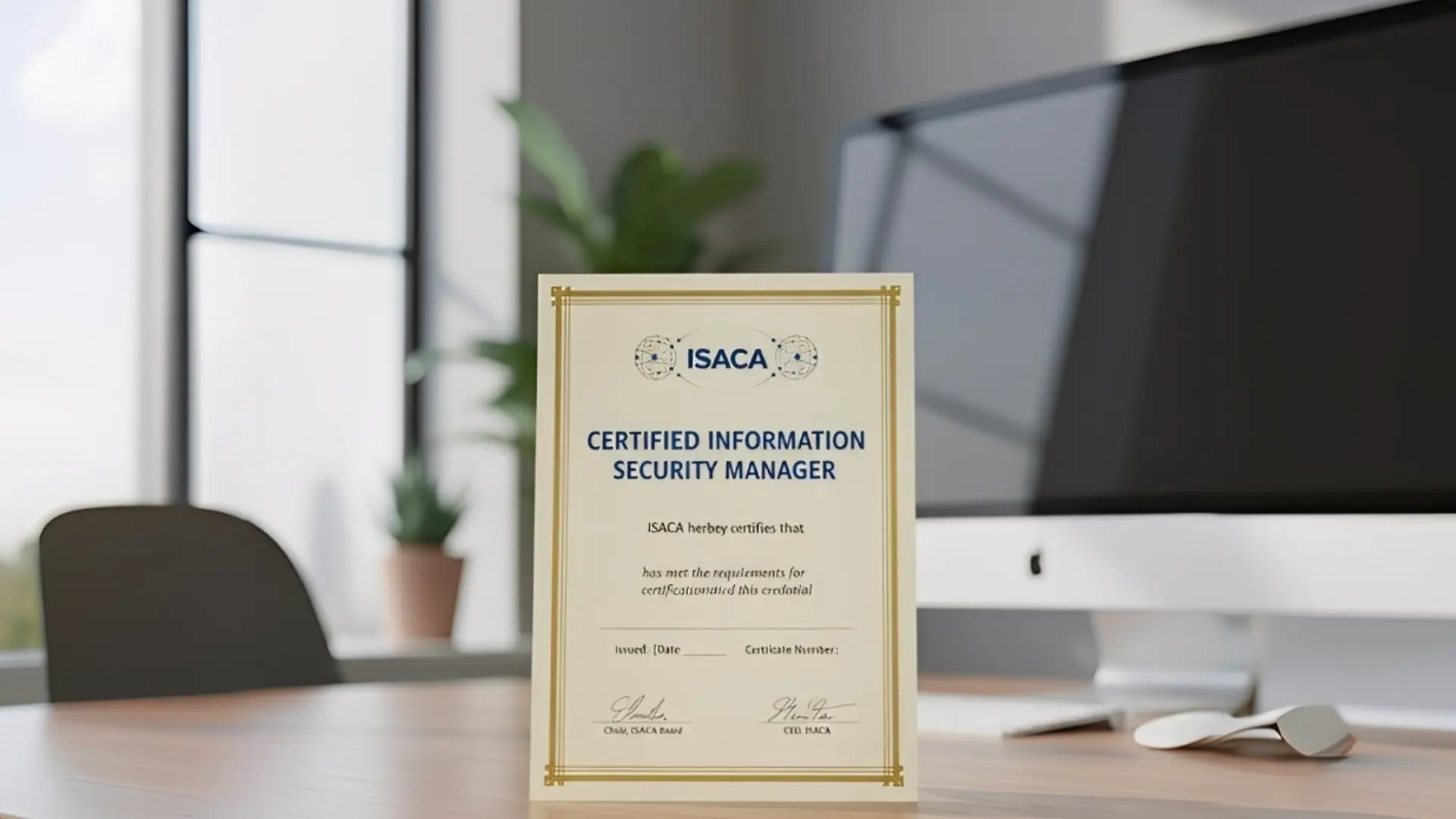
With assurance established by CISA and risk contextualised by CRISC, the final piece is strategic leadership. The Certified Information Security Manager (CISM) certification is designed for experienced leaders tasked with designing, building, and managing an entire enterprise information security programme. This credential moves beyond technical implementation and risk assessment to focus on governance and the strategic alignment of security with core business goals.
A leader holding an ISACA CISM qualification is not just a manager of security tools; they are a business enabler. Their expertise, validated across four key domains (Information Security Governance, Information Risk Management, Programme Development, and Incident Management), provides several key advantages:
The presence of a CISM-certified leader signals a mature security posture, where security is integrated into the fabric of the business, not just bolted on as an afterthought. This is crucial for gaining board confidence and demonstrating due diligence to regulators like the ICO.
These three certifications are distinct, but their true power is realised when they work in concert. A risk-ready enterprise effectively integrates all three functions. Consider a manufacturing firm in Manchester digitising its factory floor with IoT sensors:
This synergistic approach covers the entire cycle of IT assurance, risk management, and security leadership, creating a resilient organisation capable of innovating safely.
|
Certification |
Primary Focus |
Typical Role |
|
CISA |
Audit, Assurance, and Control Verification |
IT Auditor, Compliance Officer |
|
CRISC |
IT Risk Identification, Assessment, and Mitigation |
IT Risk Manager, Business Analyst |
|
CISM |
Security Programme Strategy, Governance, and Management |
Information Security Manager, CISO |

The decision to pursue or hire for ISACA certifications delivers significant returns. For professionals, these credentials dramatically enhance employability and open clear pathways to leadership. Roles in audit, risk, and security often list these certifications as requirements, and studies consistently show a salary premium for certified individuals. An enterprise risk management certification like CRISC, for example, signals a business-focused skillset that is in high demand.
For organisations, recruiting and developing ISACA-certified personnel builds a formidable competitive advantage. From financial institutions in London requiring CISA and CRISC teams for regulatory compliance to tech start-ups leveraging CISM leaders for scalable security, the value is clear. These certifications ensure that the individuals managing an organisation's technology risks possess a level of competence benchmarked against global best practices.
As digital transformation accelerates and the threat landscape grows more complex, the need for a structured approach to risk management has never been greater. The constant evolution of technology—from AI to the Internet of Things—creates new challenges that require more than just technical solutions. They demand strategic oversight, robust assurance, and a clear understanding of business risk.
The journey from a reactive to a resilient organisation is built on capability. It begins with the assurance provided by CISA, matures with the business-focused risk translation of CRISC, and is ultimately guided by the strategic leadership fostered by CISM. For UK enterprises navigating an uncertain future, investing in these competencies is not an option; it is essential for sustainable success. These certifications provide the blueprint for building an organisation that is not just protected from risk, but ready to thrive in spite of it.

Get Unlimited access to ALL the LIVE Instructor-led Microsoft courses you want - all for the price of less than one course.