





Basket
{{item.CourseTitle}}
Price: {{item.ItemPriceExVatFormatted}} {{item.Currency}}
Browse by Topic
Browse by Vendor

Unlimited Training
Attend all the top-notch LIVE Instructor-led Courses you want for the price of less than one course.

For UK professionals aiming to advance in the cloud technology sector, Microsoft's Azure data certifications offer a clear advantage. As organisations increasingly rely on Azure for their data operations, two distinct but crucial roles have emerged: the architect who builds the data systems and the guardian who ensures their stability. This distinction is at the heart of two key associate-level certifications: DP-203 for Data Engineering and DP-300 for Database Administration. Understanding which path aligns with your background and career goals is the first step toward specialisation.
Rather than viewing them as competitors, it's best to see these certifications as gateways to different career streams. This guide will help you identify your ideal starting point by examining the roles, required skills, and exam focus for both DP-203 and DP-300, empowering you to make an informed decision for your professional development.
Microsoft has structured its certification programme to reflect the specialisation within the data field. DP-203 and DP-300 are both associate-level credentials, but they cater to very different professional responsibilities. One is focused on creation and innovation, the other on management and optimisation.
The DP-203: Data Engineering on Microsoft Azure certification is for the builders. A data engineer's primary function is to design and implement complex data solutions. This involves creating data pipelines, managing large-scale data processing for both batch and real-time streams, and establishing secure, efficient data storage solutions.
If you have a passion for coding and working with 'big data' technologies like Azure Data Factory, Databricks, and Synapse Analytics to construct robust data workflows, this path is designed for you. It's about architecting the systems that allow a business to leverage its data assets effectively.
The DP-300: Administering Relational Databases on Microsoft Azure certification is for the managers and maintainers. The exam, which typically contains 40-60 questions, validates the skills needed to keep relational databases running at peak performance. This includes planning and implementing data platform resources, ensuring high availability, and managing security and compliance in line with regulations like UK GDPR.
This path is tailored for professionals with a background in SQL, such as database administrators or IT generalists who now manage cloud database resources. The focus is less on building from scratch and more on optimising, securing, and ensuring the reliability of existing Azure SQL databases.
Your professional background is the strongest indicator of which certification will be a more natural starting point. While anyone can learn the required skills for either, one path will likely align more closely with your existing expertise.
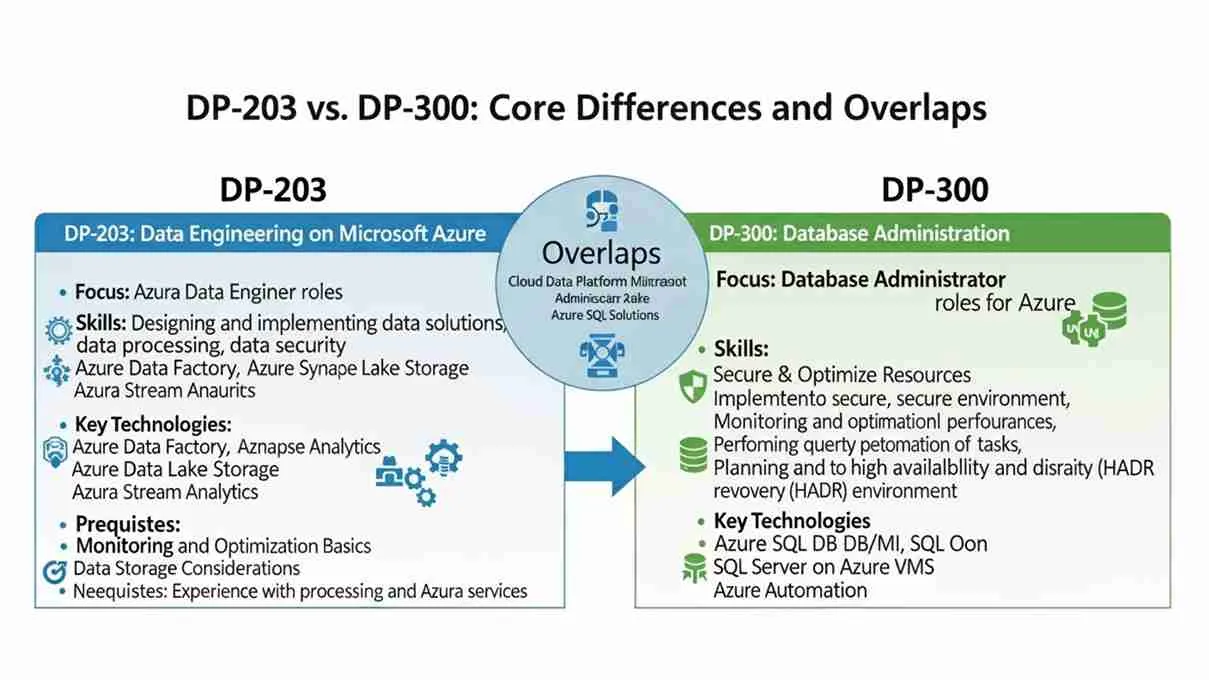
If your career has involved programming, especially with languages like Python or Scala, DP-203 is likely your next logical step. Experience with data science concepts or designing data flows puts you in a strong position. The certification builds on these skills, applying them within the Azure ecosystem. If you enjoy creating new solutions and are comfortable with coding, the design-and-build focus of DP-203 will feel familiar.
For those who have spent their careers working as DBAs, system administrators, or IT professionals managing SQL Server or similar relational databases, DP-300 is the clear choice. Your experience in database management, backups, recovery protocols, and security is directly applicable. This certification allows you to modernise your skills, transferring your on-premises expertise to the Azure cloud environment where it is in high demand.
While both exams are considered moderately difficult, their content and question styles differ significantly, reflecting their distinct job roles. Understanding this difference is key to your preparation.
The DP-203 exam tests your design and implementation capabilities. You can expect to encounter case studies and scenario-based questions that require you to architect a solution using various Azure services. It assesses your ability to integrate tools like Azure Data Factory for ETL processes and Azure Databricks for large-scale data processing. The emphasis is on building and configuring data ecosystems.
The DP-300 exam is more operationally focused, concentrating on the day-to-day tasks of a cloud DBA. Questions are often centred around SQL-specific tasks, such as configuring high availability, troubleshooting performance bottlenecks, or implementing robust security controls. It tests your practical skills in managing, monitoring, and optimising Azure SQL solutions to ensure they are secure, fast, and reliable.

Success in either exam requires a combination of theoretical knowledge and practical, hands-on experience. Avoid unreliable "exam dumps," which are often outdated, and focus instead on quality resources.
Ultimately, the choice between DP-203 and DP-300 certification isn't about which is "better," but which is the right first move for your career. The two credentials are not mutually exclusive; in fact, they are complementary. Many senior data professionals hold both, giving them a comprehensive understanding of the entire data lifecycle.
Begin with the certification that most closely matches your current skill set and immediate career aspirations. If you are a developer or analyst who enjoys building things, start your journey with the Azure Data Engineer path (DP-203). If you are an IT administrator or SQL expert focused on operational excellence, becoming an Azure Database Administrator with DP-300 is the ideal starting point. Once you have established your specialisation, you can always broaden your expertise by pursuing the other certification, making you an even more versatile and valuable Azure data professional.

Get Unlimited access to ALL the LIVE Instructor-led Microsoft courses you want - all for the price of less than one course.