





Basket
{{item.CourseTitle}}
Price: {{item.ItemPriceExVatFormatted}} {{item.Currency}}
Browse by Topic
Browse by Vendor

Unlimited Training
Attend all the top-notch LIVE Instructor-led Courses you want for the price of less than one course.

Many UK businesses operate under a dangerous illusion of security. They invest heavily in advanced firewalls, anti-virus software, and other technical safeguards, believing they are protected. However, this approach overlooks the most significant vulnerability of all: the human element. In today's digital-first environment, your employees are constantly on the front line, and without the right knowledge, they can unwittingly become the entry point for cyber criminals. This reality makes developing a robust security awareness programme not just an IT issue, but a core business necessity.
Moving beyond a simple tech-focused strategy to one that empowers your people is the key to genuine cyber resilience. When staff are educated to identify and respond to threats, they transform from a potential liability into your most valuable defensive asset—a human firewall. This article will guide you through the stages of building that firewall, from basic compliance to cultivating a proactive security culture. We will explore how to implement effective, ongoing training that protects your data, finances, and reputation from the ever-evolving threat landscape.
In an organisation with no formal security training, staff are often unaware of the risks they face daily. This lack of awareness makes them easy prey for cyber criminals. The most common and effective attacks hinge on human error. Phishing campaigns, for instance, use deceptive emails to trick employees into revealing login credentials or downloading malware. A single click can bypass millions of pounds worth of technical defences. Another prevalent danger is ransomware, where an organisation's critical data is encrypted and held hostage for a large ransom, grinding business operations to a halt.
It's a mistake to think these threats are only external. Insider threats, whether from malicious intent or simple negligence by a current or former employee, can be just as destructive. The impact of a successful breach is multifaceted. It goes far beyond the immediate financial cost of remediation and potential regulatory fines from bodies like the ICO. The damage to an organisation's reputation and the erosion of client trust can have far more severe and lasting consequences. In this high-risk environment, providing employee security awareness training is an essential first step.
Many organisations begin their security education journey with a “box-ticking” mentality. They might run a single, generic training session once a year simply to satisfy a compliance requirement. While better than nothing, this one-size-fits-all approach is fundamentally flawed. It fails to account for the different roles, responsibilities, and access levels within the business. The threats faced by the finance department are different from those confronting the marketing team. A generic programme rarely provides the specific, actionable guidance that employees need to make secure decisions in their day-to-day work.
To be truly effective, training must be relevant and continuous. A workforce that only thinks about security once a year is not prepared for threats that operate 24/7. Effective cybersecurity training for employees must evolve from a passive, annual event into an active, ongoing cultural initiative that is woven into the fabric of the organisation.
Building a robust security culture requires a comprehensive and layered training programme. A truly effective information security awareness training initiative is practical, engaging, and tailored to the audience. It’s about creating lasting behavioural change, not just imparting information.
Certain security skills are universal. All staff, from the C-suite to the front desk, need to be proficient in the basics. This includes phishing awareness, where simulated attacks are used to teach employees how to spot and report suspicious emails safely. Another critical area is password hygiene; staff must understand the importance of creating strong, unique passwords, using password managers, and enabling two-factor authentication (2FA) wherever possible. Finally, with hybrid working now standard, training must cover secure remote practices, such as using VPNs and being wary of public Wi-Fi. Crucially, every employee must know the exact procedure for reporting a suspected incident, as a swift response can dramatically limit the potential damage.
Beyond the fundamentals, training must be tailored to an employee's role. The needs of technical and non-technical staff diverge significantly. For most employees, the focus remains on awareness and safe daily habits—this is where employee security awareness training is most critical.

However, for IT and security teams, much deeper technical knowledge is required. Their training involves complex subjects like network defence, threat hunting, secure cloud configuration, and incident response protocols. For these professionals, pursuing industry-recognised certifications is a vital part of their development. Qualifications such as CompTIA Security+ establish a strong foundational knowledge, while advanced certifications like the Certified Information Systems Security Professional (CISSP) or Certified Information Security Manager (CISM) validate deep expertise. These formal programmes ensure your technical teams have the proven skills to manage complex security systems and meet stringent compliance demands from frameworks like ISO 27001 and the NIS 2 Directive.
The return on investment for a comprehensive cybersecurity training programme goes far beyond preventing attacks. It fosters a more confident, productive, and resilient organisation.
When you prioritise training employees on cybersecurity, you are sending a powerful message to clients, partners, and regulators. A demonstrable commitment to data protection builds trust and provides a significant competitive advantage. Furthermore, many data protection laws, including the UK GDPR, mandate that organisations implement appropriate technical and organisational measures, which explicitly includes staff training. A well-documented training programme is essential evidence of due diligence during an audit and can be a crucial mitigating factor in the event of a breach.
A workforce that is confident in its ability to handle security issues is a more efficient one. When employees know how to identify a threat and what to do about it, they can act decisively without panic or hesitation. This clarity reduces wasted time and allows your security team to intervene faster, minimising disruption. This fosters a security-first mindset where protecting data becomes a shared responsibility, boosting morale and integrating security into the very core of your daily operations.
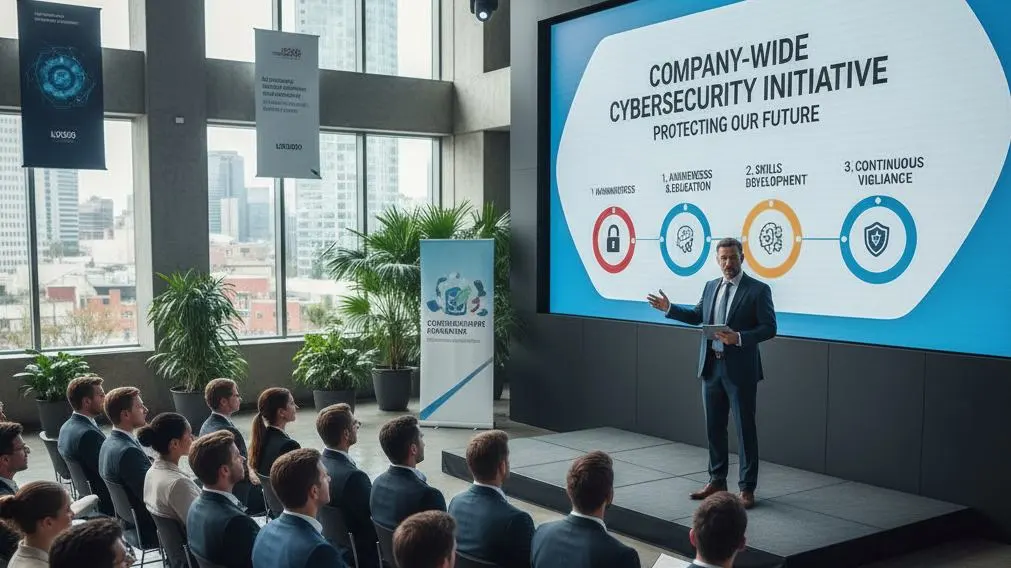
Rolling out an effective training initiative requires a structured approach. It is an ongoing cycle of assessment, development, and refinement.
To keep employees engaged, make the learning interesting. Use gamification, real-life examples, and reward individuals or departments who demonstrate excellent security practices. By focusing on the "why," you can connect security to employees' personal lives, making the lessons more memorable and impactful.
As cyber threats evolve, so must our methods for combating them. The future of corporate cybersecurity training lies in more personalised, adaptive, and immersive technologies. AI-powered platforms can now tailor phishing simulations to an individual's specific weak spots, while virtual reality labs provide safe environments for IT staff to practice their incident response skills without risking live systems.
The rise of remote and hybrid work models also presents new challenges. Training must now place greater emphasis on home network security, the correct use of VPNs, and the risks of working in public spaces. As attackers increasingly focus on social engineering to bypass automated defences, this type of adaptive, large-scale enterprise cybersecurity training will become even more critical. The ongoing enforcement of regulations like NIS 2 means that documented cybersecurity compliance training is no longer optional. Ultimately, the future of cyber defence is a partnership between smart technology and even smarter humans, with the educated employee serving as the final and most powerful line of defence.

Get Unlimited access to ALL the LIVE Instructor-led Microsoft courses you want - all for the price of less than one course.