





Basket
{{item.CourseTitle}}
Price: {{item.ItemPriceExVatFormatted}} {{item.Currency}}
Browse by Topic
Browse by Vendor

Unlimited Training
Attend all the top-notch LIVE Instructor-led Courses you want for the price of less than one course.

The rapid integration of artificial intelligence into the business world presents a significant opportunity, but also a critical choice. Many employees are already using public tools like ChatGPT for daily tasks, from composing emails to summarising reports. Yet, for an organisation, adopting AI requires a deeper consideration of data security, privacy, and governance. This is especially true for UK businesses operating under the stringent requirements of UK GDPR.
The core of the issue isn't about which AI is 'smarter'—both Microsoft Azure OpenAI and ChatGPT are powered by the same advanced models from OpenAI. The fundamental difference lies in their delivery and purpose. Is your organisation seeking a ready-made tool for individual productivity, or does it need a secure, customisable platform to build enterprise-grade solutions? Answering this question is key to making a sound strategic decision.
This guide will explore the distinction from a business and security perspective, helping you understand which service is appropriate for different organisational needs. We will focus on the factors that matter most to businesses: data handling, compliance, customisation, and scalability.
ChatGPT became a household name by offering powerful AI through a simple, intuitive web interface. As a direct-to-consumer product, its strength is its accessibility. Without any technical setup, anyone can begin using it for a vast range of tasks, such as:
For individuals, freelancers, and students, it's an exceptional tool for boosting personal productivity. However, from an organisational standpoint, its public nature raises valid concerns. Data entered into the consumer version of ChatGPT can be used to train future models, a risk that is unacceptable for any business handling sensitive or proprietary information. While it offers undeniable benefits for non-sensitive tasks, it wasn't built to meet enterprise-level security and compliance obligations.
Recognising the need for business-grade AI, Microsoft integrated OpenAI's models into its trusted cloud platform, Azure. The Azure OpenAI Service is not a chatbot you log into; it's a developer-focused service that allows organisations to embed the power of OpenAI's models into their own applications within a secure, private environment.
Think of it as AI on your own terms. Your organisation gains access to the same powerful models like GPT-4o, but through an API (Application Programming Interface) that operates within your own Azure subscription. This means all data processing is handled inside your controlled cloud environment. This structure is specifically designed to give businesses full control over security, data flow, and compliance, making it a viable option for sectors with strict regulatory oversight, such as finance, healthcare, and legal services.
The choice between ChatGPT and Azure OpenAI hinges on your organisation's priorities. Let's break down the comparison based on what matters most for business operations.
This is the most significant differentiator. With Azure OpenAI, your data remains your own. It is processed within your secure Azure instance and is not used to train OpenAI's public models. This is contractually guaranteed by Microsoft and is crucial for complying with UK GDPR and other data protection regulations. The service also inherits Azure's robust security infrastructure, including advanced identity management, content filtering, and role-based access controls. ChatGPT's consumer offering does not provide these data privacy guarantees, making it unsuitable for handling confidential customer or business data.
Azure OpenAI is designed for deep integration. As part of the Microsoft ecosystem, it connects seamlessly with other enterprise tools like Microsoft Teams, Power Automate, and internal databases. Furthermore, it allows for 'fine-tuning,' where you can train the model on your company's own data. This enables you to create a bespoke AI that understands your specific terminology and business context. ChatGPT, by contrast, is a standalone application with limited integration capabilities.
ChatGPT uses a straightforward subscription model, which is ideal for individuals or small teams. Azure OpenAI employs a consumption-based, pay-as-you-go pricing structure. While this may seem more complex, it offers far greater flexibility for businesses. You can start with a small-scale pilot project and scale up to serve thousands of users without performance issues, paying only for what you use. This model is more cost-effective for enterprise workloads that can fluctuate over time.
To put this into context, let's consider a few common business scenarios. In some cases, a hybrid approach might even be the best solution, where employees use ChatGPT for general productivity while the organisation builds custom solutions on Azure.
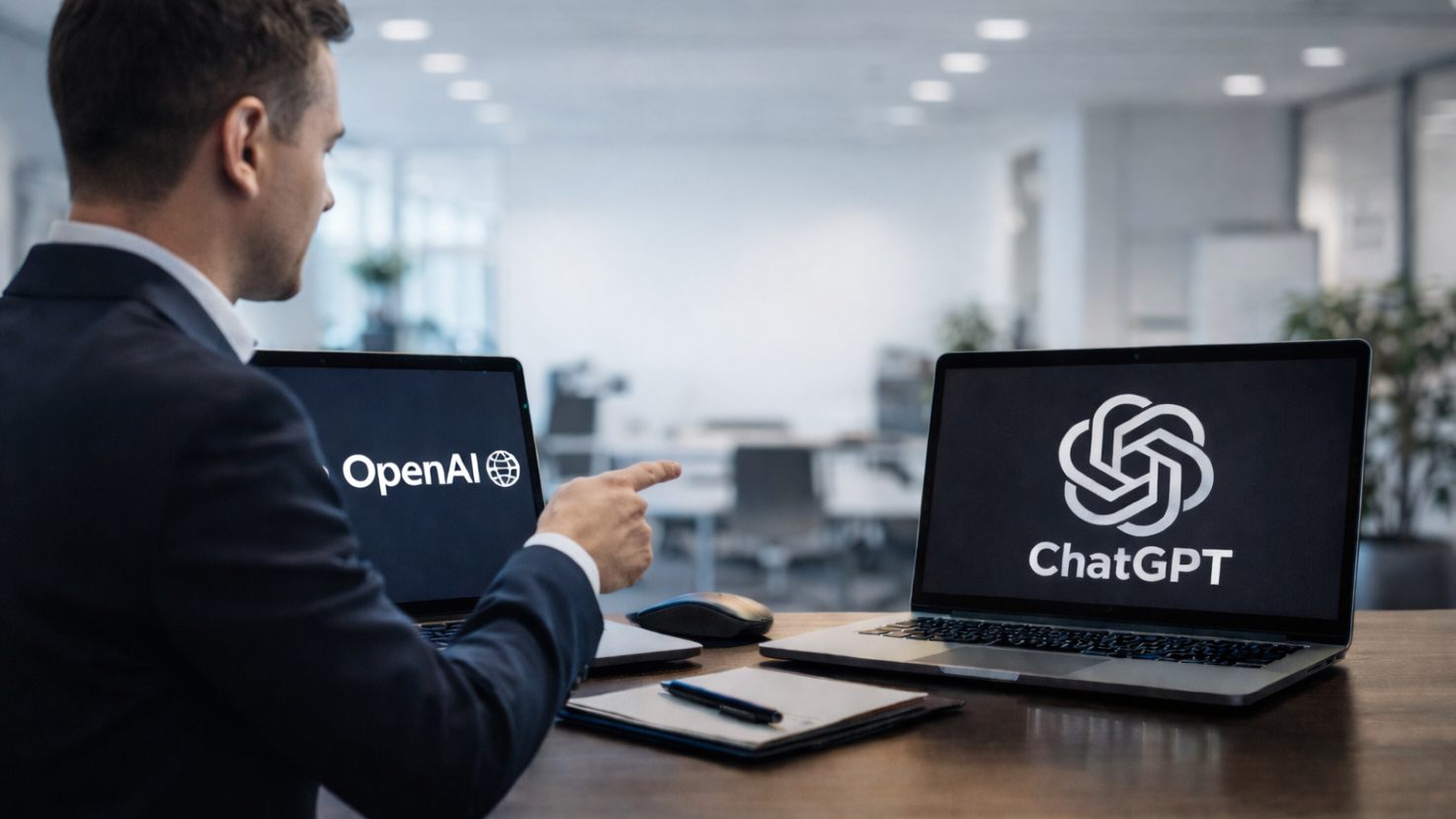
Ultimately, selecting between Microsoft Azure AI and ChatGPT is a strategic business decision, not just a technological one. These are not direct competitors but rather two different implementations of the same core technology addressing distinct needs.
ChatGPT is an excellent, ready-to-use application for personal and individual team productivity on non-sensitive tasks. It offers immediate value with no technical overhead.
The Azure OpenAI service, however, is the foundational platform for organisations that intend to build secure, scalable, and custom AI-powered solutions. For any UK business where data privacy, regulatory compliance, and integration with existing systems are priorities, Azure provides the necessary framework for responsible and powerful AI deployment. The right choice depends entirely on whether you need a quick productivity tool or a long-term strategic asset.

Get Unlimited access to ALL the LIVE Instructor-led Microsoft courses you want - all for the price of less than one course.